Loading...
Done
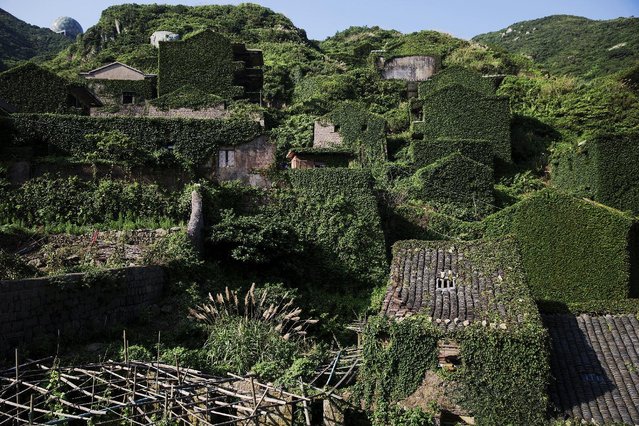
Plants grow on houses in the abandoned fishing village of Houtouwan on the island of Shengshan July 26, 2015. (Photo by Damir Sagolj/Reuters)

Plants grow on houses in the abandoned fishing village of Houtouwan on the island of Shengshan July 26, 2015. Just a handful of people still live in a village on Shengshan Island east of Shanghai that was once home to more than 2,000 fishermen. Every day hundreds of tourists visit Houtouwan, making their way on narrow footpaths past tumbledown houses overtaken by vegetation. The remote village, on one of more than 400 islands in the Shengsi archipelago, was abandoned in the early 1990s as first wealthy residents then others moved away, aiming to leave problems with education and food delivery behind them. (Photo by Damir Sagolj/Reuters)
Details
30 Jul 2015 12:24:00
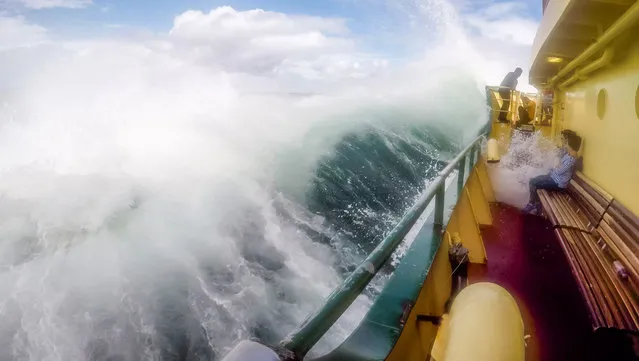
Wild weather drenches tourists, Sydney, Australia on March 7, 2017. A series of photographs as tourists take a soaking on Sydney's iconic Manly Ferry sailing big swells near Sydney's North Head. The Weather Bureau warns of large and powerful surf conditions expected to be hazardous for coastal activities such as rock fishing, swimming and surfing. (Photo by Hugh Peterswald/Pacific Press via ZUMA Wire/Rex Features/Shutterstock)

Wild weather drenches tourists, Sydney, Australia on March 7, 2017. A series of photographs as tourists take a soaking on Sydney's iconic Manly Ferry sailing big swells near Sydney's North Head. The Weather Bureau warns of large and powerful surf conditions expected to be hazardous for coastal activities such as rock fishing, swimming and surfing. (Photo by Hugh Peterswald/Pacific Press via ZUMA Wire/Rex Features/Shutterstock)
Details
08 Mar 2017 09:47:00
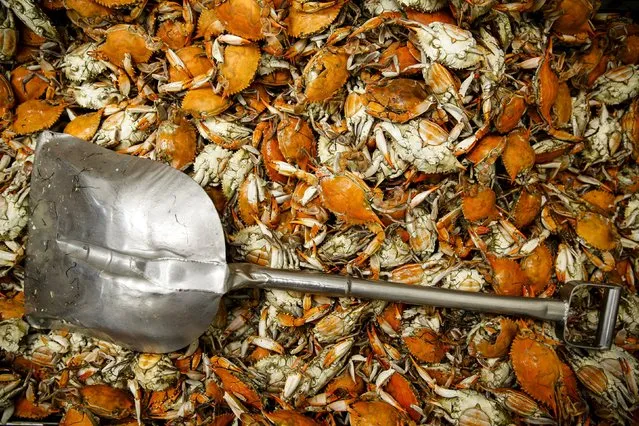
A large stainless steel shovel lies on top of steamed crabs at the A.E. Phillips & Son Inc. crab picking house on Hooper's Island in Fishing Creek, Maryland August 26, 2015. Workers speed through the lump and back fin meat inside the crabs while leaving the more tedious task of picking the claws to others. (Photo by Jonathan Ernst/Reuters)

A large stainless steel shovel lies on top of steamed crabs at the A.E. Phillips & Son Inc. crab picking house on Hooper's Island in Fishing Creek, Maryland August 26, 2015. Workers speed through the lump and back fin meat inside the crabs while leaving the more tedious task of picking the claws to others. (Photo by Jonathan Ernst/Reuters)
Details
16 Oct 2015 08:03:00
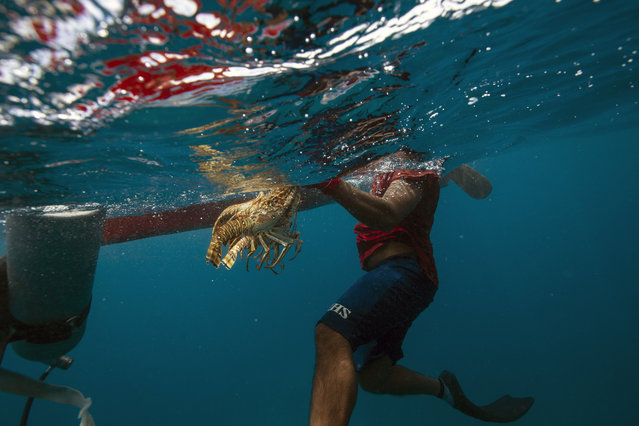
In this September 9, 2018 photo, a diver holds onto his catch of lobsters during a fishing journey in the Miskito coast near Cay Savannah, Honduras. A diver makes 75 lempiras ($3) per pound of lobster. An average 10-pound daily haul of lobster is a windfall for people in one of the most impoverished regions of the Americas, so many take the risk, and many suffer for it. (Photo by Rodrigo Abd/AP Photo)

In this September 9, 2018 photo, a diver holds onto his catch of lobsters during a fishing journey in the Miskito coast near Cay Savannah, Honduras. A diver makes 75 lempiras ($3) per pound of lobster. An average 10-pound daily haul of lobster is a windfall for people in one of the most impoverished regions of the Americas, so many take the risk, and many suffer for it. (Photo by Rodrigo Abd/AP Photo)
Details
23 Jan 2019 00:01:00
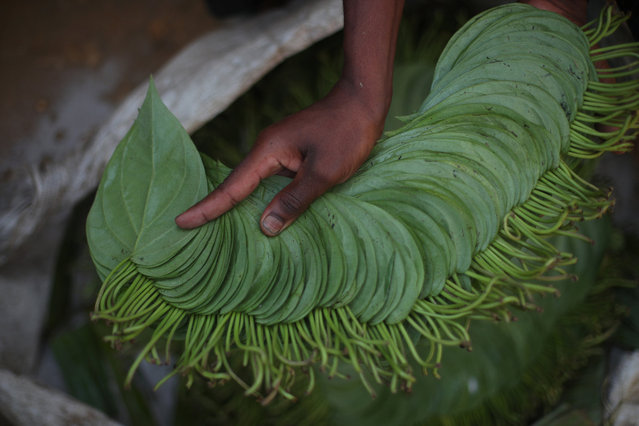
Faruk, 17, a Rohingya refugee trader holds betel leaves which are on sale at a stall in Palong Khali refugee camp near Cox's Bazar, Bangladesh, November 3, 2017. He left his village in Myanmar when the military opened fire towards the Rohingya. “I buy this betel leaf from Palong Khali market, in one bundle there are 160 pieces, I buy it for 80 taka and I sell it for 100 taka. Bangladeshi's and I sell for the same rate in the camp. Outside in the local market it is 80 taka per bundle. My problem is that I don't have money so I can't buy anything to eat, I can't buy fish to eat”, he said. (Photo by Hannah McKay/Reuters)

Faruk, 17, a Rohingya refugee trader holds betel leaves which are on sale at a stall in Palong Khali refugee camp near Cox's Bazar, Bangladesh, November 3, 2017. He left his village in Myanmar when the military opened fire towards the Rohingya. “I buy this betel leaf from Palong Khali market, in one bundle there are 160 pieces, I buy it for 80 taka and I sell it for 100 taka (1 Bangladeshi Taka = 0.012 US Dollar). Bangladeshi's and I sell for the same rate in the camp. Outside in the local market it is 80 taka per bundle. My problem is that I don't have money so I can't buy anything to eat, I can't buy fish to eat”, he said. (Photo by Hannah McKay/Reuters)
Details
27 Nov 2017 08:54:00


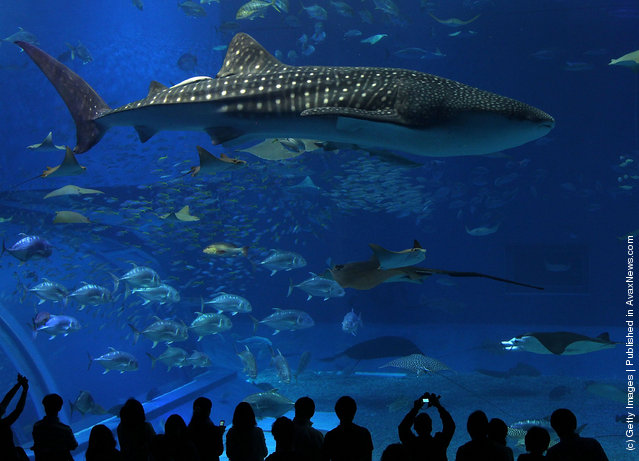
A eight-metre-long Whale shark swims with other fish in a worlds' largest tank with its front panel size of 8.2 metre x 22.5 metre at the Okinawa Churaumi Aquarium on February 26, 2010 in Motobu, Okinawa, Japan. Japan's most popular aquarium attracts more than 2.5 million visitors per year. (Photo by Koichi Kamoshida/Getty Images)
Details
17 Apr 2011 11:23:00


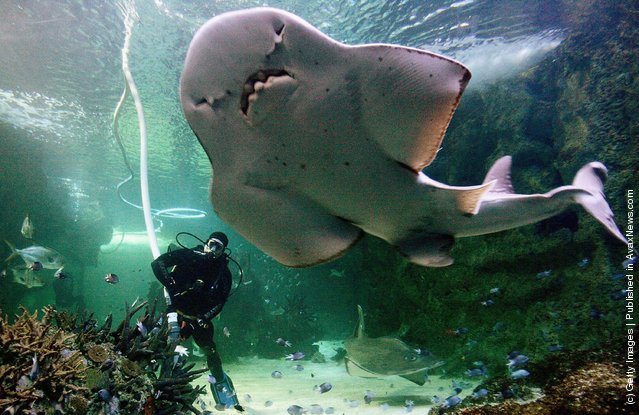
A Sydney Aquarium diver uses a vacuum to clean the gravel in the Great Barrier Reef tank as a Ray Shark swims by September 26, 2006 in Sydney, Australia. The Aquarium is undergoing its annual spring clean to prepare for the school holidays using vacuums, along with sea creatures like Sea Cucumbers, Sea Urchins, Cleaner Wrasse Fish and Sea Stars to help complete the job. (Photo by Ian Waldie/Getty Images)
Details
22 Apr 2011 10:57:00
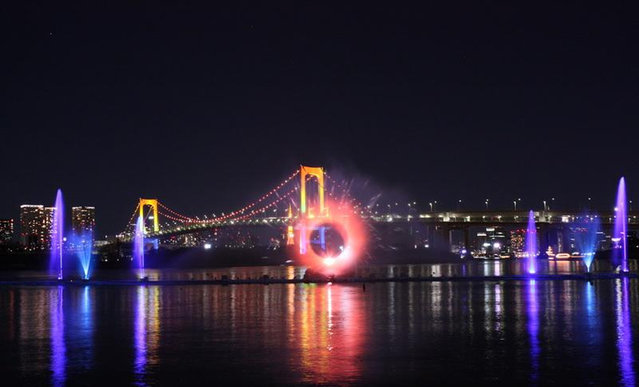
Japan Odaiba Water Illumination

An image of a breaching whale is projected on a screen created by a water fountain during the Odaiba water illumination show in Tokyo. The show, which projects images of whales, sharks, tropical fish and Easter Island statues on a water screen 23 meters tall and 60 meters wide, will be held through April 11.
Details
09 Aug 2012 12:20:00