Loading...
Done
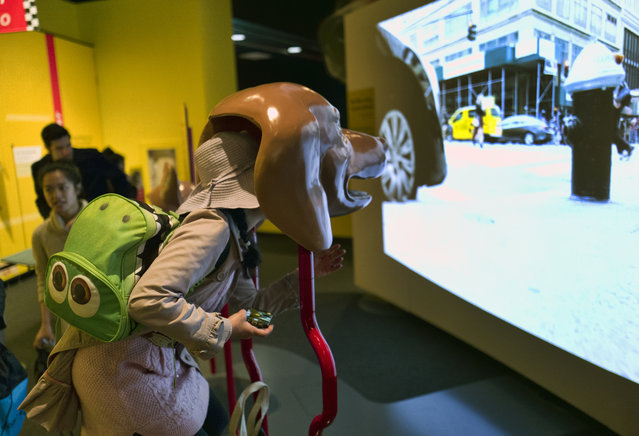
In this Tuesday, March 12, 2019 photo, a visitor takes part in an immersive experience showing visitors how dogs see from inside the head of a dog at the California Science Center in Los Angeles. A new exhibit at a Los Angeles museum examines the relationship between dogs and humans and explores why the two species seem to think so much alike and get along so well. “Dogs! A Science Tail” opens Saturday, March 16, 2019, at the California Science Center. (Photo by Richard Vogel/AP Photo)

In this Tuesday, March 12, 2019 photo, a visitor takes part in an immersive experience showing visitors how dogs see from inside the head of a dog at the California Science Center in Los Angeles. A new exhibit at a Los Angeles museum examines the relationship between dogs and humans and explores why the two species seem to think so much alike and get along so well. “Dogs! A Science Tail” opens Saturday, March 16, 2019, at the California Science Center. (Photo by Richard Vogel/AP Photo)
Details
15 Mar 2019 08:49:00
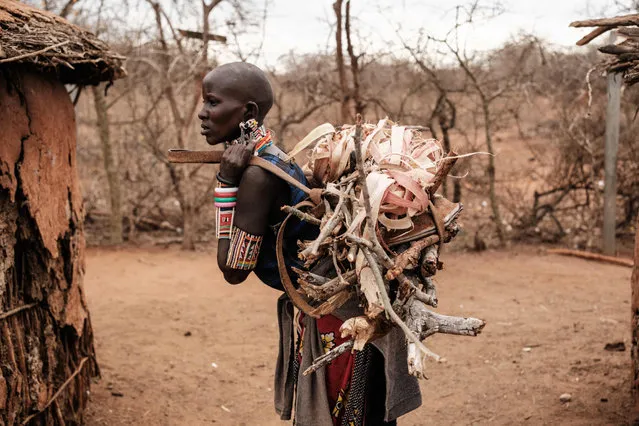
A Maasai woman arrives with collected firewoods at a village nearby Selenkay Conservancy, a community-owned conservation area running by a private company, in Amboseli, Kenya, on June 22, 2022. The camp's ten luxurious tents see tourists flocking again, after the shutdown linked to Covid-19. They observe in small groups elephants, giraffes, antelopes or lions on 5,000 hectares, located on the edge of Amboseli National Park, in the south of the country, and have a glimpse of the life of the Masai, the owners of the land. (Photo by Yasuyoshi Chiba/AFP Photo)

A Maasai woman arrives with collected firewoods at a village nearby Selenkay Conservancy, a community-owned conservation area running by a private company, in Amboseli, Kenya, on June 22, 2022. The camp's ten luxurious tents see tourists flocking again, after the shutdown linked to Covid-19. They observe in small groups elephants, giraffes, antelopes or lions on 5,000 hectares, located on the edge of Amboseli National Park, in the south of the country, and have a glimpse of the life of the Masai, the owners of the land. (Photo by Yasuyoshi Chiba/AFP Photo)
Details
22 Jul 2022 04:32:00
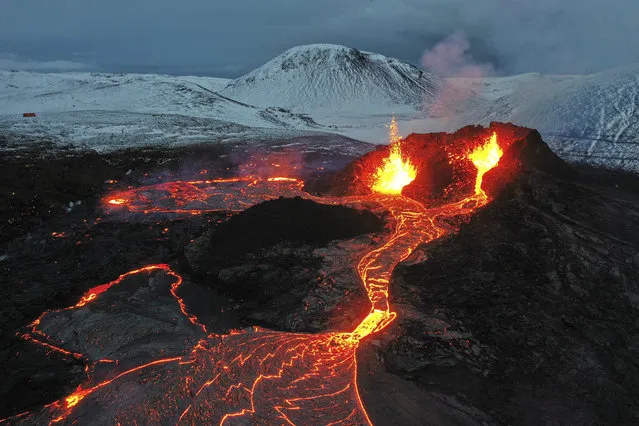
Lava flows from an eruption of a volcano on the Reykjanes Peninsula in Iceland on March 28, 2021. A week on, big crowds of Sunday hikers flocked to the Fagradalsfjall area to see up close Iceland's latest volcano eruption, as the gentle lava flow allowed people to get close to he eruption some 40 km west of Iceland's capital Reykjavik. (Photo by Halldor Kolbeins/AFP Photo)

Lava flows from an eruption of a volcano on the Reykjanes Peninsula in Iceland on March 28, 2021. A week on, big crowds of Sunday hikers flocked to the Fagradalsfjall area to see up close Iceland's latest volcano eruption, as the gentle lava flow allowed people to get close to he eruption some 40 km west of Iceland's capital Reykjavik. (Photo by Halldor Kolbeins/AFP Photo)
Details
21 Apr 2021 10:19:00
Members of Siam Classic Dance Studio perform for onlookers at Haymarket on January 21, 2023 in Sydney, Australia. The Lunar New Year or Spring Festival marks the transition of the Chinese zodiac sign from one animal to the next. 2023 sees in the Year of the Rabbit, which begins on January 22. In Chinese culture, the Rabbit is a symbol of longevity, peace and prosperity. The festival is celebrated in Australia by the country's significant Chinese-origin minority, who follow much of the same traditions as the Chinese diaspora in the rest of the world. (Photo by Lisa Maree Williams/Getty Images)

Members of Siam Classic Dance Studio perform for onlookers at Haymarket on January 21, 2023 in Sydney, Australia. The Lunar New Year or Spring Festival marks the transition of the Chinese zodiac sign from one animal to the next. 2023 sees in the Year of the Rabbit, which begins on January 22. In Chinese culture, the Rabbit is a symbol of longevity, peace and prosperity. The festival is celebrated in Australia by the country's significant Chinese-origin minority, who follow much of the same traditions as the Chinese diaspora in the rest of the world. (Photo by Lisa Maree Williams/Getty Images)
Details
13 Apr 2024 05:28:00
Manchester City's Norwegian striker #09 Erling Haaland (L) sees his shot deflected into the net by Luton Town's Japanese defender #27 Daiki Hashioka (R) for an own-goal during the English Premier League football match between Manchester City and Luton Town at the Etihad Stadium in Manchester, north west England, on April 13, 2024. (Photo by Darren Staples/AFP Photo)

Manchester City's Norwegian striker #09 Erling Haaland (L) sees his shot deflected into the net by Luton Town's Japanese defender #27 Daiki Hashioka (R) for an own-goal during the English Premier League football match between Manchester City and Luton Town at the Etihad Stadium in Manchester, north west England, on April 13, 2024. (Photo by Darren Staples/AFP Photo)
Details
20 Apr 2024 05:22:00
American actress and singer Rachel Zegler sings “Don't Cry For Me Argentina” from the balcony of the London Palladium on June 17, 2025. The show sees Rachel come out onto the balcony to sing to the audience below, and by the third night of the show's limited run the streets have already had to be cordoned off with extra security brought in because the crowds are so big. (Photo by Raphael Pour-Hashemi/The Mega Agency)

American actress and singer Rachel Zegler sings “Don't Cry For Me Argentina” from the balcony of the London Palladium on June 17, 2025. The show sees Rachel come out onto the balcony to sing to the audience below, and by the third night of the show's limited run the streets have already had to be cordoned off with extra security brought in because the crowds are so big. (Photo by Raphael Pour-Hashemi/The Mega Agency)
Details
06 Jul 2025 03:29:00
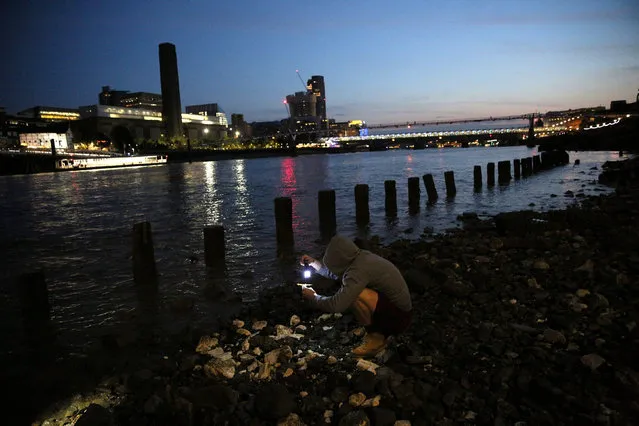
A mudlark uses a torch to look for items on the bank of the River Thames in London, Britain June 06, 2016. Mudlarking is believed to trace its origins to the 18th and 19th century, when scavengers searched the Thames' shores for items to sell. These days, history and archaeology fans are the ones hoping to find old relics such as coins, ceramics, artifacts or everyday items from across centuries. They wait for the low tide and then scour specific areas of exposed shores. "If you're in a field you could be out all day long, with the river you're restricted to about two or three hours," mudlark Nick Stevens said. While many just use the naked eye for their searches, others rely on metal detectors for which a permit from the Port of London Authority is needed. Digging also requires consent. (Photo by Neil Hall/Reuters)

A mudlark uses a torch to look for items on the bank of the River Thames in London, Britain June 06, 2016. Mudlarking is believed to trace its origins to the 18th and 19th century, when scavengers searched the Thames' shores for items to sell. These days, history and archaeology fans are the ones hoping to find old relics such as coins, ceramics, artifacts or everyday items from across centuries. their finds with the Portable Antiquities Scheme. Any item over 300 years old must be recorded. (Photo by Neil Hall/Reuters)
Details
27 Aug 2016 10:43:00
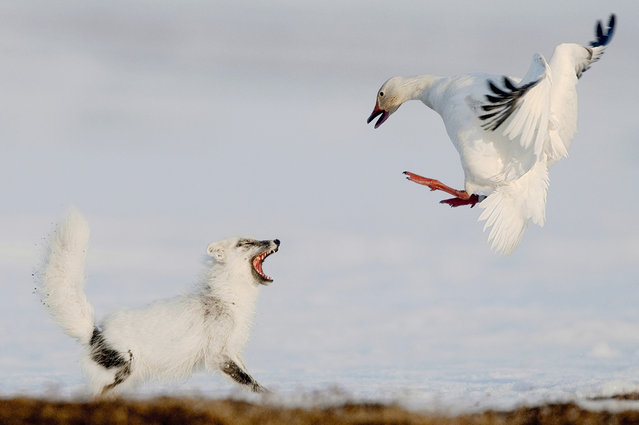
Commended. In late May, about a quarter of a million snow geese arrive from North America to nest on Wrangel Island, in northeastern Russia. They form the world's largest breeding colony of snow geese. Photographer Sergey Gorshkov spent two months on the remote island photographing the unfolding dramas. (Photo by Sergey Gorshkov/Veolia Environnement Wildlife Photographer)

Commended. In late May, about a quarter of a million snow geese arrive from North America to nest on Wrangel Island, in northeastern Russia. They form the world's largest breeding colony of snow geese. Photographer Sergey Gorshkov spent two months on the remote island photographing the unfolding dramas. Arctic foxes take advantage of the abundance of eggs, caching surplus eggs for leaner times. But a goose (here the gander) is easily a match for a fox, which must rely on speed and guile to steal eggs. “The battles were fairly equal”, notes Sergey, “and I only saw a fox succeed in grabbing an egg on a couple of occasions, despite many attempts”. Surprisingly, “the geese lacked any sense of community spirit”, he adds, “and never reacted when a fox harassed a neighboring pair nesting close by”. (Photo by Sergey Gorshkov/Veolia Environnement Wildlife Photographer)
Details
16 Jun 2015 12:30:00