Loading...
Done
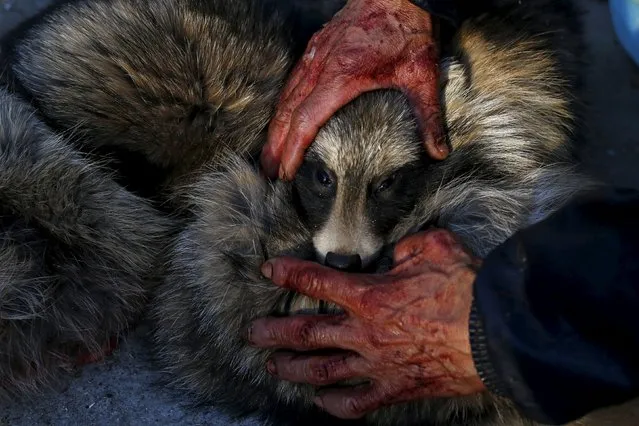
A worker holds the head of a fox while killing it with electricity for its fur at a fox farm in Nanzhuang village, Shandong province, China, December 11, 2015. There are over 60 households in the village still raising foxes, raccoon dogs and other animals for the fur trade. China is the world's largest fur producer and exporter, according to state media. (Photo by William Hong/Reuters)

A worker holds the head of a fox while killing it with electricity for its fur at a fox farm in Nanzhuang village, Shandong province, China, December 11, 2015. There are over 60 households in the village still raising foxes, raccoon dogs and other animals for the fur trade. China is the world's largest fur producer and exporter, according to state media. (Photo by William Hong/Reuters)
Details
16 Dec 2015 08:03:00
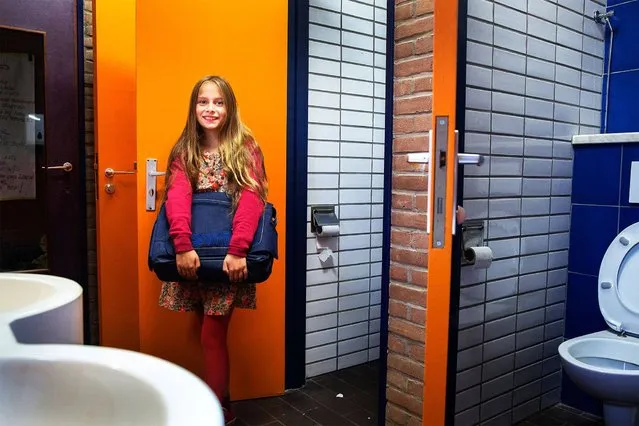
Belgium. Rosalie, 9, goes to school in Brussels. “At my school we have separate toilets for girls and boys on every floor. My classroom is on the 3rd floor. We have 22 toilets, which are shared between 230 pupils and 20 adults. The teachers at school let us go to the toilet whenever we need to”. (Photo by Tim Dirven/WSUP/Panos)

Belgium. Rosalie, 9, goes to school in Brussels. “At my school we have separate toilets for girls and boys on every floor. My classroom is on the 3rd floor. We have 22 toilets, which are shared between 230 pupils and 20 adults. The teachers at school let us go to the toilet whenever we need to”. (Photo by Tim Dirven/WSUP/Panos)
Details
25 Nov 2014 11:16:00
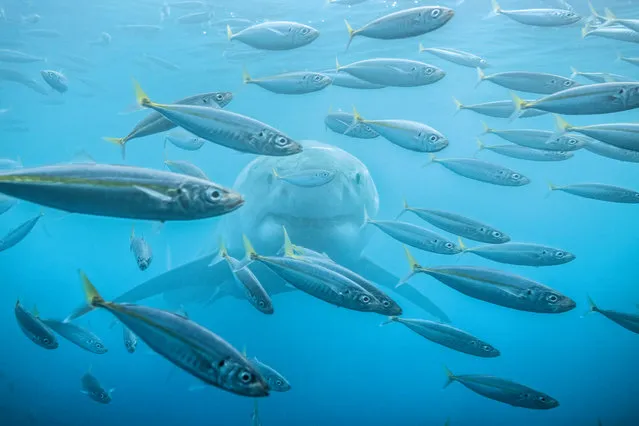
Under Exposed: Pekka Tuuri (Finland) – Great white shark, Isla Guadalupe, Mexico. Isla Guadalupe is the world capital when it comes to observing great white sharks, but cage diving seriously limits the possibilities to take ‘fresh’ pictures. When I took this, the water close to the surface was quite milky, making photography very challenging. From out of the ‘mist’, I saw this great white shark lurking behind a school of fusiliers. I quickly focused on the shark and set a wide aperture to get focus blur on the fish, along with a fast shutter to avoid excessive motion blur. (Photo by Pekka Tuuri/The Outdoor Photographer of the Year/The Guardian)

Under Exposed: Pekka Tuuri (Finland) – Great white shark, Isla Guadalupe, Mexico. “Isla Guadalupe is the world capital when it comes to observing great white sharks, but cage diving seriously limits the possibilities to take ‘fresh’ pictures. When I took this, the water close to the surface was quite milky, making photography very challenging. From out of the “mist”, I saw this great white shark lurking behind a school of fusiliers. I quickly focused on the shark and set a wide aperture to get focus blur on the fish, along with a fast shutter to avoid excessive motion blur”. (Photo by Pekka Tuuri/The Outdoor Photographer of the Year/The Guardian)
Details
25 Jan 2018 07:37:00
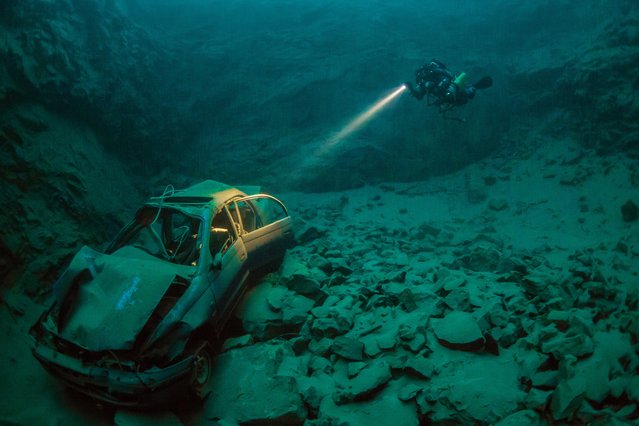
Wide-angle category winner. Part of the Illusion by Marcus Blatchford (UK). Location: National Dive & Activity Centre, Chepstow, Wales. “This is the deepest inland dive centre in the UK. The dive plan was to explore the deep end, but this time I dived ‘unplugged’ (without my strobes). With the exception of this change to my camera technique, there were no planned shots I wanted to achieve – just a fun dive with ad-hoc photos along the way. Shortly after this photo was captured, in 6C water and two hours of decompression ahead of us, we turned and started the long ascent back to the surface”. (Photo by Marcus Blatchford/Underwater Photographer of the Year 2016)

Wide-angle category winner. Part of the Illusion by Marcus Blatchford (UK). Location: National Dive & Activity Centre, Chepstow, Wales. “This is the deepest inland dive centre in the UK. The dive plan was to explore the deep end, but this time I dived ‘unplugged’ (without my strobes). With the exception of this change to my camera technique, there were no planned shots I wanted to achieve – just a fun dive with ad-hoc photos along the way. Shortly after this photo was captured, in 6C water and two hours of decompression ahead of us, we turned and started the long ascent back to the surface”. (Photo by Marcus Blatchford/Underwater Photographer of the Year 2016)
Details
18 Feb 2016 13:44:00
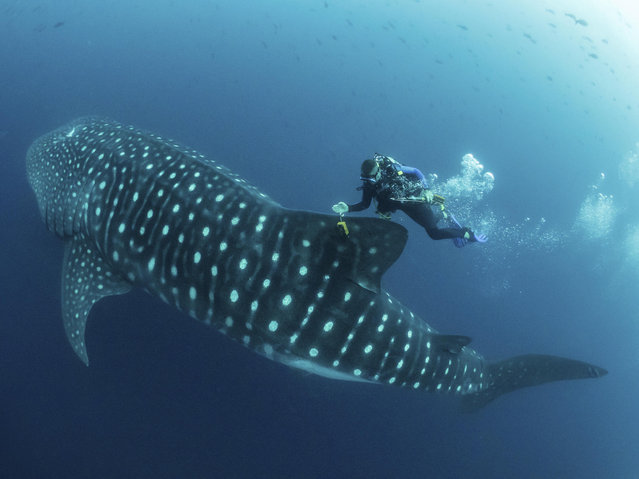
In this 2017 photo provided by Simon Pierce, Jonathan Green checks on a fin-mounted satellite tag on a whale shark in the Galapagos Islands area of Ecuador.  Despite typically being bigger than a double-decker bus, the elusive whale shark has only tiny, almost useless teeth. It's also one of the least understood animals in the ocean. (Photo by Simonjpierce.com via AP Photo)

In this 2017 photo provided by Simon Pierce, Jonathan Green checks on a fin-mounted satellite tag on a whale shark in the Galapagos Islands area of Ecuador. Despite typically being bigger than a double-decker bus, the elusive whale shark has only tiny, almost useless teeth. It's also one of the least understood animals in the ocean. (Photo by Simonjpierce.com via AP Photo)
Details
02 Mar 2018 00:03:00
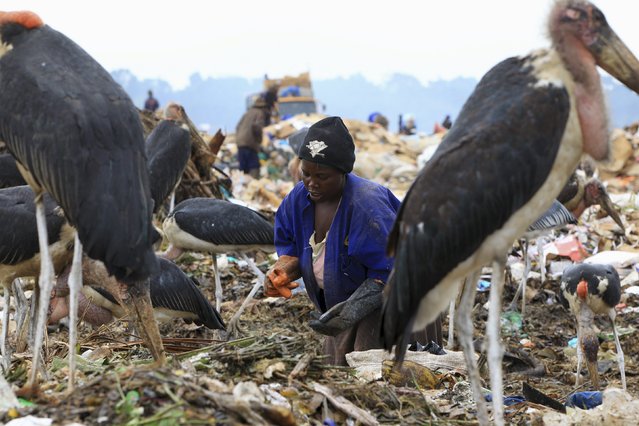
A woman whose livelihood depends on selling recyclable wastes collects trash from a dumping site while surrounded by Marabou storks on the outskirts of Uganda's capital Kampala March 31, 2015. (Photo by James Akena/Reuters)

A woman whose livelihood depends on selling recyclable wastes collects trash from a dumping site while surrounded by Marabou storks on the outskirts of Uganda's capital Kampala March 31, 2015. (Photo by James Akena/Reuters)
Details
04 Apr 2015 10:41:00
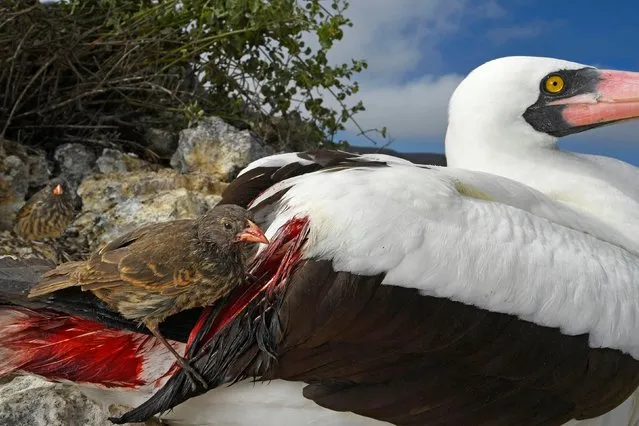
Bloodthirsty by Thomas P Peschak, Germany/South Africa — winner, Behaviour: birds. When rations run short on Wolf Island, in the remote northern Galápagos, the sharp-beaked ground finches become vampires. Their sitting targets are Nazca boobies and other large birds. The finches rely on a scant diet of seeds and insects, which regularly dries up, so they drink blood to survive. ‘I’ve seen more than half a dozen finches drinking from a single Nazca booby,’ says Tom. Rather than leave their nests the boobies tolerate the vampires, and the blood loss doesn’t seem to cause permanent harm. (Photo by Thomas P Peschak/2018 Wildlife Photographer of the Year)

Bloodthirsty by Thomas P. Peschak, Germany/South Africa — winner, Behaviour: birds. When rations run short on Wolf Island, in the remote northern Galápagos, the sharp-beaked ground finches become vampires. Their sitting targets are Nazca boobies and other large birds. The finches rely on a scant diet of seeds and insects, which regularly dries up, so they drink blood to survive. ‘I’ve seen more than half a dozen finches drinking from a single Nazca booby,’ says Tom. Rather than leave their nests the boobies tolerate the vampires, and the blood loss doesn’t seem to cause permanent harm. (Photo by Thomas P. Peschak/2018 Wildlife Photographer of the Year)
Details
19 Oct 2018 00:05:00
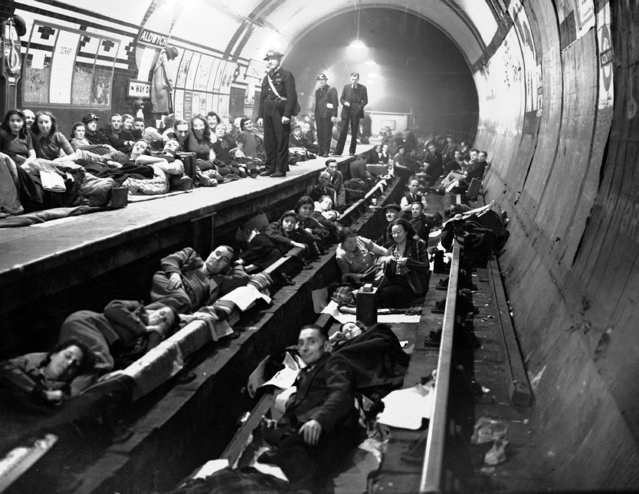
Londoners sleep on the platform and on the train tracks at Aldwych Underground station,London, during heavy all night Nazi bombing raids, October 8, 1940. (Photo by AP Photo)

Londoners sleep on the platform and on the train tracks at Aldwych Underground station,London, during heavy all night Nazi bombing raids, October 8, 1940. (Photo by AP Photo)
Details
10 Oct 2015 08:06:00