Loading...
Done
Tridacna Gigas, or Giant Clams

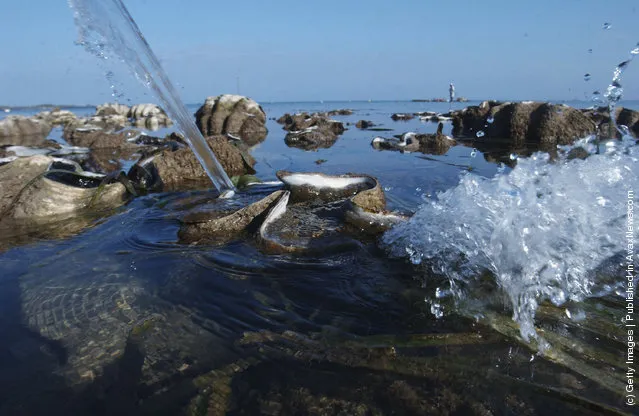
“The giant clam, Tridacna gigas (known as pā’ua in Cook Islands Māori), is the largest living bivalve mollusc. T. gigas is one of the most endangered clam species. It was mentioned as early as 1825 in scientific reports. One of a number of large clam species native to the shallow coral reefs of the South Pacific and Indian oceans, they can weigh more than 200 kilograms (440 lb) measure as much as 120 cm (47 in) across, and have an average lifespan in the wild of 100 years or more”. – Wikipedia

Photo: Tridacna Gigas, or Giant Clams spew water as a traditional fisherman passes by a small sanctuary on January 23, 2004 near Bolinao in the Northern Philippines. The clams, prime builders for coral reefs and providing shelter for spawning fish and other marine life, are exposed by low tides in the sanctuary. Overfishing and pollution throughout the country are not only threatening food security, but are also starting to choke one of the few working clam sanctuaries in the world. (Photo by David Greedy/Getty Images)
Details
01 Oct 2011 13:10:00
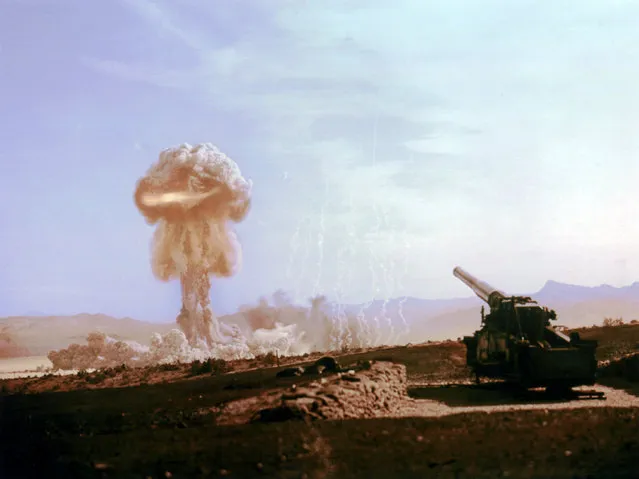
Atomic Annie at work during the Upshot-Knothole test series, 1953. (Photo by Los Alamos National Laboratory/US Army)

“A fter the former Soviet Union conducted its first nuclear test in August 1949, the US reevaluated its postwar defense policies. With the US monopoly on atomic weapons broken, military and political leaders chose to diversify the American stockpile by developing thermonuclear and tactical nuclear weapons. One of the more interesting concepts to come out of this period was atomic artillery, which was successfully tested at the Nevada Proving Grounds (now the Nevada Test Site) in May 1953”. – Alan Carr. Photo: Atomic Annie at work during the Upshot-Knothole test series, 1953. (Photo by Los Alamos National Laboratory/US Army)
Details
11 Mar 2013 11:43:00
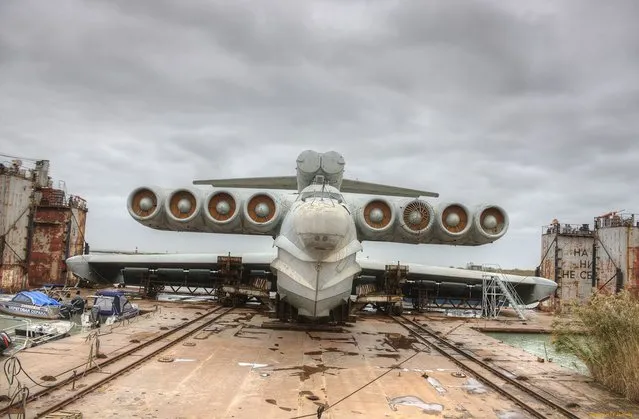
The Lun-class Ekranoplane was used by the Soviet Navy starting in 1987, and wasn't retired until the late 1990s, after the Soviet Union's fall. (Igor113)

“The Lun-class ekranoplan (NATO reporting name Duck) was a ground effect vehicle (GEV) designed by Rostislav Evgenievich Alexeev and used by the Soviet and Russian navies from 1987 until sometime in the late 1990s. It “flew” using the lift generated by the ground effect of its large wings when close to the surface of the water – about four metres or less. Although they might look similar and/or have related technical characteristics, ekranoplans like the Lun are not aircraft, seaplanes, hovercraft, or hydrofoils – ground effect is a separate technology altogether. The International Maritime Organization classifies these vehicles as maritime ships. The name Lun comes from the Russian for harrier”. – Wikipedia (Photo by Igor113)
Details
08 Aug 2014 10:51:00
The Soviet Union Abandoned: A Communist Empire In Decay By Rebecca Litchfield

Only the most intrepid urban explorers cross the tattered ruins of the old Iron Curtain to endure the excessive bureaucracy, military paranoia and freezing winds of the East to hunt for the ghosts of an empire. Rebecca Litchfield is one who couldn’t resist the haunting allure of the ruins of the Soviet Union.
Details
21 Jul 2014 11:03:00
A man cries over the body of his girlfriend, who was killed by shelling in the Kalininsky district of Donetsk, territory under control of the pro-Russian Government of the Donetsk People's Republic in eastern Ukraine, Thursday, June 9, 2022, during the Russian invasion. (Photo by Alexei Alexandrov/AP Photo)

A man cries over the body of his girlfriend, who was killed by shelling in the Kalininsky district of Donetsk, territory under control of the pro-Russian Government of the Donetsk People's Republic in eastern Ukraine, Thursday, June 9, 2022, during the Russian invasion. (Photo by Alexei Alexandrov/AP Photo)
Details
12 Jun 2022 04:05:00
A Lion peers out of a window on Fitzwilliam Square, Dublin, Republic of Ireland on October 25, 2022. (Photo by Dara Mac Dónaill/The Irish Times)

A Lion peers out of a window on Fitzwilliam Square, Dublin, Republic of Ireland on October 25, 2022. (Photo by Dara Mac Dónaill/The Irish Times)
Details
08 Nov 2022 04:13:00
This handout picture taken and released by Taipei Zoo on November 2, 2022 showing Chinese panda experts Wei Ming (L) and Wu Honglin (C) checking on sick male panda Tuan Tuan at the zoo in Taipei. (Photo by Handout/Taipei Zoo via AFP Photo)

This handout picture taken and released by Taipei Zoo on November 2, 2022 showing Chinese panda experts Wei Ming (L) and Wu Honglin (C) checking on sick male panda Tuan Tuan at the zoo in Taipei. (Photo by Handout/Taipei Zoo via AFP Photo)
Details
13 Nov 2022 06:08:00
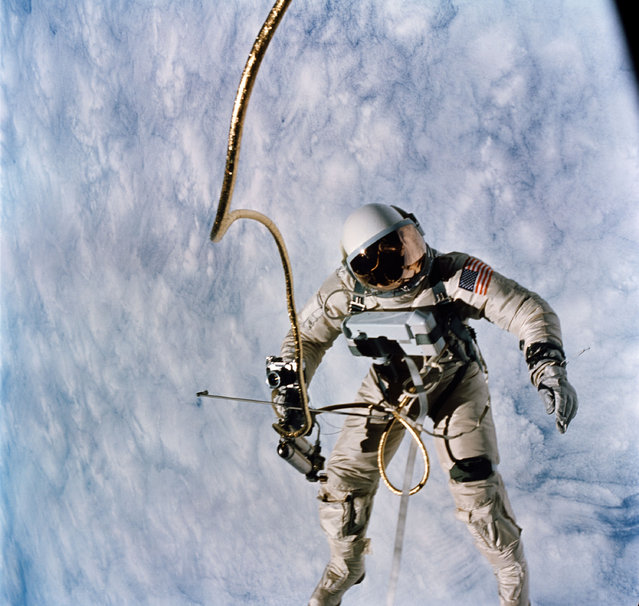
Astronaut Edward H. White II, pilot for the Gemini-Titan 4 (GT-4) spaceflight, floats in the zero-gravity of space during the third revolution of the GT-4 spacecraft on June 3, 1965. White wears a specially designed spacesuit. His face is shaded by a gold-plated visor to protect him from unfiltered rays of the sun. (Photo by NASA)

Astronaut Edward H. White II, pilot for the Gemini-Titan 4 (GT-4) spaceflight, floats in the zero-gravity of space during the third revolution of the GT-4 spacecraft on June 3, 1965. White wears a specially designed spacesuit. His face is shaded by a gold-plated visor to protect him from unfiltered rays of the sun. In his right hand he carries a Hand-Held Self-Maneuvering Unit (HHSMU) that gives him control over his movements in space. White also wears an emergency oxygen chest pack; and he carries a camera mounted on the HHSMU for taking pictures of the sky, Earth and the GT-4 spacecraft. He is secured to the spacecraft by a 25-feet umbilical line and a 23-feet tether line. Both lines are wrapped together in gold tape to form one cord. Astronaut James A. McDivitt, command pilot, remained inside the spacecraft during the extravehicular activity (EVA). Astronaut White died in the Apollo/Saturn 204 fire at Cape Kennedy on January 27, 1967. (Photo by NASA)
Details
22 Jul 2014 12:05:00