Loading...
Done
Midas Cichlid a.k.a. Amphilophus Citrinellus

“Amphilophus citrinellus is a large cichlid fish endemic to the San Juan River and adjacent watersheds in Costa Rica and Nicaragua. In the aquarium trade A. citrinellus is often sold under the trade name of Midas cichlid. A. citrinellus are omnivorous and their diet consists of plant material, molluscs and smaller fish”. – Wikipedia

Photo: Two Midas Cichlid (lat: amphilophus citrinellus) fish are seen in an aquarium at Hellabrunn zoo on December 23, 2009 in Munich, Germany. (Photo by Alexandra Beier/Getty Images)
Details
17 Aug 2011 11:29:00
Chernobyl

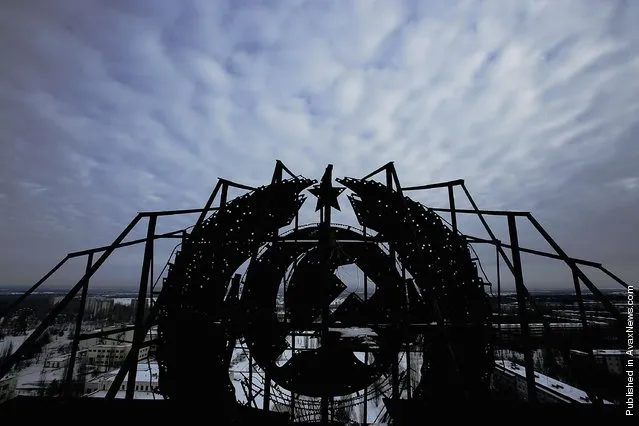
Scaffolding holding a remnant of the Soviet Union, the hammer and sickle, is seen on a rooftop of an abandoned building in the town of Pripyat on January 25, 2006 near Chernobyl, Ukraine. The town of Pripyat, deserted since the 1986 catastrophe, once housed 30,000 people, the majority of being workers from the Chernobyl Nuclear Power Plant. Days after the catastrophe the inhabitants were relocated to other locations in the Soviet Union. The town of Pripyat has remained uninhabited since. Prypyat and the surrounding area will not be safe for human habitation for several centuries. Scientists estimate that the most dangerous radioactive elements will take up to 900 years to decay sufficiently to render the area safe.
Details
14 Mar 2011 10:20:00
Women wearing flower and sprout-like hairpins walk past an advertisement board in Beijing, China, September 25, 2015. (Photo by Kim Kyung-Hoon/Reuters)

Women wearing flower and sprout-like hairpins walk past an advertisement board in Beijing, China, September 25, 2015. Wearing antenna styled hairpins in the shape of various flowers and plants at scenic spots has become a new trend in Beijing. (Photo by Kim Kyung-Hoon/Reuters)
Details
28 Sep 2015 08:02:00
Visual artist Ben Heine at work in his studio while he creates one of his “anamorphic illusions” in Rochefort, Belgium

An arm holding a giant gun appears to explode through a wall, while elsewhere a man walks a tiger on a leash. These breathtaking pencil drawings are the work of 31-year-old artist Ben Heine, who lives and works in Rochefort, Belgium. The “anamorphic illusions”, part of the artist's “Pencil Vs Camera” series, appear slightly distorted unless viewed from the exact same perspective in which they were created. Photo: Visual artist Ben Heine at work in his studio while he creates one of his “anamorphic illusions” in Rochefort, Belgium. (Photo by Ben Heine/Barcroft Media)
Details
23 Mar 2014 11:00:00
People take part in a water gun battle as part of the annual Songkran festival, also known as water festival, the traditional Thai New Year celebrations, at the tourist spot of Khao San Road in Bangkok, Thailand, 13 April 2023. Thailand celebrates its first water-splashing Songkran festival following a three-year pause due to the COVID-19 pandemic. Songkran is celebrated with splashing water and putting powder on each other's faces as a symbolic sign of cleansing and washing away the sins from the old year. (Photo by Rungroj Yongrit/EPA)

People take part in a water gun battle as part of the annual Songkran festival, also known as water festival, the traditional Thai New Year celebrations, at the tourist spot of Khao San Road in Bangkok, Thailand, 13 April 2023. Thailand celebrates its first water-splashing Songkran festival following a three-year pause due to the COVID-19 pandemic. Songkran is celebrated with splashing water and putting powder on each other's faces as a symbolic sign of cleansing and washing away the sins from the old year. (Photo by Rungroj Yongrit/EPA)
Details
29 Jul 2024 03:44:00
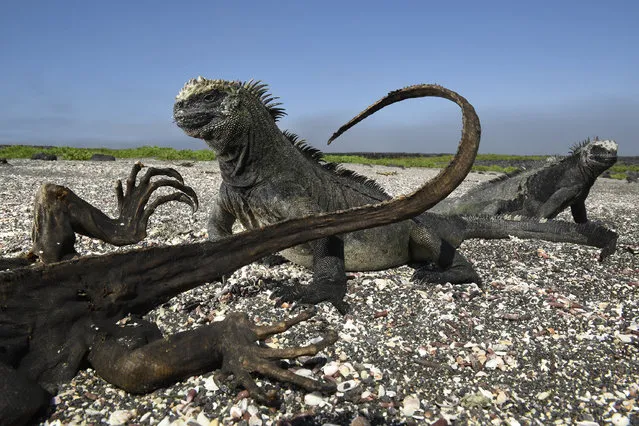
Galapagos – Rocking the Cradle: Four major ocean currents converge along the Galapagos archipelago, creating the conditions for an extraordinary diversity of animal life, April 25, 2016. The islands are home to at least 7,000 flora and fauna species, of which 97 percent of the reptiles, 80 percent of the land birds, 50 percent of the insects and 30 percent of the plants are endemic. The local ecosystem is highly sensitive to the changes in temperature, rainfall and ocean currents that characterize the climatic events known as El Niño and La Niña. These changes cause marked fluctuations in weather and food availability. Many scientists expect the frequency of El Niño and La Niña to increase as a result of climate change, making the Galapagos a possible early-warning location for its effects. (Photo by Thomas P. Peschak for National Geographic/World Press Photo)

Galapagos – Rocking the Cradle: Four major ocean currents converge along the Galapagos archipelago, creating the conditions for an extraordinary diversity of animal life, April 25, 2016. The islands are home to at least 7,000 flora and fauna species, of which 97 percent of the reptiles, 80 percent of the land birds, 50 percent of the insects and 30 percent of the plants are endemic. (Photo by Thomas P. Peschak for National Geographic/World Press Photo)
Details
16 Apr 2018 00:01:00
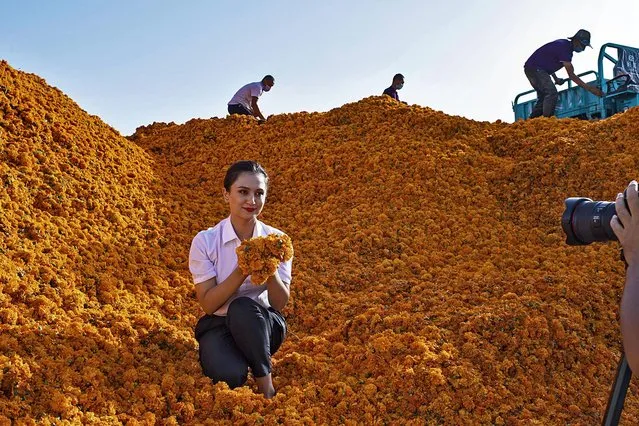
A staff member of Yutian County poses for a video on marigold industry at an agricultural industrial park in Yutian County, northwest China's Xinjiang Uygur Autonomous Region, September 20, 2020. As one of the five counties in Hotan Prefecture that have not been lifted out of poverty, Yutian County is accelerating its steps to shake off poverty by planting marigold. (Photo by Chine Nouvelle/SIPA Press/Rex Features/Shutterstock)

A staff member of Yutian County poses for a video on marigold industry at an agricultural industrial park in Yutian County, northwest China's Xinjiang Uygur Autonomous Region, September 20, 2020. As one of the five counties in Hotan Prefecture that have not been lifted out of poverty, Yutian County is accelerating its steps to shake off poverty by planting marigold. (Photo by Chine Nouvelle/SIPA Press/Rex Features/Shutterstock)
Details
01 Oct 2020 00:05:00
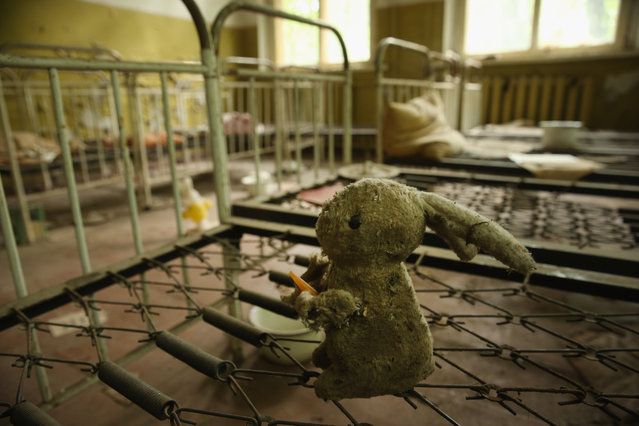
A stuffed rabbit doll sits among children's beds standing in the abandoned kindergarten of Kopachi village located inside the Chernobyl Exclusion Zone on September 29, 2015 near Chornobyl, Ukraine. Kopachi, a village that before 1986 had a population of 1,114, lies only a few kilometers south of the former Chernobyl nuclear power plant, where in 1986 workers inadvertantly caused reactor number four to explode, creating the worst nuclear accident in history. Radiation fallout was so high that authorities bulldozed and buried all of Kopachi's structures except for the kindergarten. (Photo by Sean Gallup/Getty Images)

A stuffed rabbit doll sits among children's beds standing in the abandoned kindergarten of Kopachi village located inside the Chernobyl Exclusion Zone on September 29, 2015 near Chornobyl, Ukraine. Kopachi, a village that before 1986 had a population of 1,114, lies only a few kilometers south of the former Chernobyl nuclear power plant, where in 1986 workers inadvertantly caused reactor number four to explode, creating the worst nuclear accident in history. (Photo by Sean Gallup/Getty Images)
Details
27 Apr 2016 09:28:00