Loading...
Done
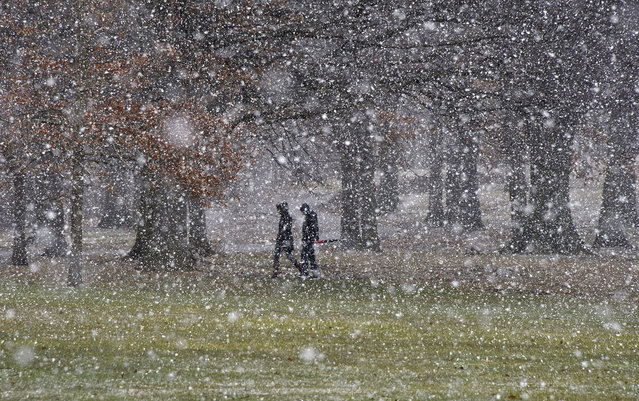
People cross Flagstaff Hill as the snow starts to fall, in Schenley Park, on their way to the Carnegie Mellon University campus, Tuesday, March 20, 2018, in the Oakland section of Pittsburgh. Yet another powerful storm bore down on the Northeast on Tuesday, with wind-whipped snow falling in parts of Pennsylvania and New Jersey as people grumbled and complained about a first day of spring that looked an awful lot like the last weeks of winter. (Photo by Darrell Sapp/Pittsburgh Post-Gazette via AP Photo)

People cross Flagstaff Hill as the snow starts to fall, in Schenley Park, on their way to the Carnegie Mellon University campus, Tuesday, March 20, 2018, in the Oakland section of Pittsburgh. Yet another powerful storm bore down on the Northeast on Tuesday, with wind-whipped snow falling in parts of Pennsylvania and New Jersey as people grumbled and complained about a first day of spring that looked an awful lot like the last weeks of winter. (Photo by Darrell Sapp/Pittsburgh Post-Gazette via AP Photo)
Details
07 Apr 2018 00:01:00
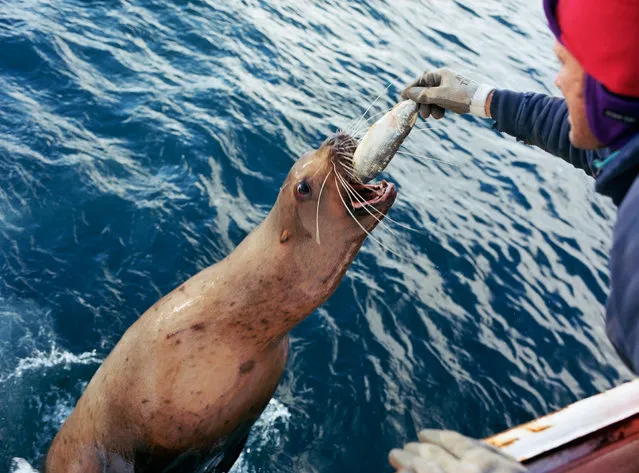
Before heading up to Alaska, the ship loads up with 3 months worth of food. Even so, it's hardly necessary. The ship's cook is constantly steaming fresh crab legs and seafood caught during the day. The hard labour of fishing requires a diet heavy in fat, protein, and omega-3s. Here, a sea lion gets a bite of the grub. (Photo by Corey Arnold)

In 2002 photographer Corey Arnold left behind a poor economy in San Francisco and headed up to Alaska to try his luck at his longtime passion of fishing. Arnold, who had worked summers during college on a salmon boat in Alaska, signed onto the f/v Rollo, a crabbing boat that fishes in the dangerous Bering Sea. While working long, strenuous hours on the Rollo, Arnold often stole away with the captain’s permission to grab his camera and photograph the crew and the ship. Arnold eventually put together “Fish Work: Bering Sea”, a documentation of his seven adventurous and dicey crab seasons aboard the Rollo. (Photo by Corey Arnold)
Details
20 Aug 2014 10:05:00
Professional conceptual category winner. Greetings from Mars, by Julien Mauve, France. Mauve says: “I have always wondered what it would be like to discover a totally different world ... and to photograph it for the first time as if I was Ansel Adams. So I came up with this project, which is about space exploration and discovery. But it’s also about our behavior in front of landscapes and how we create pictures that will share our personal story with the world”. (Photo by Julien Mauve)

Professional conceptual category winner. Greetings from Mars, by Julien Mauve, France. Mauve says: “I have always wondered what it would be like to discover a totally different world ... and to photograph it for the first time as if I was Ansel Adams. So I came up with this project, which is about space exploration and discovery. But it’s also about our behavior in front of landscapes and how we create pictures that will share our personal story with the world”. (Photo by Julien Mauve)
Details
23 Apr 2016 13:57:00
Hucul horses play in the wild meadows and forests near Odrzychowa in southeastern Poland on October 18, 2014. Huculs, a primitive breed of horse, escaped total extinction due to the efforts of scientists and Polish farmers. (Photo by Janek Skarzynski/AFP Photo)

Hucul horses play in the wild meadows and forests near Odrzychowa in southeastern Poland on October 18, 2014. Huculs, a primitive breed of horse, escaped total extinction due to the efforts of scientists and Polish farmers. (Photo by Janek Skarzynski/AFP Photo)
Details
25 Oct 2014 14:08:00
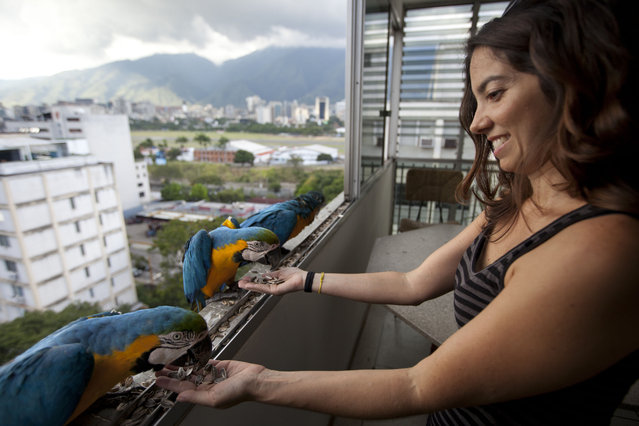
Vanessa Silva, 38, feeds macaws that fly to her apartment window every day looking for food, in Caracas, Venezuela. A group of gold-and-royal blue birds poked their heads through Silva’s window, as if saying “I’m here, is anyone home?” “I’d seen them flying when I was down on the street, and I thought ‘Oh how pretty,’” the 38-year-old said, a macaw eating out of her hand. (Photo by Ariana Cubillos/AP Photo)

Vanessa Silva, 38, feeds macaws that fly to her apartment window every day looking for food, in Caracas, Venezuela, on November 24, 2014. A group of gold-and-royal blue birds poked their heads through Silva’s window, as if saying “I’m here, is anyone home?” “I’d seen them flying when I was down on the street, and I thought ‘Oh how pretty,’” the 38-year-old said, a macaw eating out of her hand. (Photo by Ariana Cubillos/AP Photo)
Details
27 Nov 2014 15:27:00
Chahad, 16, gets groomed at a beauty Salon in Kalak before her wedding party, Iraq February 16, 2017. (Photo by Zohra Bensemra/Reuters)

Chahad, 16, gets groomed at a beauty Salon in Kalak before her wedding party, Iraq February 16, 2017. It's the second marriage to take place in the IDP camps east of the city where tens of thousands are living, having fled the fighting in Mosul. (Photo by Zohra Bensemra/Reuters)
Details
18 Feb 2017 00:06:00
Muhannad al-Kadiri (R),18, and Ibrahim Eid, 16, demonstrate their Parkour skills over a military vehicle in the rebel-held city of Inkhil, west of Deraa, Syria, February 4, 2017. (Photo by Alaa Al-Faqir/Reuters)

Muhannad al-Kadiri (R),18, and Ibrahim Eid, 16, demonstrate their Parkour skills over a military vehicle in the rebel-held city of Inkhil, west of Deraa, Syria, February 4, 2017. (Photo by Alaa Al-Faqir/Reuters)
Details
05 May 2017 07:26:00
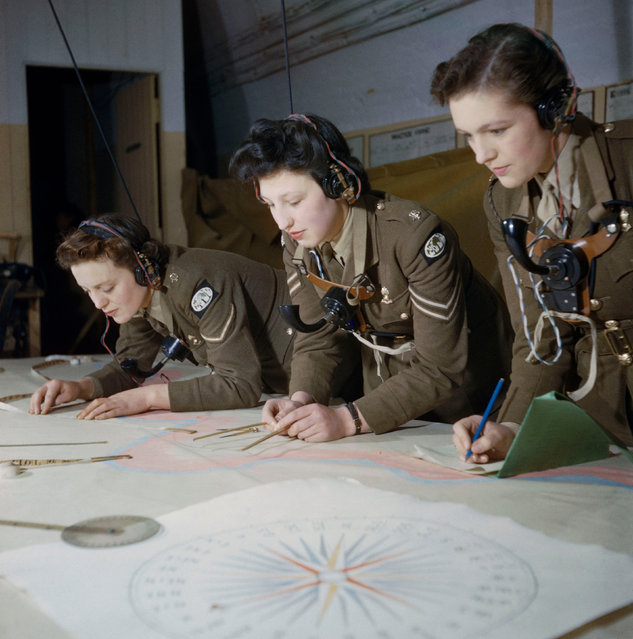
Auxiliary Territorial Service (ATS) plotters at work at Coastal Artillery Headquarters in Dover, December 1942. (Photo by Ted Dearberg/IWM/PA Wire)

Auxiliary Territorial Service (ATS) plotters at work at Coastal Artillery Headquarters in Dover, December 1942. The Auxiliary Territorial Service was the women's branch of the British Army during the Second World War. It was formed on 9 September 1938, initially as a women's voluntary service, and existed until 1 February 1949, when it was merged into the Women's Royal Army Corps. The ATS had its roots in the Women's Auxiliary Army Corps (WAAC), which was formed in 1917 as a voluntary service. During the First World War its members served in a number of jobs including clerks, cooks, telephonists and waitresses. The WAAC was disbanded after four years in 1921. (Photo by Ted Dearberg/IWM/PA Wire)
Details
13 Jul 2017 07:52:00