Loading...
Done
A 41-year-old man going by the name of Chibatman rides his “Chibatpod” on the road in Chiba, east of Tokyo, August 31, 2014. (Photo by Yuya Shino/Reuters)

A 41-year-old man going by the name of Chibatman rides his “Chibatpod” on the road in Chiba, east of Tokyo, August 31, 2014. The man, who dresses up as the comic book superhero Batman, came up with his moniker after adding a prefix of the first three letters of the city name, of which he roams on his three-wheeled motorcycle. However, unlike the hero from the Batman series, he rides around in his machine, designed from inspiration of the “Batpod” from the movies The Dark Knight and The Dark Knight Rises, delivering smiles instead of fighting crime. (Photo by Yuya Shino/Reuters)
Details
06 Sep 2014 11:37:00
Perpetual Calendar By Arina Pozdnyak

We place too much value into something as elusive as time. This is the lesson that Arina Pozdnyak, the creator of Perpetual Calendar, is trying to teach us. Days fly by, and even months are mere speckles of sand in an hourglass of eternity. People do not realize that the time given to us by fate cannot be measured using months or even years. It is measured using emotions and impressions. If a person lives to be 150 years old without experiencing any emotions, he might as well have lived one day, for all it’s worth. On the other hand, a person who lived an exciting, fulfilling life, read countless books and cherished every moment that he had, is actually the one who lived a longer life, even if in reality his flame was snuffed out much too soon. (Photo by Arina Pozdnyak)
Details
30 Oct 2014 13:33:00
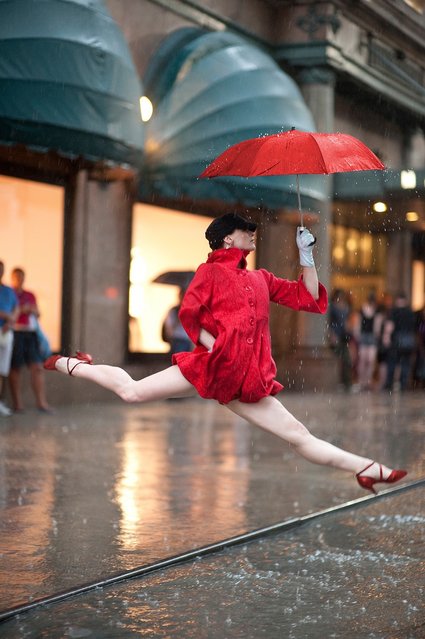
“Dancers Among Us”: Macys, NYC – Annmaria Mazzini. (Photo by Jordan Matter)

“The inspiration for this book came to me one afternoon as I watched my son, Hudson, playing with his toy bus. I was trying to keep pace with his three-year-old mind as he got deeper and deeper into a fantasy involving nothing more than a yellow plastic box and armless figurines. At least that’s what I saw. He saw frantic commuters rushing to catch the 77 local bus to Australia. He jumped in place, mouth open and slapping his knees, joyously reacting to a world I couldn’t see, but one powerfully present for him...”. – Jordan Matter

Photo: “Dancers Among Us”: Macys, NYC – Annmaria Mazzini. (Photo by Jordan Matter)
Details
12 Nov 2012 11:17:00
Son And Dad Nicolas and  Weston Cage

Weston Coppola Cage (born Weston Coppola on December 26, 1990) is the son of Nicolas Cage and Christina Fulton. Weston appeared in Cage's film Lord of War as Vladimir, a young Ukrainian mechanic who quickly disarms a Mil Mi-24 helicopter. He also appeared in the vampire film Raven in 2009 and was featured on the soundtrack for the film Drive Angry.

Weston is lead singer of black metal bands Eyes of Noctum and Arsh Anubis (With the moroccan bass player Soufiane Elyamouni "Apophis" n the Egyptian Guitar player Alhussain Sherif "Izund" ). He has also created a comic book with his father, Nicolas Cage, called Voodoo Child, which was published by Virgin Comics in 2007.
Details
09 Jan 2013 13:30:00
Giant gathering by Tony Wu. “The first indication that something extraordinary was going on were the blows, huge numbers of them – the exhalations of huge numbers of whales. Entering the water, the photographer witnessed an extraordinary scene. Hundreds, possibly thousands, of sperm whales were twirling and twisting through the water, bumping and rubbing against each other, and there was a cacophony of sound – the pulsation, buzz, creak and crackle of whale communication. The picture shows just a fraction of the scene, with the whales stacked up below. Undoubtedly, this was a clan gathering”. (Photo by Tony Wu/Unforgettable Underwater Photography/NHM)

A new book published by the UK Natural History Museum showcases some of the most memorable underwater photographs taken over the last few decades in its annual wildlife photographer of the year competition. Here: Giant gathering by Tony Wu. “The first indication that something extraordinary was going on were the blows, huge numbers of them – the exhalations of huge numbers of whales. Entering the water, the photographer witnessed an extraordinary scene”. (Photo by Tony Wu/Unforgettable Underwater Photography/NHM)
Details
17 Apr 2018 00:03:00
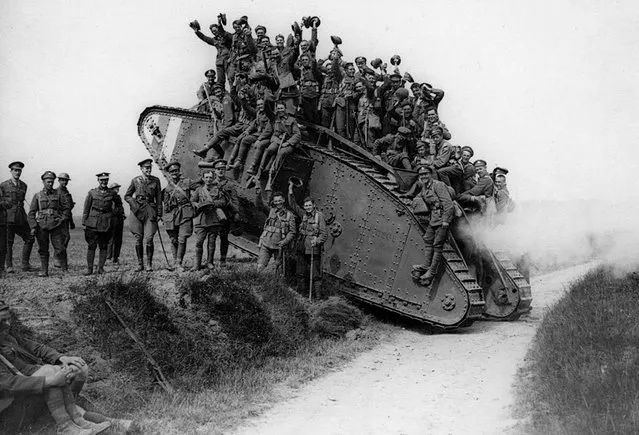
These black-and-white photos are taken from the new book “Armoured Warfare in the First World War 1916 – 1918” by Anthony Tucker-Jones and published by Pen & Sword Military. “Interestingly the British, French and Germans took completely different approaches with varying results”. The British military produced “Little Willie” in Autumn 1915 weighing 18 tonnes, which had a crew of two plus four gunners. “Inspired by a tracked artillery tractor “Little Willie” was referred to as a water tank – hence the name tank – to ensure secrecy”, said Anthony. “This led to the strange looking Mark I with its peculiar rhomboid shape, designed to cross trenches with guns in sponsons on either side. The Germans saw the tank as unchivalrous and were slow to grasp its utility. They favoured the Stormtrooper (specialist soldiers used to infiltrate enemy trenches) and artillery, not the tank”, said Anthony. “However, they didn’t hesitate to make use of captured British tanks. Although the tank helped secure victory and German soldiers dubbed it “Germany’s Downfall” the country was ultimately brought to its knees by the Allies blockade”. Here: British troops hitch a ride on a Mark IV after the massed tank fleet spearheading attack at Cambrai on November 20, 1917. (Photo by Anthony Tucker-Jones/Mediadrumworld.com)

These black-and-white photos are taken from the new book “Armoured Warfare in the First World War 1916 – 1918” by Anthony Tucker-Jones and published by Pen & Sword Military. Here: British troops hitch a ride on a Mark IV after the massed tank fleet spearheading attack at Cambrai on November 20, 1917. (Photo by Anthony Tucker-Jones/Mediadrumworld.com)
Details
23 Feb 2017 00:02:00
Retired builder Vasili Sidamonidze, 70, poses for a portrait at his home in Gori, Georgia, December 6, 2016. “Unfortunately, Stalin is not popular nowadays. Our people don't respect him. Only we, members of the (Communist) Party, respect him”, Sidamonidze said. “I always try to attend Stalin's birthday anniversaries in Gori. Unfortunately many people don't want to join us even if they live nearby. They look at us from their windows”. Stalin, who was born in Gori in 1878 and died in 1953, is largely reviled today in Georgia, which regained its independence during the 1991 collapse of the Soviet Union. Over the years, his memorials have been dismantled, most recently in 2010 when authorities removed a statue of the dictator from Gori's central square. But Stalin is still revered by a small group of mainly elderly supporters who stress his role in the industrialisation of the Soviet Union and in defeating Nazi Germany in World War Two. Each Dec. 21, a few dozen people mark his birthday by gathering outside a Gori museum dedicated to Stalin, where they make speeches and walk to the square where a 6-meter-high bronze statue of him once stood, calling for it to be reinstated. Opponents say it was a symbol of Moscow's still lingering shadow. In 2008, Russia fought a brief war with Georgia and recognised its breakaway regions of Abkhazia and South Ossetia as independent states. (Photo by David Mdzinarishvili/Reuters)

Retired builder Vasili Sidamonidze, 70, poses for a portrait at his home in Gori, Georgia, December 6, 2016. “Unfortunately, Stalin is not popular nowadays. Our people don't respect him. Only we, members of the (Communist) Party, respect him”, Sidamonidze said. “I always try to attend Stalin's birthday anniversaries in Gori. Unfortunately many people don't want to join us even if they live nearby. They look at us from their windows”. (Photo by David Mdzinarishvili/Reuters)
Details
17 Dec 2016 07:59:00
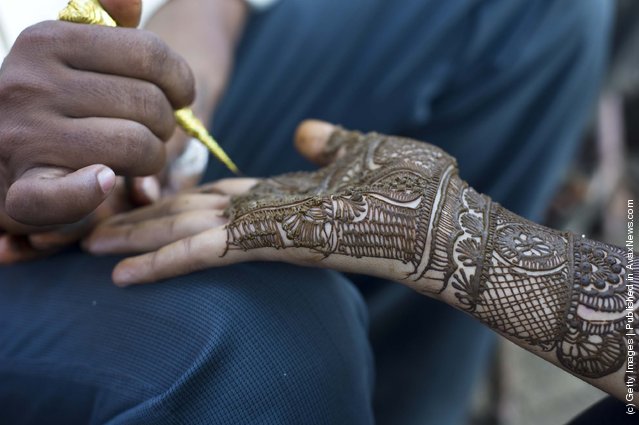
Application of henna or “Mehndi”  to a girls hand in a market in Jaipur, India

“Mehndi or menhdi is the application of henna as a temporary form of skin decoration in India, as well as by expatriate communities from the country. The word mehndi is derived from the Sanskrit word mendhikā. The use of mehndi and turmeric is described in the earliest Vedic ritual books. Haldi (Staining oneself with turmeric paste) as well as mehndi are important Vedic customs as a symbolic representation of the Outer and the Inner Sun. Vedic customs are meant to awaken the “inner light” and so the gold of the inner Sun has an important symbolic function”. – Wikipedia

Photo: Application of henna or “Mehndi” to a girls hand in a market on October 18, 2010 in Jaipur, India. (Photo by Simon de Trey-White/Getty Images)
Details
23 Nov 2011 13:33:00