Loading...
Done
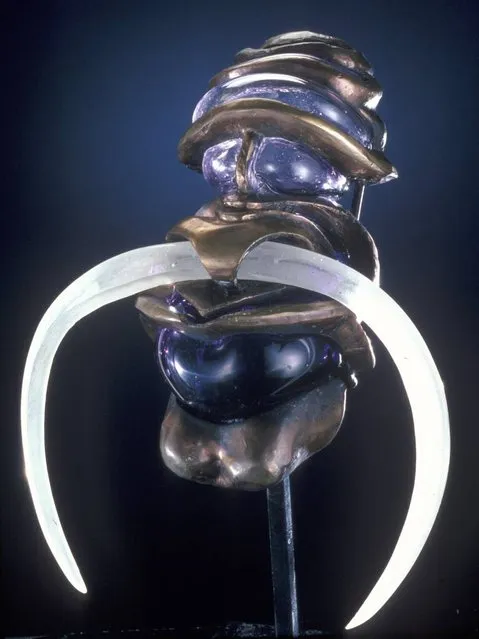
Sculpture By Miles Van Rensselaer

Miles Van Rensselaer using everything from glass and crystal to bronze and iron, from gold and silver to tooth and bone, from steel, copper and lead to wood, clay, feather and hair. He has been fortunate enough to work – and humbled by working – with and among talented artists from all over the world. His work is his homage to these people and their vanishing ways of life, his translation of their technique, imagery, idea of “primitive” art into modern Western materials.
Details
14 Sep 2015 07:55:00
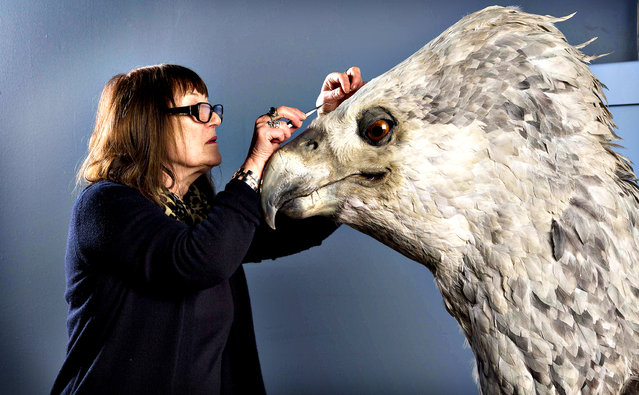
Undated handout photo of Buckbeak, a Hippogriff that lived with Rubeus Hagrid in the Harry Potter series, has his feathers preened and replenished by featherologist Val Jones, as he will feature in the the Feathers and Flight event at Warner Bros. Studio Tour London. (Photo credit should read: Tim Anderson/PA Wire)

Undated handout photo of Buckbeak, a Hippogriff that lived with Rubeus Hagrid in the Harry Potter series, has his feathers preened and replenished by featherologist Val Jones, as he will feature in the the Feathers and Flight event at Warner Bros. Studio Tour London. This is the first make-over Buckbeak has received since the hugely popular Harry Potter film series was made. His intricate coat is created from thousands of individually airbrushed chicken and goose feathers that Val will carefully clean and replenish in time for the start of Feathers and Flight. Val will lead an expert team to demonstrate the techniques that made winged wonders such as Buckbeak and Fawkes the Phoenix a reality on screen. (Photo by Tim Anderson/PA Wire)
Details
22 Mar 2014 13:56:00
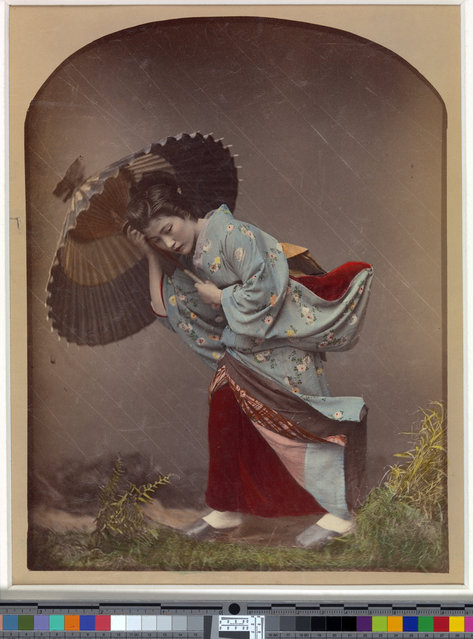
“Woman with Umbrella in Rain” by Raimund von Stillfried. Artist: Kusakabe Kimbei (Japanese, 1841–1934), 1870s. (Photo courtesy of The Metropolitan Museum of Art)

“Woman with Umbrella in Rain” by Raimund von Stillfried. Artist: Kusakabe Kimbei (Japanese, 1841–1934), 1870s. Commercial photography studios in Meiji-era Japan were renowned for the subtlety and refinement of their coloring techniques. This hand-tinted image of a young woman caught in a heavy rainstorm achieved its naturalistic effect by knitting together multiple strands of artifice: the greenery in the foreground was a studio prop; the flaps of the kimono were suspended by thin wires to create the impression of a strong wind; and long, diagonal marks were made on the negative to suggest streaks of rain. (Photo courtesy of The Metropolitan Museum of Art)
Details
12 May 2013 10:13:00
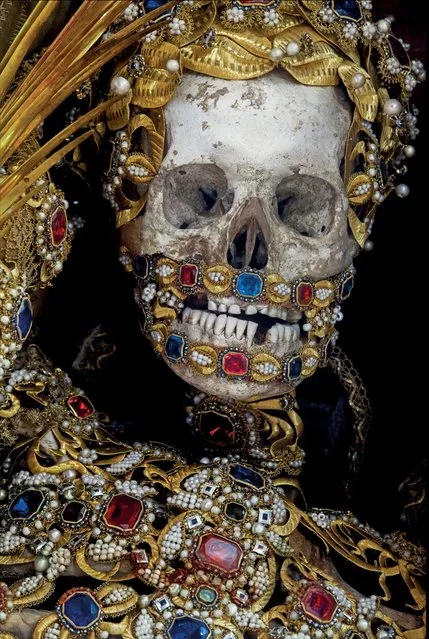
Albertus in the church of St George in Burgrain, Germany. Incredibly, some of the skeletons, which took up to five years to decorate, were even found hidden away in lock-ups and containers. (Photo by Paul Koudounaris/BNPS)

A relic hunter dubbed “Indiana Bones” has lifted the lid on a macabre collection of 400-year-old jewel-encrusted skeletons unearthed in churches across Europe. Art historian Paul Koudounaris has hunted down and photographed dozens of gruesome skeletons in some of the world's most secretive religious establishments. Photo: Albertus in the church of St George in Burgrain, Germany. Incredibly, some of the skeletons, which took up to five years to decorate, were even found hidden away in lock-ups and containers. (Photo by Paul Koudounaris/BNPS)
Details
08 Sep 2013 07:20:00
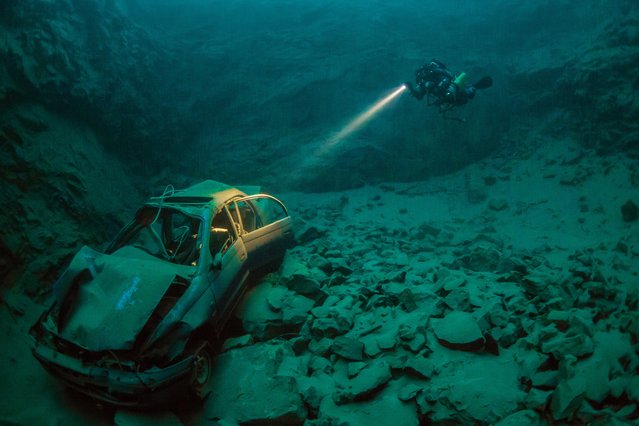
Wide-angle category winner. Part of the Illusion by Marcus Blatchford (UK). Location: National Dive & Activity Centre, Chepstow, Wales. “This is the deepest inland dive centre in the UK. The dive plan was to explore the deep end, but this time I dived ‘unplugged’ (without my strobes). With the exception of this change to my camera technique, there were no planned shots I wanted to achieve – just a fun dive with ad-hoc photos along the way. Shortly after this photo was captured, in 6C water and two hours of decompression ahead of us, we turned and started the long ascent back to the surface”. (Photo by Marcus Blatchford/Underwater Photographer of the Year 2016)

Wide-angle category winner. Part of the Illusion by Marcus Blatchford (UK). Location: National Dive & Activity Centre, Chepstow, Wales. “This is the deepest inland dive centre in the UK. The dive plan was to explore the deep end, but this time I dived ‘unplugged’ (without my strobes). With the exception of this change to my camera technique, there were no planned shots I wanted to achieve – just a fun dive with ad-hoc photos along the way. Shortly after this photo was captured, in 6C water and two hours of decompression ahead of us, we turned and started the long ascent back to the surface”. (Photo by Marcus Blatchford/Underwater Photographer of the Year 2016)
Details
18 Feb 2016 13:44:00
Aerialist Erin Blaire, 33, performs a hair hanging trick for a photographer while hanging from a metal bar on a subway platform on March 14, 2023 in New York City. Erin Blaire, originally from Vermont, has lived in New York City for eight years and has been performing her aerial hair routine for the last three. The origin of hair hanging is believed to have originated in China, according to reports, and is a closely guarded circus trick passed from mentor to mentee. Although it is possible to find the technique and secrets online it is most-likely not how professional performers learned the skillset, and not how Blaire did either. (Photo by Alexi Rosenfeld/Getty Images)

Aerialist Erin Blaire, 33, performs a hair hanging trick for a photographer while hanging from a metal bar on a subway platform on March 14, 2023 in New York City. Erin Blaire, originally from Vermont, has lived in New York City for eight years and has been performing her aerial hair routine for the last three. The origin of hair hanging is believed to have originated in China, according to reports, and is a closely guarded circus trick passed from mentor to mentee. Although it is possible to find the technique and secrets online it is most-likely not how professional performers learned the skillset, and not how Blaire did either. (Photo by Alexi Rosenfeld/Getty Images)
Details
23 Mar 2023 04:45:00
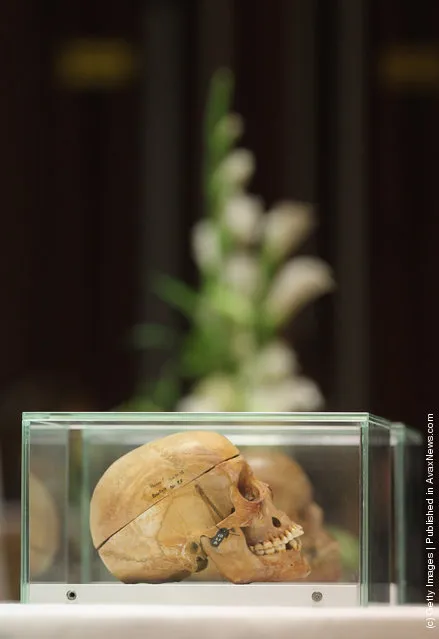
Charite Hospital Returns Herero Skulls To Namibia

Two of 20 skulls to be taken possession of by a delegation from Namibia stand on display at a ceremony at Charite hospital on September 30, 2011 in Berlin, Germany. The skulls are from Herero and Nama tribespeople taken by German colonial forces between 1904 and 1908, when the Germans violently suppressed an uprising in what was then German Southwest Africa, which is today's Namibia, and in the process killed tens of thousand of Herero and Nama. German scientists at the time took the skulls back to Berlin to demonstrate the racial superiority of Europeans over black Africans. Many Namibians demand a formal apology from the German government. (Photo by Sean Gallup/Getty Images)
Details
02 Oct 2011 11:42:00
Models of Cold War-era Allied (L) and Soviet Bloc weaponry

Models of Cold War-era Allied (L) and Soviet Bloc weaponry face one another at the new Bundeswehr Military History Museum (Militaerhistorisches Museum der Bundeswehr, or MHM) on October 11, 2011 in Dresden, Germany. The museum, redesigned by star architect Daniel Libeskind, traces Germany military history from 1300 to the present, including during the Nazi period and the Cold War, and also examines the influence of the military on popular culture. (Photo by Sean Gallup/Getty Images)
Details
12 Oct 2011 11:55:00