Loading...
Done
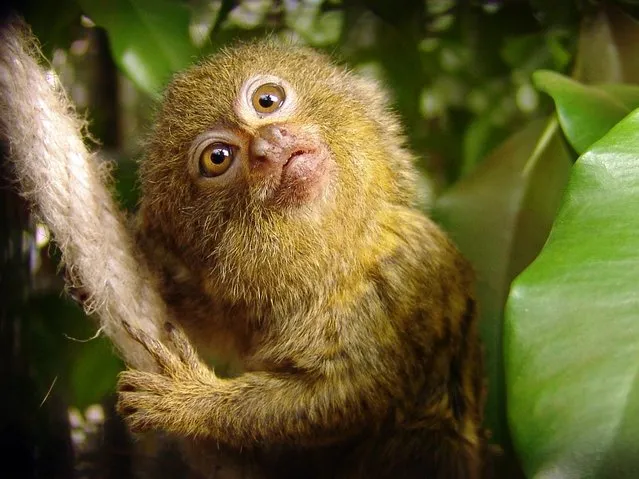
Pygmy Marmoset - The Smallest Monkey

The pygmy marmoset (Cebuella pygmaea) is a small New World monkey native to rainforests of the western Amazon Basin in South America. It is notable for being the smallest monkey in the world at just over 100 grams (3.5 oz). It is generally found in evergreen and river edge forests and is a gum-feeding specialist
Details
29 Jan 2014 12:59:00
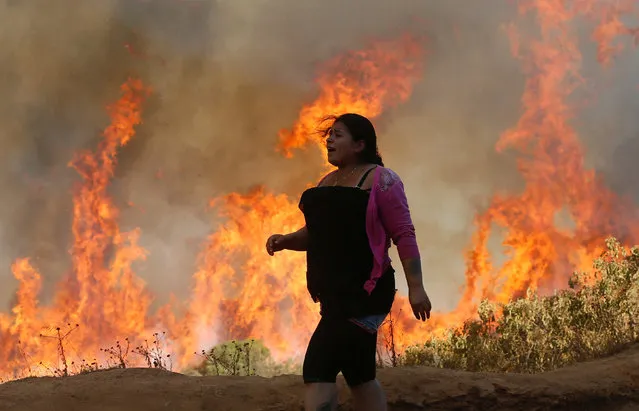
A resident looks at a wildfire in Vina del Mar, Chile, March 12, 2017. (Photo by Rodrigo Garrido/Reuters)

A resident looks at a wildfire in Vina del Mar, Chile, March 12, 2017. Forest fires are a regular feature of Chile's hot, arid summers, but a nearly decade-long drought combined with historically high temperatures have created tinder-like conditions in the nation's central regions. (Photo by Rodrigo Garrido/Reuters)
Details
15 Mar 2017 00:01:00
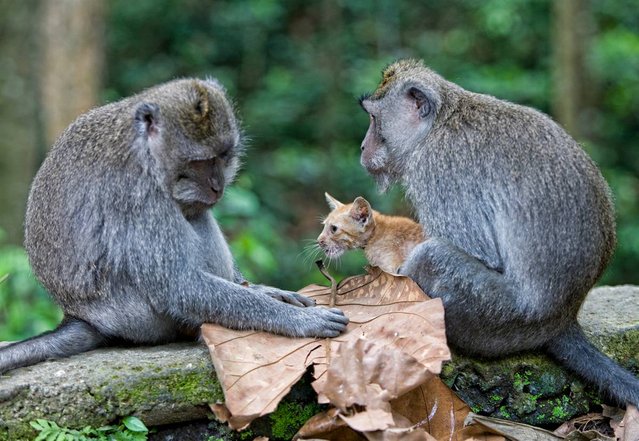
Monkey Adopts Kitten By Anne Young

A wild monkey has stunned animal lovers after it adopted an abandoned kitten and cared for it as his own. The young long-tailed macaque monkey was spotted in a forest protectively nuzzling and grooming the ginger kitten, making sure no harm came to it.
Details
05 Aug 2013 05:48:00
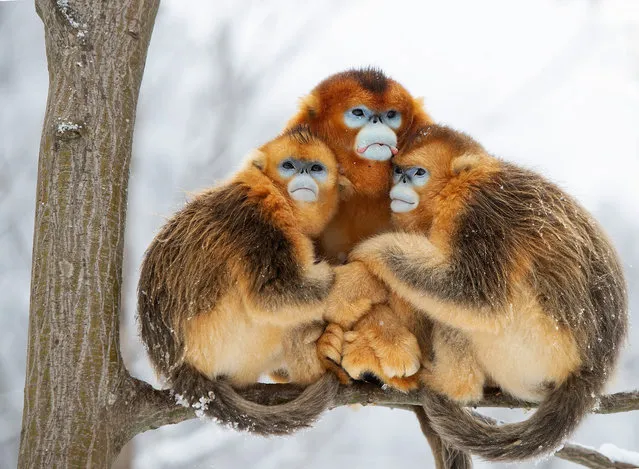
A golden huddle by Minqiang Lu, China. Two females and a male golden snub-nosed monkey huddle together to keep warm in the extreme cold. Threatened by forest loss and fragmentation, this endangered species is confined to central China. Restricted to living high up in the temperate forests, these monkeys – here in the Qinling mountains in Shaanxi province – feed mostly in the trees, on leaves, bark, buds and lichen. In heavy wind and snow, Minqiang walked up the mountain carrying his equipment. He stayed for half an hour in temperatures of –10C opposite the tree where the group was huddled before achieving this eye-level composition. (Photo by Minqiang Lu/Wildlife Photographer of the Year)

A golden huddle by Minqiang Lu, China. Two females and a male golden snub-nosed monkey huddle together to keep warm in the extreme cold. Threatened by forest loss and fragmentation, this endangered species is confined to central China. Restricted to living high up in the temperate forests, these monkeys – here in the Qinling mountains in Shaanxi province – feed mostly in the trees, on leaves, bark, buds and lichen. In heavy wind and snow, Minqiang walked up the mountain carrying his equipment. He stayed for half an hour in temperatures of –10C opposite the tree where the group was huddled before achieving this eye-level composition. (Photo by Minqiang Lu/Wildlife Photographer of the Year)
Details
12 Jan 2023 01:19:00
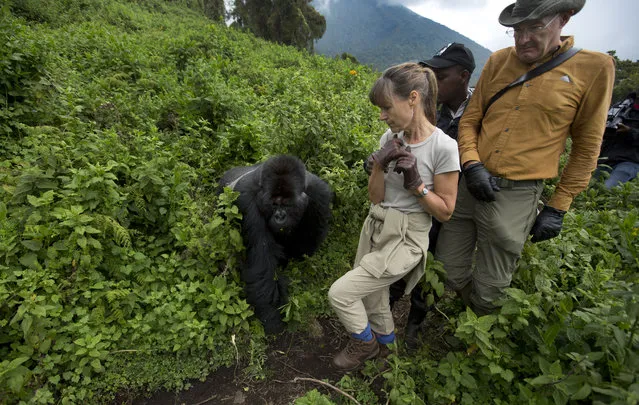
In this photo taken Friday, September 4, 2015, tourists Sarah and John Scott from Worcester, England, take a step back as a male silverback mountain gorilla from the family of mountain gorillas named Amahoro, which means “peace” in the Rwandan language, unexpectedly steps out from the bush to cross their path in the dense forest on the slopes of Mount Bisoke volcano in Volcanoes National Park, northern Rwanda. (Photo by Ben Curtis/AP Photo)

In this photo taken Friday, September 4, 2015, tourists Sarah and John Scott from Worcester, England, take a step back as a male silverback mountain gorilla from the family of mountain gorillas named Amahoro, which means “peace” in the Rwandan language, unexpectedly steps out from the bush to cross their path in the dense forest on the slopes of Mount Bisoke volcano in Volcanoes National Park, northern Rwanda. Deep in Rwanda's steep-sloped forest, increasing numbers of tourists are heading to see the mountain gorillas, a subspecies whose total population is an estimated 900 and who also live in neighboring Uganda and Congo, fueling an industry seen as key to the welfare of the critically endangered species as well as Rwanda's economy. (Photo by Ben Curtis/AP Photo)

Details
18 Sep 2015 14:55:00
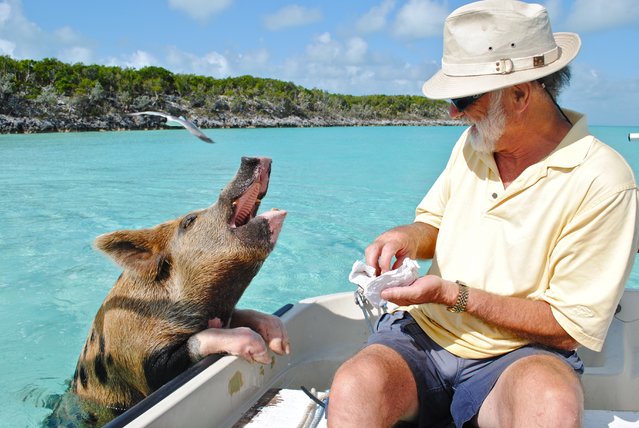
“So you're on a boat in Bahamas and then this pig swims by begging for food”. (Photo and caption by Lisa Larsen/Public Domain)

The Bahamas, the Commonwealth nation of hundreds of islands roughly the size of Connecticut and with population of just a bit over Anaheim, is known for its crystal waters and pristine beaches. This is possibly one of the world’s most beautiful havens of nature, yet people are coming here to see pigs. It is unclear when the pigs first appeared on Exuma Island or where they come from. There’s talk about a daring escape from a shipwreck, or sailors releasing the swine on purpose. In all probability, there were no pigs on this tropical paradise before European settlers came, so their mere presence is the work of human. The intriguing feat of nature, however, is that this population of pigs developed a fine aptitude for swimming. Here: “So you're on a boat in Bahamas and then this pig swims by begging for food”. (Photo and caption by Lisa Larsen/Public Domain)
Details
03 Sep 2015 11:53:00
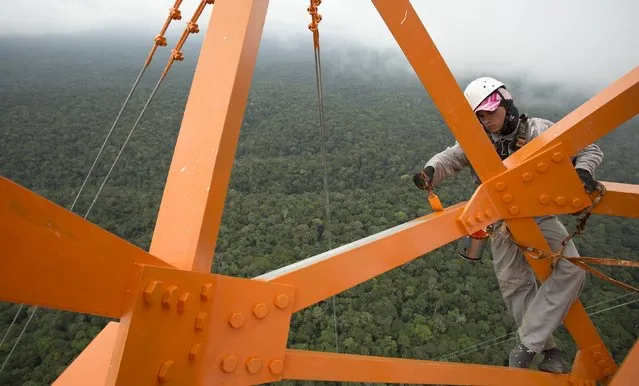
A worker paints the Amazon Tall Tower Observatory (ATTO) in Sao Sebastiao do Uatuma in the middle of the Amazon forest in Amazonas state January 10, 2015. (Photo by Bruno Kelly/Reuters)

A worker paints the Amazon Tall Tower Observatory (ATTO) in Sao Sebastiao do Uatuma in the middle of the Amazon forest in Amazonas state January 10, 2015. The Amazon Tall Tower Observatory is a project of Brazil's National Institute of Amazonian Research and Germany's Max Planck Institute and will be equipped with high-tech instruments and an observatory to monitor relationships between the jungle and the atmosphere from next July. According to the institutes, ATTO will gather data on heat, water, carbon gas, winds, cloud formation and weather patterns. (Photo by Bruno Kelly/Reuters)
Details
14 Jan 2015 12:39:00
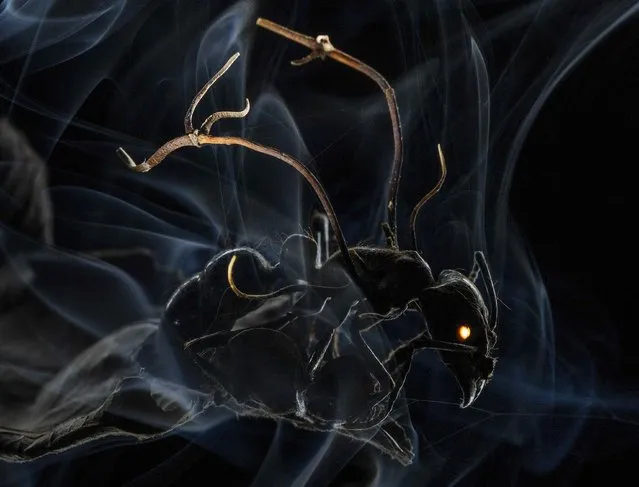
Anand Varma, a U.S. photographer working for the National Geographic, won the First Prize in the Nature Category, Stories, of the 2015 World Press Photo contest with his series of pictures, which includes this one of spores of a fungus landing on an ant, penetrating its exoskeleton and entering its brain, compelling the host to leave its normal habitat on the forest floor and scale a nearby tree, in this picture taken January 22, 2014 and released by the World Press Photo on February 12, 2015. (Photo by Anand Varma/Reuters/National Geographic/World Press Photo)

Anand Varma, a U.S. photographer working for the National Geographic, won the First Prize in the Nature Category, Stories, of the 2015 World Press Photo contest with his series of pictures, which includes this one of spores of a fungus landing on an ant, penetrating its exoskeleton and entering its brain, compelling the host to leave its normal habitat on the forest floor and scale a nearby tree, in this picture taken January 22, 2014 and released by the World Press Photo on February 12, 2015. (Photo by Anand Varma/Reuters/National Geographic/World Press Photo)
Details
15 Feb 2015 15:21:00