Loading...
Done
Legs Photography By Stacey Baker


When you look at the pictures created by Stacey Baker, you immediately think that these photos must have been staged by the photographer to convey some deep meaning. In reality, however, Stacy created her new series called “CitiLegs”, which has about 300 pictures of female legs, by asking passing girls and women in Manhattan, New York if she could photograph their legs. And that is when the realization hits you – “Some people actually dress like that!” What kind of a person would wear neon-green shorts over orange leggings with leopard-patterned boots, the toes of which are completely torn? Yes, there is a possibility that such a person might be insane; however, there are just too many “crazy” photos in this series! (Photo by Stacey Baker)
Details
19 Nov 2014 14:23:00


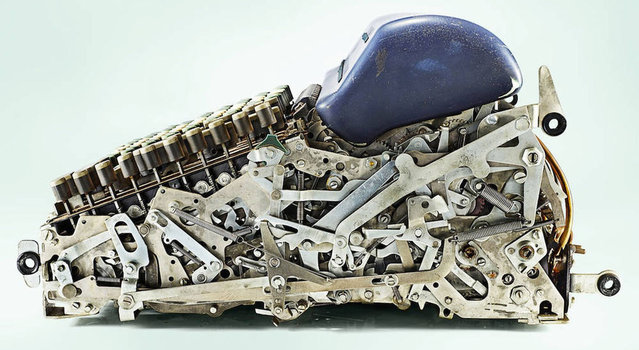
In his newest series of photos called Low Tech, Kevin Twomey artfully captures the complexity of old-style typewriters and similar machines. Despite being completely outdated, you cannot help being amazed at how complicated those “simple” devises really are. Hundreds of little parts were meticulously put together to form a machine that would perform such “basic” functions by today’s standards. Similarly, very few modern people actually think about how complicated the current technology really is. We take for granted streaming videos, GPS, and countless devises that we use every day, while in reality, these things would seem like magic to even the most prominent scientists from only half a century ago. (Photo by Kevin Twomey)
Details
21 Nov 2014 12:42:00
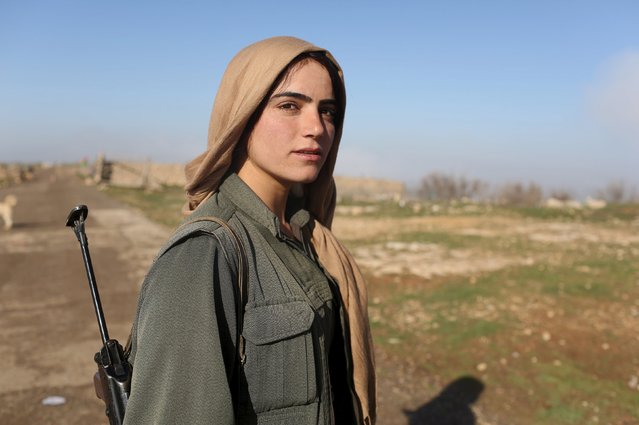
A female Kurdistan Workers Party (PKK) fighter stands near a security position in Sinjar, March 13, 2015. (Photo by Asmaa Waguih /Reuters)

A female Kurdistan Workers Party (PKK) fighter stands near a security position in Sinjar, March 13, 2015. Women fighters at a Kurdistan Workers Party (PKK) base on Mount Sinjar in northwest Iraq, just like their male counterparts, have to be ready for action at any time. Smoke from the front line, marking their battle against Islamic State, which launched an assault on northern Iraq last summer, is visible from the base. Many of the women have cut links with their families back home; the fighters come from all corners of the Kurdish region. (Photo by Asmaa Waguih /Reuters)
Details
02 May 2015 14:44:00
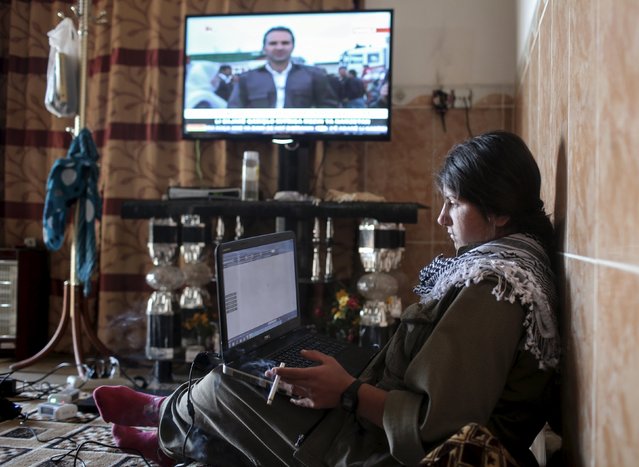
A female Kurdistan Workers Party (PKK) fighter works on her laptop while watching a Kurdish TV station at a base in the Sinjar mountains, March 11, 2015. (Photo by Asmaa Waguih/Reuters)

A female Kurdistan Workers Party (PKK) fighter works on her laptop while watching a Kurdish TV station at a base in the Sinjar mountains, March 11, 2015. Women fighters at a Kurdistan Workers Party (PKK) base on Mount Sinjar in northwest Iraq, just like their male counterparts, have to be ready for action at any time. Smoke from the front line, marking their battle against Islamic State, which launched an assault on northern Iraq last summer, is visible from the base. Many of the women have cut links with their families back home; the fighters come from all corners of the Kurdish region. (Photo by Asmaa Waguih/Reuters)
Details
04 May 2015 09:44:00
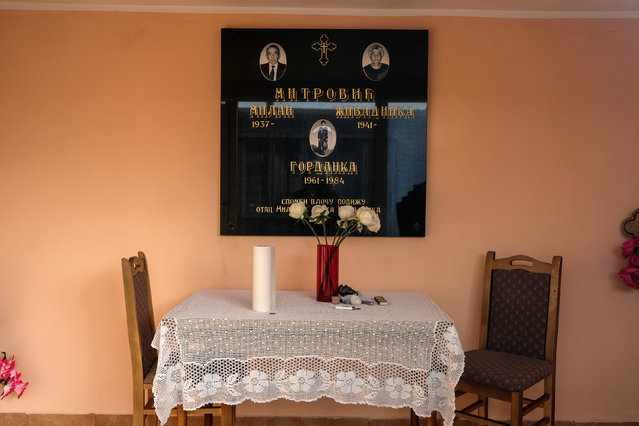
Pictures of deceased people are seen inside a chapel at a cemetery in the village of Smoljinac, Serbia, October 25, 2016. (Photo by Marko Djurica/Reuters)

Pictures of deceased people are seen inside a chapel at a cemetery in the village of Smoljinac, Serbia, October 25, 2016. From a distance, the cemetery in the eastern Serbian village of Smoljinac looks like a residential neighbourhood eerily placed among graves. But once inside the grounds, after passing a section with the usual stone slabs, visitors find rows of small bungalows painted in pastel colours. They have one or two rooms, large windows and ornate plaques – some inside, some outside – memorialising the deceased. These are the burial chapels of Smoljinac, cosy cabins with a furnished room inside, a storage place for wreaths and funeral paraphernalia, and the family crypt below. Some even have electric power inside. (Photo by Marko Djurica/Reuters)
Details
12 Nov 2016 10:37:00
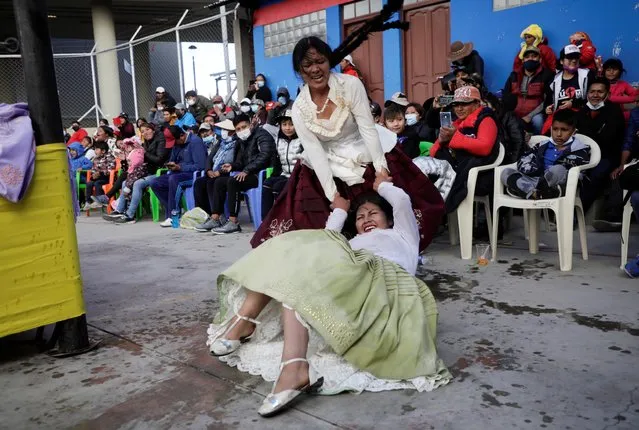
Barbara Quisbert and Susana La Bonita, cholitas wrestlers, fight during their return to the ring after the coronavirus disease (COVID-19) restrictions, in El Alto outskirts of La Paz, November 29, 2020. (Photo by David Mercado/Reuters)

The Fighting Cholitas are a group of female wrestlers who perform in El Alto, Bolivia. Tickets to the exhibitions cost $1. Like the general population of El Alto, which consists almost entirely of Aymara and Quechua residents, the Cholitas are indigenous. They wear braided hair, bowler hats and multilayered skirts in the ring. Here: Barbara Quisbert and Susana La Bonita, cholitas wrestlers, fight during their return to the ring after the coronavirus disease (COVID-19) restrictions, in El Alto outskirts of La Paz, November 29, 2020. (Photo by David Mercado/Reuters)
Details
12 Dec 2020 00:03:00
“Whether that means getting up way before the sun, like I do most days, going out somewhere that I’m not comfortable or just trying to get different angles or styles of photos, I am trying to display the crazy beauty of the ocean, and usually moments that literally last less than a split second”. (Photo by Ryan Pernoski/Caters News Agency)

These kaleidoscopic images are the work of one persistent photographer’s efforts to capture vibrant hues at the exact moment a wave breaks. Ryan Pernofski‘s stunning shots feature brilliant yellows, reds, blues and purples as an array of sunlight hits the water at the perfect time. What’s even more impressive: Ryan, a 27-year-old Australian, began shooting his popular masterpieces without using a professional camera, taking his iPhone out into the water instead. Ryan began experimenting with this method in 2012, using an underwater housing to protect his phone, as he could not afford a professional camera. (Photo by Ryan Pernoski/Caters News Agency)
Details
09 Jun 2018 00:05:00
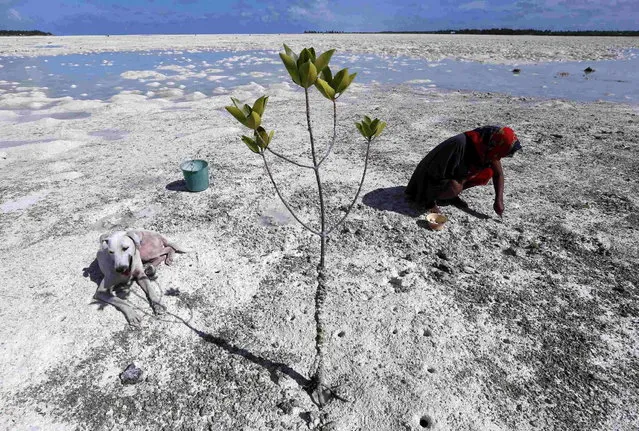
A dog sits in the shade of a mangrove tree as a woman uses a fork to dig for shellfish on the reef-mud flats of a lagoon located at South Tarawa in the central Pacific island nation of Kiribati May 23, 2013. (Photo by David Gray/Reuters)

A dog sits in the shade of a mangrove tree as a woman uses a fork to dig for shellfish on the reef-mud flats of a lagoon located at South Tarawa in the central Pacific island nation of Kiribati May 23, 2013. Kiribati consists of a chain of 33 atolls and islands that stand just metres above sea level, spread over a huge expanse of otherwise empty ocean. With surrounding sea levels rising, Kiribati President Anote Tong has predicted his country will likely become uninhabitable in 30-60 years because of inundation and contamination of its freshwater supplies. (Photo by David Gray/Reuters)
Details
13 Jun 2013 09:23:00