Loading...
Done
A store mannequin with a protective mask stands before a clothes store as they open for the first time since March during the novel coronavirus (COVID-19) pandemic on April 22, 2020 in Berlin, Germany. Small to midsized-shops are opening across Germany this week as state authorities follow a recommendation by the federal government to ease restrictions imposed in March meant to slow the spread of the coronavirus. Some schools are also planning to reopen soon, as are museums and hair salons in coming weeks. (Photo by Maja Hitij/Getty Images)

A store mannequin with a protective mask stands before a clothes store as they open for the first time since March during the novel coronavirus (COVID-19) pandemic on April 22, 2020 in Berlin, Germany. Small to midsized-shops are opening across Germany this week as state authorities follow a recommendation by the federal government to ease restrictions imposed in March meant to slow the spread of the coronavirus. Some schools are also planning to reopen soon, as are museums and hair salons in coming weeks. (Photo by Maja Hitij/Getty Images)
Details
24 Apr 2020 00:01:00
These may look like alien creatures from another planet, but the odd organisms are, in fact, colorful, microscopic life forms found in our forests. The bizarre slime molds, known as mycetozoa or fungus animals, were captured by geologist Valeriya Zvereva. (Photo by Valeriya Zvereva/Caters News)

These may look like alien creatures from another planet, but the odd organisms are, in fact, colorful, microscopic life forms found in our forests. The bizarre slime molds, known as mycetozoa or fungus animals, were captured by geologist Valeriya Zvereva. She spent months documenting the common life forms that are found beneath our feet – but are rarely seen. Incredibly, the organisms can move and hunt for other microscopic life forms on which to feed. Zvereva, who is from Moscow, used a special macro lens to capture the vibrant and up-close shots, which show off the organisms’ unlikely beauty. (Photo by Valeriya Zvereva/Caters News)
Details
20 Apr 2015 13:27:00
On August 31, 2012, a long filament of solar material that had been hovering in the sun's atmosphere, the corona, erupted out into space at 4:36 p.m. EDT. The coronal mass ejection, or CME, traveled at over 900 miles per second. The CME did not travel directly toward Earth, but did connect with Earth's magnetic environment, or magnetosphere, causing aurora to appear on the night of Monday, September 3. (Photo by NASA/GSFC/SDO)

On August 31, 2012, a long filament of solar material that had been hovering in the sun's atmosphere, the corona, erupted out into space at 4:36 p.m. EDT. The coronal mass ejection, or CME, traveled at over 900 miles per second. The CME did not travel directly toward Earth, but did connect with Earth's magnetic environment, or magnetosphere, causing aurora to appear on the night of Monday, September 3. (Photo by NASA/GSFC/SDO via The Atlantic)
Details
14 Sep 2012 09:01:00
In this September 5, 2012 file photo, people run for cover as smoke rises from the site of a fire at a fireworks factory on the outskirts of Sivakasi, about 500 kilometers (310 miles) southwest of Chennai, India. Police in southern India arrested six employees of the fireworks factory for a massive blaze that killed 40 workers and injured 60 others. (Photo by AP Photo/File)

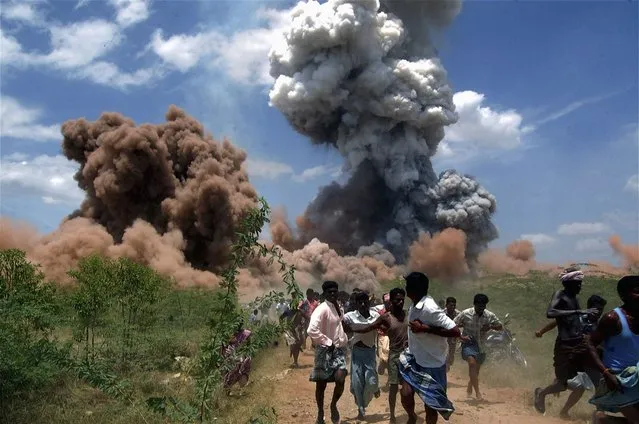
In this September 5, 2012 file photo, people run for cover as smoke rises from the site of a fire at a fireworks factory on the outskirts of Sivakasi, about 500 kilometers (310 miles) southwest of Chennai, India. Police in southern India arrested six employees of the fireworks factory for a massive blaze that killed 40 workers and injured 60 others. (Photo by AP Photo/File). P.S. I didn't publish the photos which you already saw here (Avax).
Details
04 Jan 2013 15:25:00
A general view showing the shipwrecked cruise ship Costa Concordia in an upright position after the salvage operations in Giglio island, Italy, 17 September 2013. Salvage crews pulled off a major engineering feat when they straightened the listed Costa Concordia cruise ship from the rocks it had been wedged against for the past 20 months. The delicate operation took 19 hours and was completed at 4 am (0200 GMT). The vessel ran aground near the island of Giglio, in Tuscany, in an accident that made world-wide news. (Photo by Angelo Carconi/EPA)

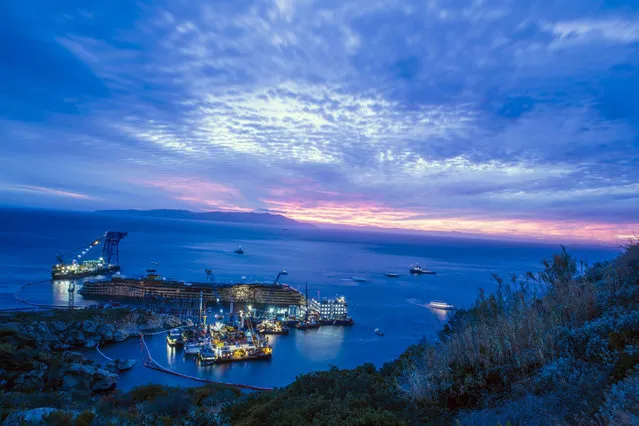
A general view showing the shipwrecked cruise ship Costa Concordia in an upright position after the salvage operations in Giglio island, Italy, 17 September 2013. Salvage crews pulled off a major engineering feat when they straightened the listed Costa Concordia cruise ship from the rocks it had been wedged against for the past 20 months. The delicate operation took 19 hours and was completed at 4 am (0200 GMT). The vessel ran aground near the island of Giglio, in Tuscany, in an accident that made world-wide news. (Photo by Angelo Carconi/EPA)
Details
18 Sep 2013 09:27:00
A boy poses with a butterfly on his face during a photocall to promote the "Sensational Butterflies" exhibition at the Natural History Museum in central London, on March 25, 2013.  With around 400 live tropical butterflies and moths living in the temporary facility, visitors will get the chance to see them flying freely as well as looking for emerging butterflies at the hatchery window. Running from March 29 to September 15, 2013, the exhibition is housed in a structure in the museum grounds. (Photo by Leon Neal/AFP Photo)

A boy poses with a butterfly on his face during a photocall to promote the “Sensational Butterflies” exhibition at the Natural History Museum in central London, on March 25, 2013. With around 400 live tropical butterflies and moths living in the temporary facility, visitors will get the chance to see them flying freely as well as looking for emerging butterflies at the hatchery window. Running from March 29 to September 15, 2013, the exhibition is housed in a structure in the museum grounds. (Photo by Leon Neal/AFP Photo)
Details
26 Mar 2013 13:37:00
Employees prepare spacesuits at the Russian-leased Baikonur cosmodrome in Kazakhstan on August 19, 2015. Members of the main crew of the 45/46 expedition to the International Space Station ISS, Kazakhstan's cosmonaut Aydyn Aimbetov, Russian cosmonaut Sergei Volkov and Denmark's astronaut Andreas Mogensen from the European Space Agency, are scheduled to blast off to the International Space Station (ISS) on September 2, 2015. (Photo by AFP Photo)

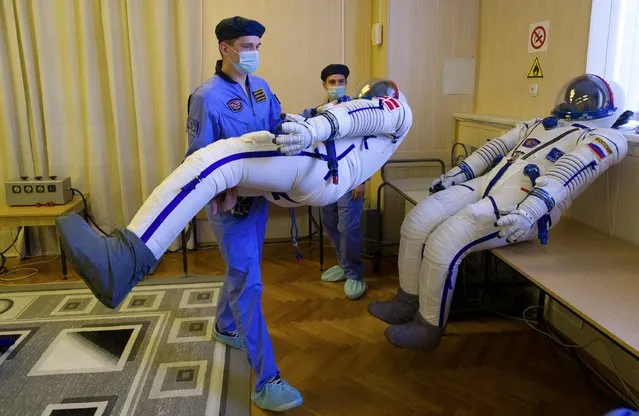
Employees prepare spacesuits at the Russian-leased Baikonur cosmodrome in Kazakhstan on August 19, 2015. Members of the main crew of the 45/46 expedition to the International Space Station ISS, Kazakhstan's cosmonaut Aydyn Aimbetov, Russian cosmonaut Sergei Volkov and Denmark's astronaut Andreas Mogensen from the European Space Agency, are scheduled to blast off to the International Space Station (ISS) on September 2, 2015. (Photo by AFP Photo)
Details
20 Aug 2015 13:45:00
In this September 1, 2015 photo, street artists Jenaro de Rosenzweig, left, and Alejandro Revilla pose for a portrait behind a restaurant's window covered with a mural by artist Francisco Munoz, signed with his artist's name below, in the Roma Norte neighborhood of Mexico City. Rosenzweig and Revilla founded the “Street Art Chilango” cooperative in March 2013, which is filling neighborhoods with public art by local street artists. (Photo by Rebecca Blackwell/AP Photo)

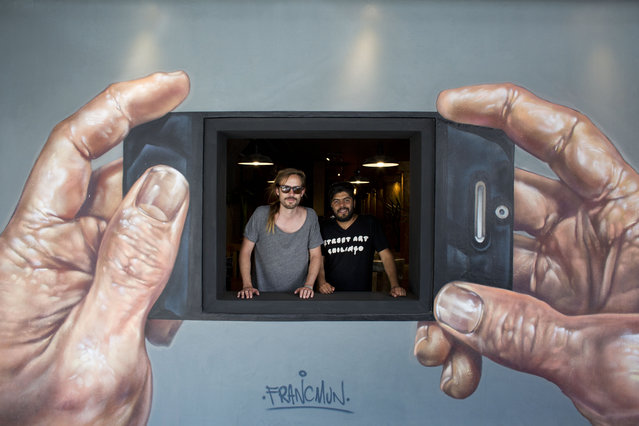
In this September 1, 2015 photo, street artists Jenaro de Rosenzweig, left, and Alejandro Revilla pose for a portrait behind a restaurant's window covered with a mural by artist Francisco Munoz, signed with his artist's name below, in the Roma Norte neighborhood of Mexico City. Rosenzweig and Revilla founded the “Street Art Chilango” cooperative in March 2013, which is filling neighborhoods with public art by local street artists. (Photo by Rebecca Blackwell/AP Photo)
Details
08 Sep 2015 11:42:00