Loading...
Done
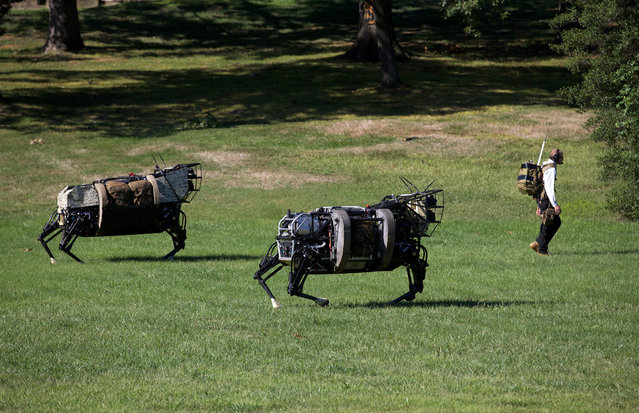
Two robotic legged squad support system (LS3) machines by the Defense Advanced Research Project Agency follow a technician during a demonstration at Joint Base Myer-Henderson Hall, Virginia, on September 10, 2012. (U.S. Marine Corps photo by Sgt. Mallory S. VanderSchans)

Two robotic legged squad support system (LS3) machines by the Defense Advanced Research Project Agency follow a technician during a demonstration at Joint Base Myer-Henderson Hall, Virginia, on September 10, 2012. (U.S. Marine Corps photo by Sgt. Mallory S. VanderSchans via The Atlantic)
Details
20 Oct 2012 10:30:00
Freshmen in Zhengzhou Institute of Aeronautical Industry Management head bottles of mineral water for upright stand during military training on September 17, 2015 in Zhengzhou, Henan Province of China. More than 6,800 freshmen in the school are required to take part in the military training. (Photo by ChinaFotoPress/ChinaFotoPress via Getty Images)

Freshmen in Zhengzhou Institute of Aeronautical Industry Management head bottles of mineral water for upright stand during military training on September 17, 2015 in Zhengzhou, Henan Province of China. More than 6,800 freshmen in the school are required to take part in the military training. (Photo by ChinaFotoPress/ChinaFotoPress via Getty Images)
Details
02 Oct 2015 08:02:00


“Snowflake (c. 1964 – November 24, 2003) was an albino gorilla. He was the only known albino gorilla so far, and the most popular resident of the Barcelona Zoo in Catalonia, Spain. Originally named Nfumu Ngui in Fang language ("white gorilla") by his captor, he was then nicknamed Floquet de Neu (Catalan for little snowflake) by his keeper Jordi Sabater Pi. On his arrival to Barcelona where he was given an official reception by the then Mayor of Barcelona, Josep Maria de Porcioles, in November 1966, he was called Blancanieves (“Snow White”) in the newspaper Tele/Exprés. But he became famous with the name given to him by Sabater when National Geographic Magazine featured him on the main page in March 1967, with the English name Snowflake. This name spread among the press (Stern, Life, Paris-Match) and was later translated to Spanish as Copito de Nieve. Sabater himself called the gorilla Floquet or Copi, and in the later years Nfumu. The asteroid 95962 Copito, discovered by Catalan astronomer J. Manteca, is named in his honour”.

Details
07 Mar 2011 15:50:00


Street fighting in Berlin between Government troops and Spartacists, during the Spartacist uprising which followed Germany's defeat in World War I. (Photo by Keystone/Getty Images). 1919
Details
03 May 2011 09:09:00


An F/A-18 Hornet assigned to Strike Fighter Squadron One Five One (VFA-151) emerges from a cloud created when it broke the sound barrier in the skies over the Pacific Ocean, July 7, 1999. (Photo by John Gay/US Navy)
Details
25 May 2011 10:33:00


A young girl navigates her way around Hampton Court maze in the spring sunshine on May 2, 2009 in London, England. The Hampton Court maze is one of the most famous hedge mazes in the world and was planted between 1689 and 1695 by George London and Henry Wise. (Photo by Dan Kitwood/Getty Images)
Details
12 Jun 2011 09:31:00
Free Xiangnong Primary School At Ganzi Tibetan

Tibetan students play at a class break at the Xiangnong primary school on April 15, 2005 in Kangding County of Ganzi Tibetan Autonomous Prefecture, Sichuan Province, southwest China. There is only one teahcer in the Tagong Village, 12 Tibetan students get free education from him in Xiangnong primary school. (Photo by China Photos/Getty Images)
Details
27 Aug 2011 14:40:00
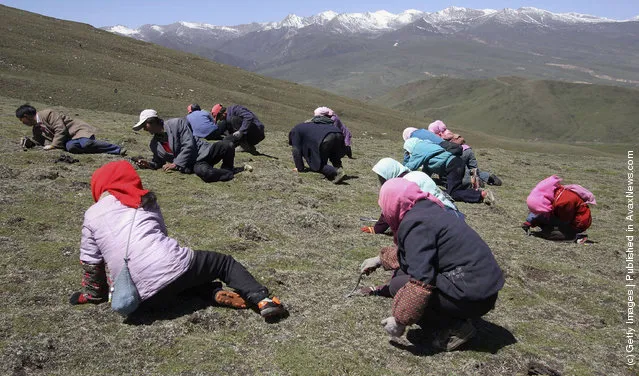
Ophiocordyceps Sinensis A.K.A. Caterpillar Fungus

“There are over 680 documented species of the sac fungus genus Ophiocordyceps, and one of the best known of these is Ophiocordyceps sinensis, colloquially known as caterpillar fungus. The fungus is known in Tibetan as yartsa gunbu or yatsa gunbu. O. sinensis is known in the West as a medicinal mushroom and its use has a long history in Traditional Chinese medicine as well as Traditional Tibetan medicine. The highly valuable fungus-caterpillar combination is hand-collected and is used as an aphrodisiac and as a treatment for a variety of ailments from fatigue to cancer”. – Wikipedia

Photo: Nomads dig for Chinese caterpillar fungus from a mountain May 25, 2007 in Guide County, Hainan Prefecture, Qinghai Province, China. Nomads can earn about 2,000 yuan to 5,000 yuan (about U.S. $260 to $653 ) through their work during the fifty-day Chinese caterpillar fungus gathering season. (Photo by China Photos/Getty Images)
Details
26 Sep 2011 10:47:00