Loading...
Done


“Haile Selassie I (23 July 1892 – 27 August 1975), born Tafari Makonnen, was Ethiopia's regent from 1916 to 1930 and Emperor of Ethiopia from 1930 to 1974. The heir to a dynasty that traced its origins to the 13th century, and from there by tradition back to King Solomon and Queen Makeda, Empress of Axum, known in the Abrahamic tradition as the Queen of Sheba. Haile Selassie is a defining figure in both Ethiopian and African history.

Haile Selassie is revered as the returned Messiah of the Bible, God incarnate, among the Rastafari movement, the number of followers of which is estimated between 200,000 and 800,000. Begun in Jamaica in the 1930s, the Rastafari movement perceives Haile Selassie as a messianic figure who will lead a future golden age of eternal peace, righteousness, and prosperity. He himself remained an Ethiopian Orthodox Christian throughout his life”. – Wikipedia

Photo: Negusa Negasti, Emperor of Ethiopia Haile Selassie I, known as “Lord of Lords”, “The Conquering Lion of the tribe of Judah”, “Light of the world”, “Elect of God”, in full ceremonial regalia following his coronation. (Photo by Hulton Archive/Getty Images)
Details
21 Jun 2011 11:04:00
Fritz Lang, Metropolis

“Friedrich Christian Anton “Fritz” Lang (December 5, 1890 – August 2, 1976) was an Austrian-American filmmaker, screenwriter, and occasional film producer and actor. One of the best known émigrés from Germany's school of Expressionism, he was dubbed the “Master of Darkness” by the British Film Institute. His most famous films are the groundbreaking «Metropolis» (the world's most expensive silent film at the time of its release) and «M», made before he moved to the United States, his iconic precursor to the film noir genre”. – Wikipedia

Photo: Director Fritz Lang (right) and crew members inspect the robot from the film “Metropolis”, which is made to resemble the saintly Maria. (Photo by Hulton Archive/Getty Images). Circa 1926
Details
20 Aug 2011 11:50:00
Tridacna Gigas, or Giant Clams

“The giant clam, Tridacna gigas (known as pā’ua in Cook Islands Māori), is the largest living bivalve mollusc. T. gigas is one of the most endangered clam species. It was mentioned as early as 1825 in scientific reports. One of a number of large clam species native to the shallow coral reefs of the South Pacific and Indian oceans, they can weigh more than 200 kilograms (440 lb) measure as much as 120 cm (47 in) across, and have an average lifespan in the wild of 100 years or more”. – Wikipedia

Photo: Tridacna Gigas, or Giant Clams spew water as a traditional fisherman passes by a small sanctuary on January 23, 2004 near Bolinao in the Northern Philippines. The clams, prime builders for coral reefs and providing shelter for spawning fish and other marine life, are exposed by low tides in the sanctuary. Overfishing and pollution throughout the country are not only threatening food security, but are also starting to choke one of the few working clam sanctuaries in the world. (Photo by David Greedy/Getty Images)
Details
01 Oct 2011 13:10:00
Films that are being screened are advertised in a makeshift cinema located under a bridge in the old quarters of Delhi, India May 25, 2016. (Photo by Cathal McNaughton/Reuters)

Films that are being screened are advertised in a makeshift cinema located under a bridge in the old quarters of Delhi, India May 25, 2016. A makeshift cinema hall under a 140-year-old bridge in the Indian capital is allowing poor rickshaw pullers and migrant labourers to escape daily hardship and sweltering heat into a world of Bollywood song, dance and romance. With the rusty iron floor of the bridge as its ceiling and some old rags acquired on the cheap from a nearby crematorium serving as curtains and floor mats, the cinema shows four films a day. (Photo by Cathal McNaughton/Reuters)
Details
28 May 2016 12:21:00
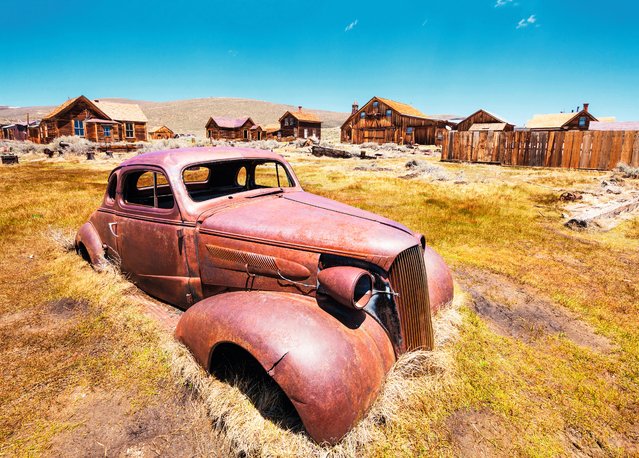
Bodie, Mono County, California. Gold was discovered at Bodie in 1859 (just after the initial California gold rush) and it went from mining camp to boomtown. Its decline began in 1880, when word spread of new boomtowns elsewhere. The Standard Consolidated Mine closed in 1913, and four years later the Bodie Railway was abandoned. By 1940 the population was down to 40. Today, Bodie is maintained in a state of arrested decay as a visitor attraction. (Photo by Alamy Stock Photo)

Kieron Connolly’s new book of photographs of more than 100 once-busy and often elegant buildings gives an idea of how the world might look if humankind disappeared. Here: Bodie, Mono County, California. Gold was discovered at Bodie in 1859 (just after the initial California gold rush) and it went from mining camp to boomtown. Its decline began in 1880, when word spread of new boomtowns elsewhere. The Standard Consolidated Mine closed in 1913, and four years later the Bodie Railway was abandoned. By 1940 the population was down to 40. Today, Bodie is maintained in a state of arrested decay as a visitor attraction. (Photo by Alamy Stock Photo)
Details
07 Sep 2016 09:50:00
The Art Of Clean Up By Ursus Wehrli

Are you one of those people who like to keep everything in order? If you do, you’re going to love the project The Art of Clean Up, created by Ursus Wehrli. This guy will perfectly organize the most unusual of places! Do you hate how unorganized the parking lots are, or how your haphazardly your grandma hangs the laundry to dry in the sun? Welcome to the perfect world where everything is in its rightful place. Every little detail is kept in check; every color is placed where it belongs, just like you love it. Did you ever think that your Christmas tree is not orderly enough? Well, Ursus will take it apart and put it in near little piles. (Photo by Ursus Wehrli)
Details
15 Dec 2014 11:09:00
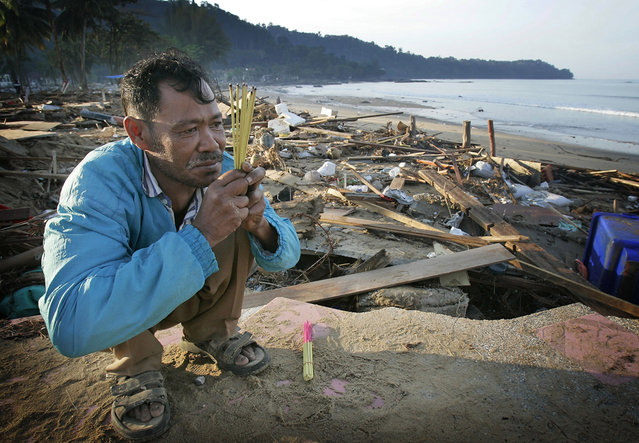
In this December 29, 2004 file photo, Kusol Wetchakul offers prayers for the soul of his sister, at dawn along the beach near Khao Lak, Thailand.  Wetchakul's sister was swept out to sea and believed drowned as she sold goods to tourists on the popular tourist beach just north of Phuket. (Photo by David Longstreath/AP Photo)

In this December 29, 2004 file photo, Kusol Wetchakul offers prayers for the soul of his sister, at dawn along the beach near Khao Lak, Thailand. Wetchakul's sister was swept out to sea and believed drowned as she sold goods to tourists on the popular tourist beach just north of Phuket. Friday marks the 10th anniversary of one of the deadliest natural disasters in world history: a tsunami, triggered by a massive earthquake off the Indonesian coast, leaving more than 230,000 people dead in 14 countries and causing about $10 billion in damage. (Photo by David Longstreath/AP Photo)
Details
26 Dec 2014 15:16:00
Norwegian Trolls By Ivar Rodningen Part 1

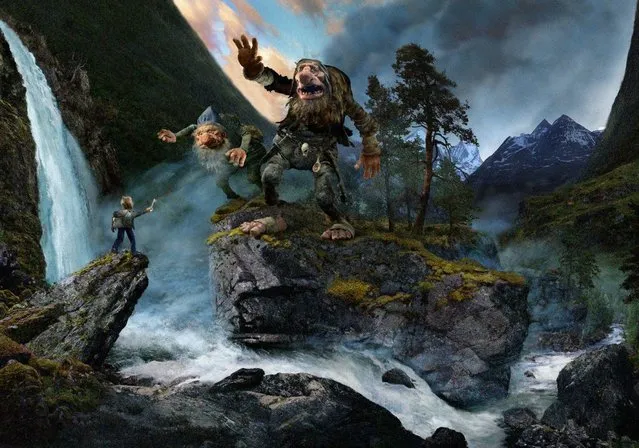
Ivar Rodningem is a professional illustrator, whose imaginative mind transports us into a parallel world where trolls roam the lands. These creatures might seem scary at first sight, but in reality they are very docile and friendly, help each other and humans that they happen to meet. One of their characteristic features is of course their large noses and long tails. They are one with the nature, which is why it is almost impossible to see a troll if he doesn’t want to be found. Just like you and I they love having fun, though it is hard thing to do, considering their size.


See also:Part 2
Details
26 Feb 2015 20:03:00