Loading...
Done


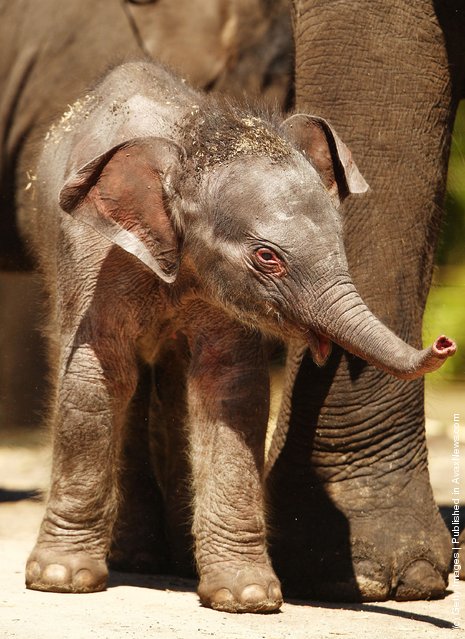
Taronga's first female elephant calf explores the paddock with her mother Pak Boon at Taronga Zoo on November 3, 2010 in Sydney, Australia. The 120kg elephant was born at 1:12am and is Taronga's first female calf and fifth born to The Australian Conservation Management Plan for endangered elephants. The calf will be given a Thai name to reflect the herds' cultural origin. (Photo by Brendon Thorne/Getty Images)
Details
16 Apr 2011 11:01:00


Beyonce Knowles performs at the Glastonbury Festival at Worthy Farm, Pilton on June 26, 2011 in Glastonbury, England. The festival, which started in 1970 when several hundred hippies paid 1 GBP to watch Marc Bolan, has grown into Europe's largest music festival attracting more than 175,000 people over five days. (Photo by Dave Hogan/Getty Images)
Details
28 Jun 2011 11:02:00
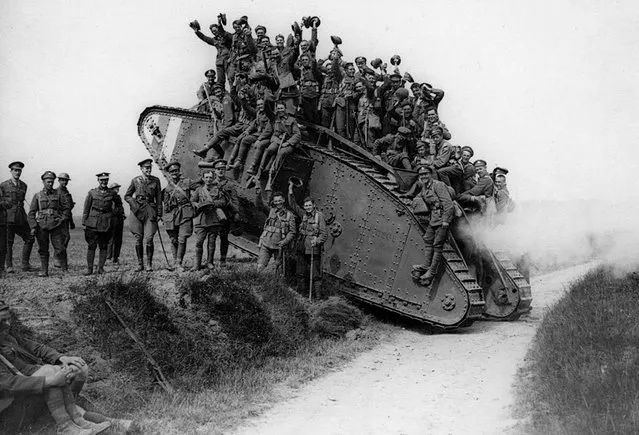
These black-and-white photos are taken from the new book “Armoured Warfare in the First World War 1916 – 1918” by Anthony Tucker-Jones and published by Pen & Sword Military. “Interestingly the British, French and Germans took completely different approaches with varying results”. The British military produced “Little Willie” in Autumn 1915 weighing 18 tonnes, which had a crew of two plus four gunners. “Inspired by a tracked artillery tractor “Little Willie” was referred to as a water tank – hence the name tank – to ensure secrecy”, said Anthony. “This led to the strange looking Mark I with its peculiar rhomboid shape, designed to cross trenches with guns in sponsons on either side. The Germans saw the tank as unchivalrous and were slow to grasp its utility. They favoured the Stormtrooper (specialist soldiers used to infiltrate enemy trenches) and artillery, not the tank”, said Anthony. “However, they didn’t hesitate to make use of captured British tanks. Although the tank helped secure victory and German soldiers dubbed it “Germany’s Downfall” the country was ultimately brought to its knees by the Allies blockade”. Here: British troops hitch a ride on a Mark IV after the massed tank fleet spearheading attack at Cambrai on November 20, 1917. (Photo by Anthony Tucker-Jones/Mediadrumworld.com)

These black-and-white photos are taken from the new book “Armoured Warfare in the First World War 1916 – 1918” by Anthony Tucker-Jones and published by Pen & Sword Military. Here: British troops hitch a ride on a Mark IV after the massed tank fleet spearheading attack at Cambrai on November 20, 1917. (Photo by Anthony Tucker-Jones/Mediadrumworld.com)
Details
23 Feb 2017 00:02:00
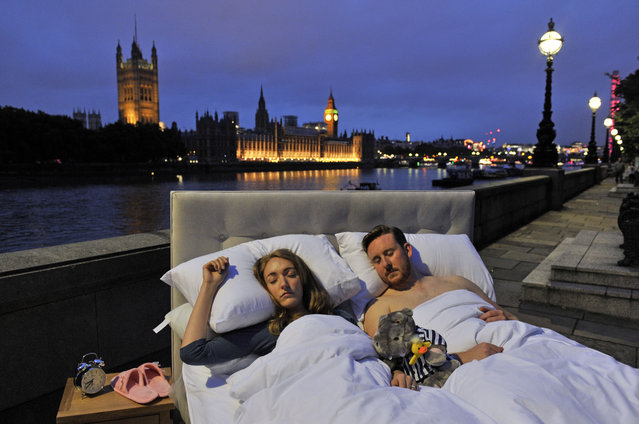
Londoners enjoy a “Silent Night” as Big Ben falls silent, London, UK on August 21, 2017. Londoners snuggle up to enjoy the city's first silent night as Big Ben chimed its last for four years. As the sun set over London last night the city bid a temporary farewell to the chimes of its beloved Big Ben. Londoners were testing out the new quiet of the Southbank in an unusual fashion. A luxurious bed, courtesy of bed firm, Silentnight, complete with fluffy white duvet, plump pillows, a hot water bottle and a cuddly toy, emerged in the heart of the city, just in time for bed. It didn't take local residents and workers long to make the most of the peace and quiet with the city's tired workers climbing in for a nap. Rose Allerston from Clapham, London said “After a stressful day in the office, I couldn't think of anything better than going home and climbing into bed - but when I saw this bed opposite Big Ben I just couldn't resist getting in for a snuggle”. (Photo by Imagewise Ltd/Rex Features/Shutterstock)

Londoners enjoy a “Silent Night” as Big Ben falls silent, London, UK on August 21, 2017. ose Allerston from Clapham, London said “After a stressful day in the office, I couldn't think of anything better than going home and climbing into bed – but when I saw this bed opposite Big Ben I just couldn't resist getting in for a snuggle”. (Photo by Imagewise Ltd/Rex Features/Shutterstock)
Details
23 Aug 2017 08:44:00
A military police officer patrols in the Roquette Pinto shantytown, part of the Mare slum complex in Rio de Janeiro, Brazil, Wednesday, April 1, 2015. The Brazilian army has begun to pull out of one of Rio de Janeiro's most violent slums, with police assuming responsibility for security in the area. (Photo by Felipe Dana/AP Photo)

A military police officer patrols in the Roquette Pinto shantytown, part of the Mare slum complex in Rio de Janeiro, Brazil, Wednesday, April 1, 2015. The Brazilian army has begun to pull out of one of Rio de Janeiro's most violent slums, with police assuming responsibility for security in the area. (Photo by Felipe Dana/AP Photo)
Details
02 Apr 2015 12:26:00
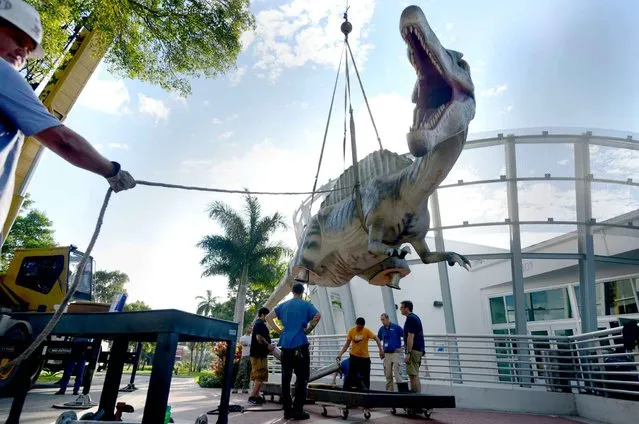
Workers from the South Florida Science Center and Aquarium and Imagine Exhibitions put together an animatronic spinosaurus outside the science center in West Palm Beach, Fla., Tuesday, October 27, 2015. The giant spinosaurus is part of the Dinosaurs Around the World exhibit, set to open on Nov. 1. (Photo by Maria Lorenzino/South Florida Sun-Sentinel via AP Photo)

Workers from the South Florida Science Center and Aquarium and Imagine Exhibitions put together an animatronic spinosaurus outside the science center in West Palm Beach, Fla., Tuesday, October 27, 2015. The giant spinosaurus is part of the Dinosaurs Around the World exhibit, set to open on November 1. (Photo by Maria Lorenzino/South Florida Sun-Sentinel via AP Photo)
Details
29 Oct 2015 08:07:00
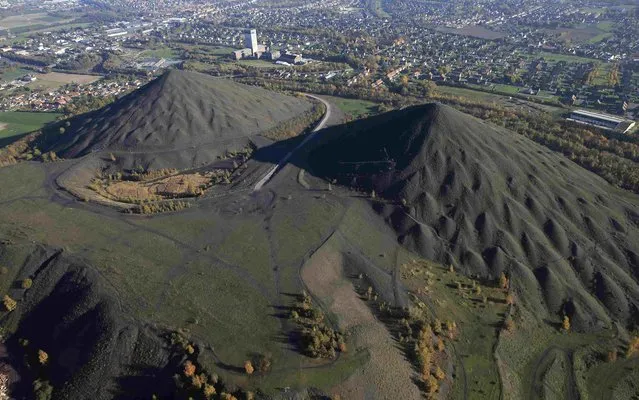
An aerial view shows the 11/19 pit and twin slag heaps at the former coal mine site in Loos-en-Gohelle, northern France, November 1, 2015. Loos-en-Gohelle, a town of 7000 inhabitants in the North of France, marked by the closure of coal mines in 1970, has demonstrated a successful transition from coal to a green economy. (Photo by Pascal Rossignol/Reuters)

An aerial view shows the 11/19 pit and twin slag heaps at the former coal mine site in Loos-en-Gohelle, northern France, November 1, 2015. Loos-en-Gohelle, a town of 7000 inhabitants in the North of France, marked by the closure of coal mines in 1970, has demonstrated a successful transition from coal to a green economy. (Photo by Pascal Rossignol/Reuters)
Details
07 Nov 2015 08:01:00
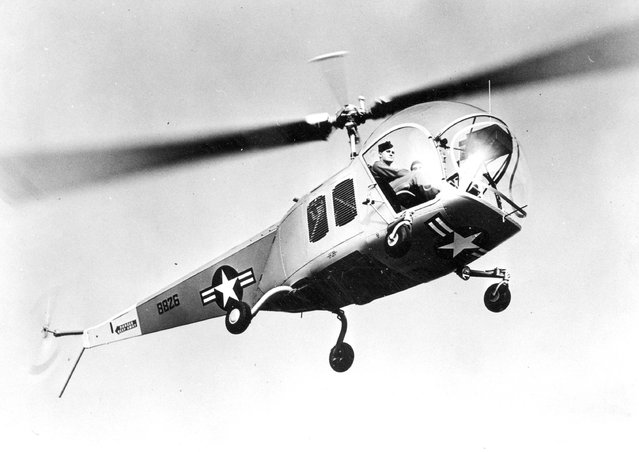
Number 10. BELL H-13 SIOUX was a two-bladed, single engine, light helicopter built by Bell Helicopter. Westland Aircraft manufactured the Sioux under license for the British military as the Sioux AH.1 and HT. (Photo by AP Photo)

Number 10. BELL H-13 SIOUX was a two-bladed, single engine, light helicopter built by Bell Helicopter. Westland Aircraft manufactured the Sioux under license for the British military as the Sioux AH.1 and HT. In 1947, the United States Air Force ordered the improved Bell Model 47A. Most were designated YR-13 and three winterized versions were designated YR-13A. The United States Army first ordered Bell 47s in 1948 under the designation H-13. These would later receive the name Sioux. The Bell-built H-13 B is seen airborne in this April 29, 1951 photo. The helicopter is equipped with a 173 horsepower engine, cruises at 85 miles per hour, climbs 900 feet in a minute and has a service ceiling of 11,500 feet. (Photo by AP Photo)
Details
08 Aug 2014 11:59:00