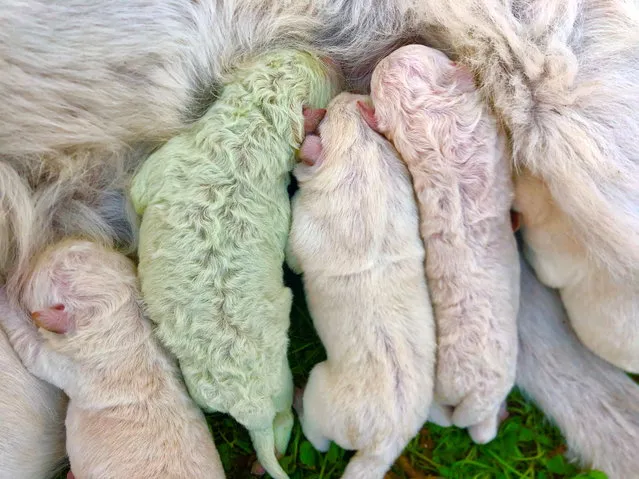
Pistachio, a puppy who was born with green fur, is seen on the day he was born on a farm on the island of Sardinia, in Pattada, Italy, October 9, 2020. (Photo by Cristian Mallocci/Handout via Reuters)
A Sphynx cat stares sitting on its owner's lap during an international feline beauty competition in Bucharest, Romania, Saturday, April 14, 2018. More than 250 cats take part in the two-day competition in the Romanian capital. (Photo by Vadim Ghirda/AP Photo)
A girl carries her sibling as she walks through stranded flood water, following rains and floods during the monsoon season in Nowshera, Pakistan on September 4, 2022. (Photo by Fayaz Aziz/Reuters)
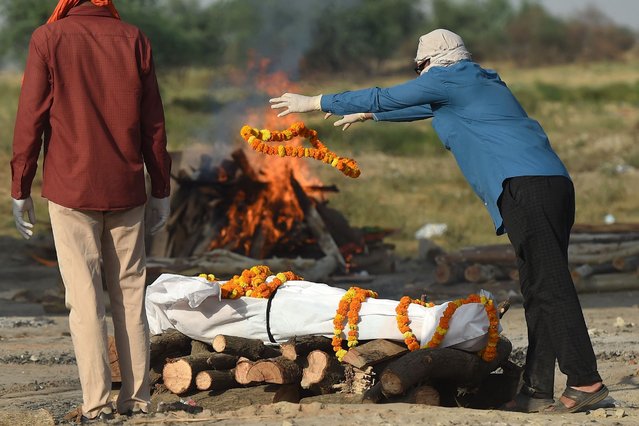
Relatives perform the last rites before the cremation of their loved one who died due to the Covid-19 coronavirus at a cremation ground in Allahabad on May 4, 2021. (Photo by Sanjay Kanojia/AFP Photo)
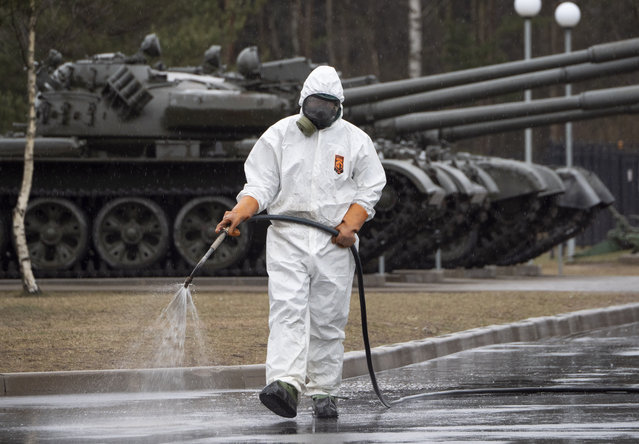
A specialist from a local veterinary service wears a protective suit as sprays disinfectant near Russian tanks displayed at area near Proryv (The Breakthrough) museum dedicated to the breakthrough of the Siege of Leningrad during World WarII near Kirovsk, about 30 kilometres (19 miles) east of St.Petersburg, Russia, Thursday, April 2, 2020. (Photo by Dmitri Lovetsky/AP Photo)
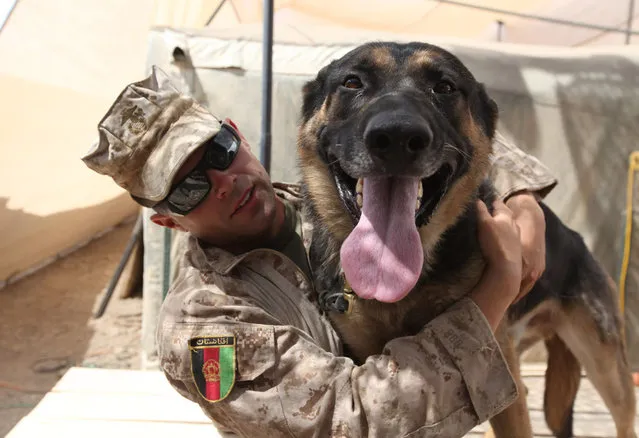
Throughout the course of the long war in Afghanistan, Coalition troops have relied on thousands of military working dogs to help keep them safe, and make their jobs easier. The dogs are trained to detect explosives, to find illegal drugs, to search for missing comrades, or target enemy combatants. Not only are they active on the front lines, but behind the lines they serve as therapy dogs, service dogs, and loyal companions. They also share the same risks as the ground troops, suffering injuries and sometimes death on the battlefields. Gathered here are images of these dogs and their handlers in Afghanistan and back home, from over the past several years, part of the ongoing series here on Afghanistan.
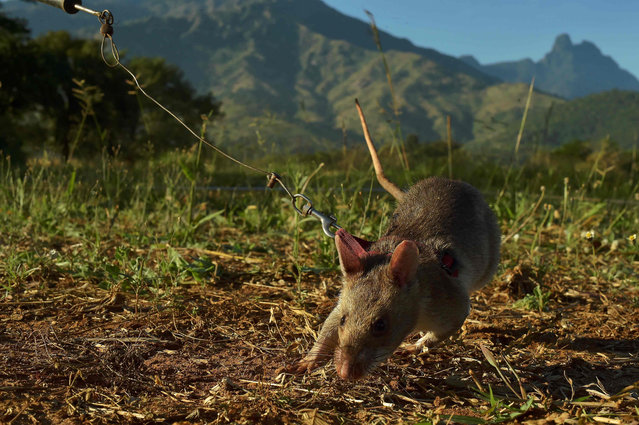
An African giant pouched rat sniffs for traces of landmine explosives at APOPO's training facility in Morogoro on June 17, 2016. APOPO trains the rats to detect both tuberculosis and landmines at its facility. Every year landmines kill or maim thousands of people worldwide. The trained rats sniff for explosive and so are able to detect the presence of landmines far faster than conventional methods which involve metal detection. (Photo by Carl De Souza/AFP Photo)
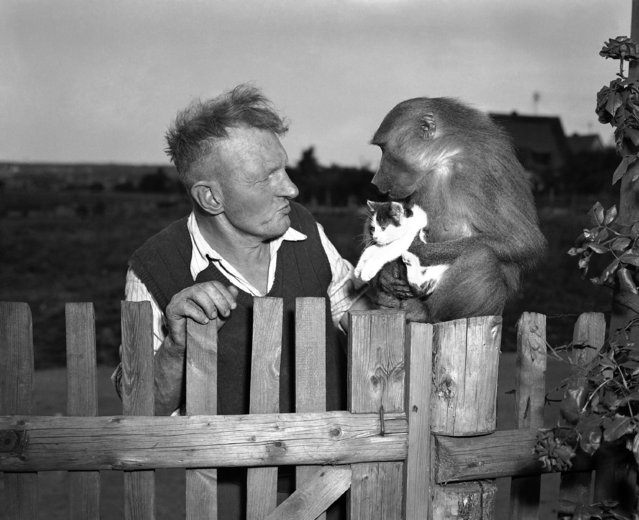
Leonhard Nienbling is shown with his 6-month old pet baboon Jackl, who holds a 6-month old kitten, its playmate, June 29, 1952. Niebling has quite an animal collection at his home in Zirndorf, Germany. (Photo by Heinrich Sanden/AP Photo)