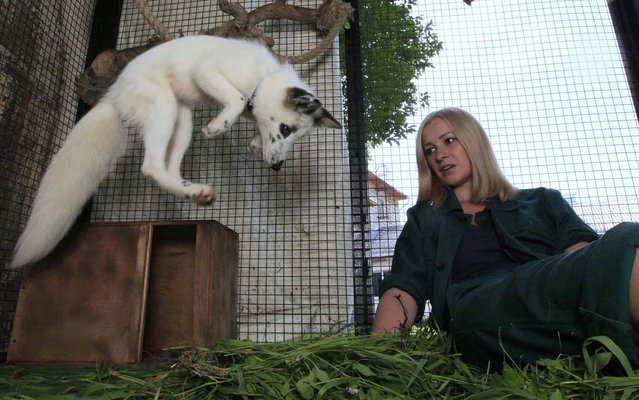
A four-month-old snow fox cub named “Vesna” (“Spring”) leaps next to a Zoo employee at the Royev Ruchey Zoo in Krasnoyarsk, Russia, on August 6, 2013. (Photo by Ilya Naymushin/Reuters)
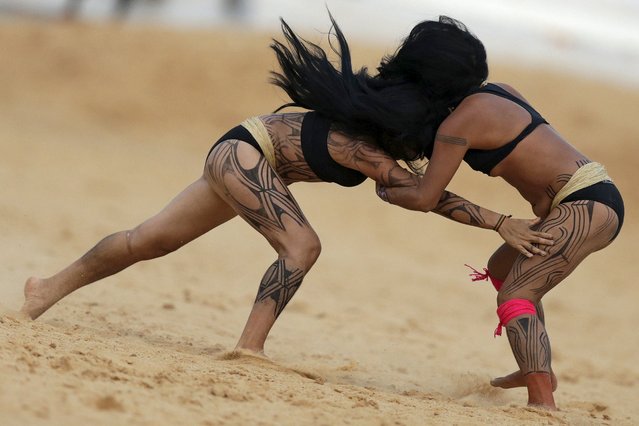
Indigenous women from the Kamayura tribe take part in a demonstration of Huka Huka fight at the first World Games for Indigenous Peoples in Palmas, Brazil, October 29, 2015. (Photo by Ueslei Marcelino/Reuters)
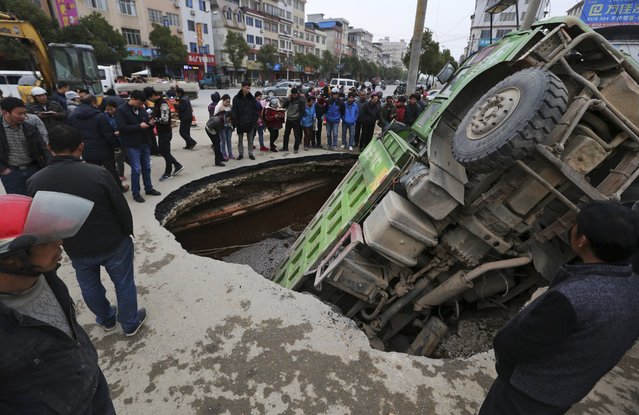
People look at a loaded truck that got stuck in a sinkhole on a road in Guilin, Guangxi Zhuang Autonomous Region, January 7, 2015. No injury was reported, according to local media. (Photo by Reuters/Stringer)
A medical worker wearing a full protective outfit tests a man for Covid-19 symptoms in a street in Wuhan, China, 01 April 2020. Wuhan, the epicenter of the coronavirus outbreak, partly lifted the lockdown allowing people to enter the city after more than two months. According to Chinese government figures over 2,500 people have died of Covid-19 in Wuhan since the outbreak began. (Photo by Roman Pilipey/EPA/EFE)
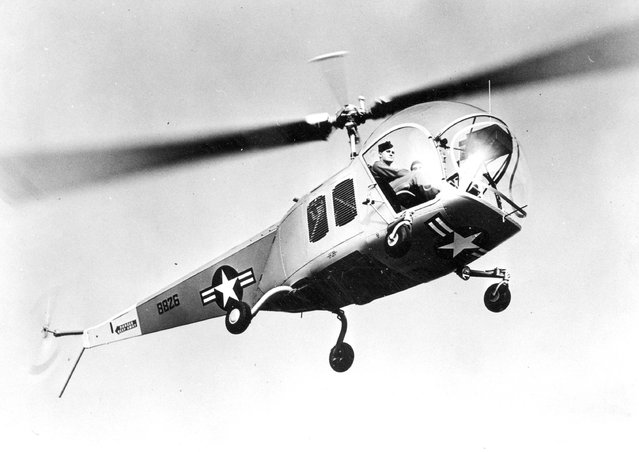
Number 10. BELL H-13 SIOUX was a two-bladed, single engine, light helicopter built by Bell Helicopter. Westland Aircraft manufactured the Sioux under license for the British military as the Sioux AH.1 and HT. In 1947, the United States Air Force ordered the improved Bell Model 47A. Most were designated YR-13 and three winterized versions were designated YR-13A. The United States Army first ordered Bell 47s in 1948 under the designation H-13. These would later receive the name Sioux. The Bell-built H-13 B is seen airborne in this April 29, 1951 photo. The helicopter is equipped with a 173 horsepower engine, cruises at 85 miles per hour, climbs 900 feet in a minute and has a service ceiling of 11,500 feet. (Photo by AP Photo)
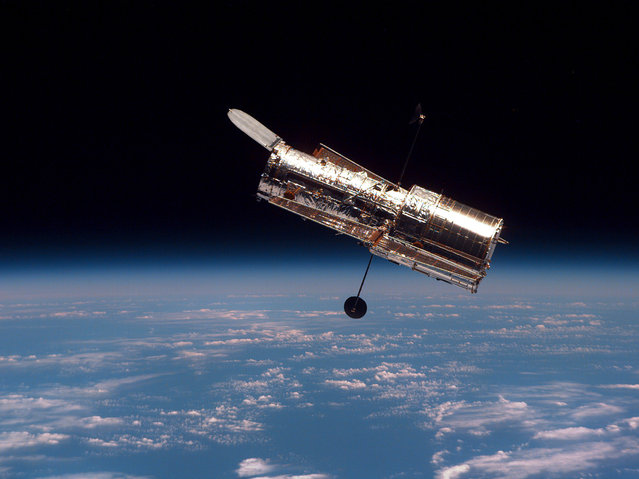
The Hubble Space Telescope is shown following its release from the space shuttle Discovery Wednesday, February 19, 1997. The Hubble Space Telescope, one of NASA'S crowning glories, marks its 25th anniversary on Friday, April 24, 2015. With more than 1 million observations, including those of the farthest and oldest galaxies ever beholden by humanity, no man-made satellite has touched as many minds or hearts as Hubble. (Photo by AP Photo/NASA)