Loading...
Done
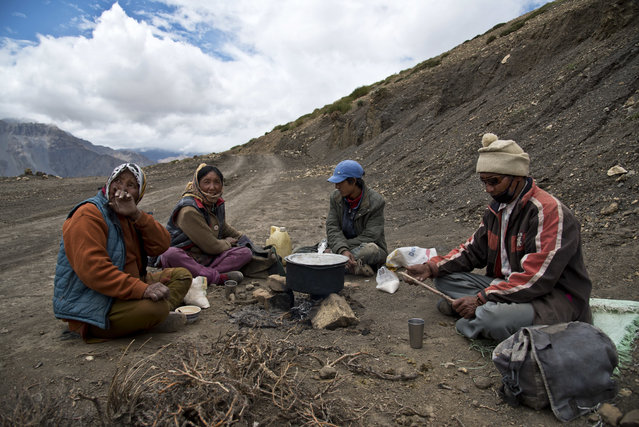
In this August 17, 2016, photo, from left to right, Chhering Chodom, 60, Tashi Yangzom, 50, Lobsang Chhering, 27, and Dorje Tandup, 58, drink milk tea on the side of the road. For centuries, the sleepy valley nestled in the Indian Himalayas remained a hidden Buddhist enclave forbidden to outsiders. Enduring the harsh year-round conditions of the high mountain desert, the people of Spiti Valley lived by a simple communal code – share the Earth's bounty, be hospitable to neighbors, and eschew greed and temptation at all turns. That's all starting to change, for better or worse. Since India began allowing its own citizens as well as outsiders to visit the valley in the early 1990s, tourism and trade have boomed. And the marks of modernization, such as solar panels, asphalt roads and concrete buildings, have begun to appear around some of the villages that dot the remote landscape at altitudes above 4,000 meters (13,000 feet). (Photo by Thomas Cytrynowicz/AP Photo)

In this August 17, 2016, photo, from left to right, Chhering Chodom, 60, Tashi Yangzom, 50, Lobsang Chhering, 27, and Dorje Tandup, 58, drink milk tea on the side of the road. For centuries, the sleepy valley nestled in the Indian Himalayas remained a hidden Buddhist enclave forbidden to outsiders. Enduring the harsh year-round conditions of the high mountain desert, the people of Spiti Valley lived by a simple communal code – share the Earth's bounty, be hospitable to neighbors, and eschew greed and temptation at all turns. That's all starting to change, for better or worse. (Photo by Thomas Cytrynowicz/AP Photo)
Details
15 Sep 2016 09:22:00
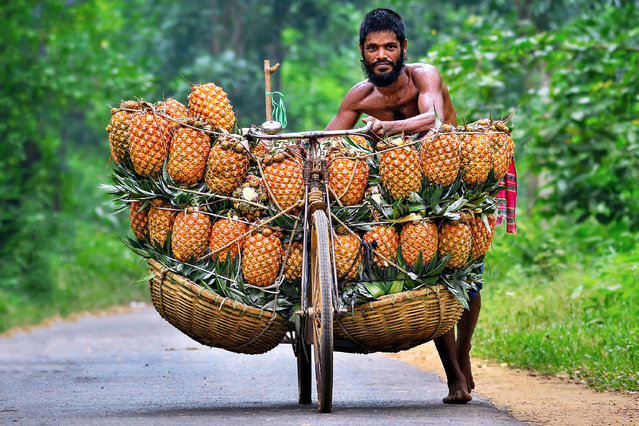
Cyclists desperately try to keep their heavily-laden bicycles upright as they arrive at a market with baskets full of pineapples on August 23, 2018. The men travel up to 12 and a half miles with two baskets tied to the sides of their bikes, carrying between 50 and 100 pineapples to sell. Each of the bicycles is so heavily laden with fruit it is impossible for the men to actually ride their bikes, instead having to walk alongside them. When they arrive at the market place in Madhupur, Bangladesh, buyers will pay up to 30 Taka for a pineapple – the equivalent of around 28 pence. (Photo by Abdul Momin/Solent News & Photo Agency UK)

Cyclists desperately try to keep their heavily-laden bicycles upright as they arrive at a market with baskets full of pineapples on August 23, 2018. The men travel up to 12 and a half miles with two baskets tied to the sides of their bikes, carrying between 50 and 100 pineapples to sell. Each of the bicycles is so heavily laden with fruit it is impossible for the men to actually ride their bikes, instead having to walk alongside them. When they arrive at the market place in Madhupur, Bangladesh, buyers will pay up to 30 Taka for a pineapple – the equivalent of around 28 pence. (Photo by Abdul Momin/Solent News & Photo Agency UK)
Details
21 Sep 2018 00:03:00
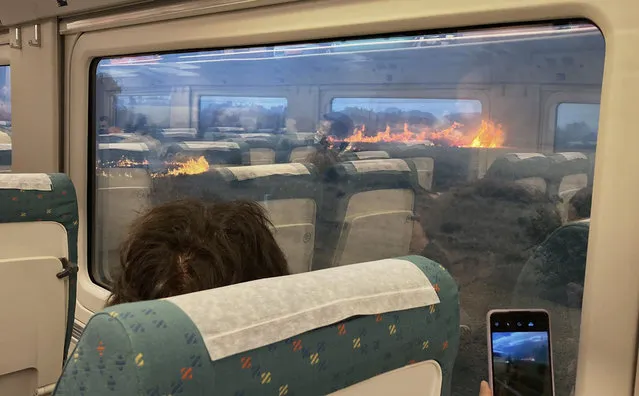
Passengers take photos at a wildfire while traveling on a train in Zamora, Spain, Monday, July 18, 2022. When Francisco Seoane's train unexpectedly stopped in Spanish countryside that was being engulfed by a wildfire, he and other passengers got a fright when they looked out at flames encroaching on both sides of the track. The Spaniard told The Associated Press it was scary to see how quickly the fire spread. Video of the unscheduled – and unnerving – stop shows about a dozen passengers in Seoane's railcar appearing alarmed as they look out of the windows Monday. (Photo by Francisco Seoane Perez/AP Photo)

Passengers take photos at a wildfire while traveling on a train in Zamora, Spain, Monday, July 18, 2022. When Francisco Seoane's train unexpectedly stopped in Spanish countryside that was being engulfed by a wildfire, he and other passengers got a fright when they looked out at flames encroaching on both sides of the track. The Spaniard told The Associated Press it was scary to see how quickly the fire spread. Video of the unscheduled – and unnerving – stop shows about a dozen passengers in Seoane's railcar appearing alarmed as they look out of the windows Monday. (Photo by Francisco Seoane Perez/AP Photo)
Details
19 Jul 2022 05:05:00
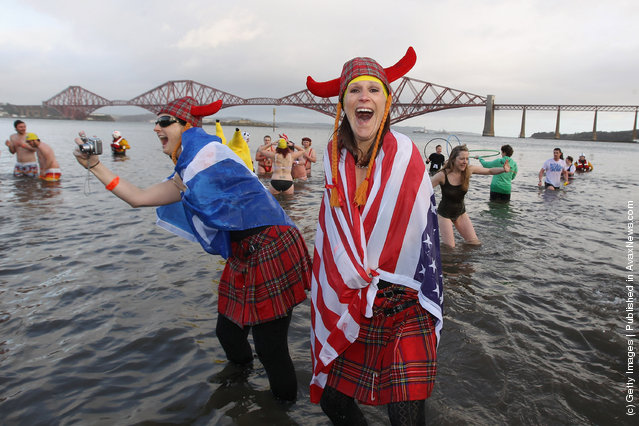
New Year revellers, many in fancy dress, braved freezing conditions in the River Forth in front of the Forth Rail Bridge during the annual Loony Dook Swim

Over 1000 New Year revellers, many in fancy dress, braved freezing conditions in the River Forth in front of the Forth Rail Bridge during the annual Loony Dook Swim on January 1, 2012 in South Queensferry, Scotland. Thousands of people gathered last night to see in the New Year at Hogmanay celebrations in towns and cities across Scotland. (Photo by Jeff J. Mitchell/Getty Images)
Details
02 Jan 2012 12:00:00
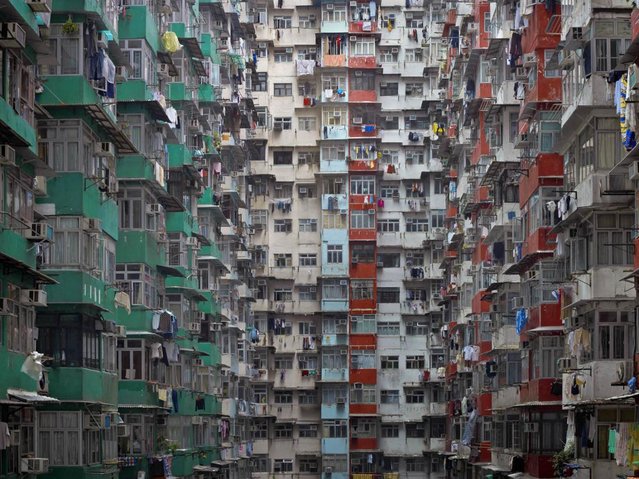
Hong Kong By Michael Wolf

The focus of the german photographer michael wolf's work is life in mega cities. Many of his projects document the architecture and the vernacular culture of metropolises. Wolf grew up in Canada, Europe and the United States, studying at UC Berkeley and at the Folkwang School with Otto Steinert in Essen, Germany. He moved to Hong Kong in 1994 where he worked for 8 years as contract photographer for Stern magazine. Since 2001, Wolf has been focusing on his own projects, many of which have been published as books.
Details
23 Jan 2013 12:02:00
A member of the “Avocadoo” club performs a pole dance on a street sign pole in Lodz, central Poland on June 27, 2013. Talk about a traffic stopper: three pole dancers in central Poland have been honing their skills out in the streets, throwing their legs around signposts to the surprise and delight of many a passerby. (Photo by Janek Skarzynski/AFP Photo)

A member of the “Avocadoo” club performs a pole dance on a street sign pole in Lodz, central Poland on June 27, 2013. Talk about a traffic stopper: three pole dancers in central Poland have been honing their skills out in the streets, throwing their legs around signposts to the surprise and delight of many a passerby. (Photo by Janek Skarzynski/AFP Photo)
Details
05 Sep 2013 07:06:00
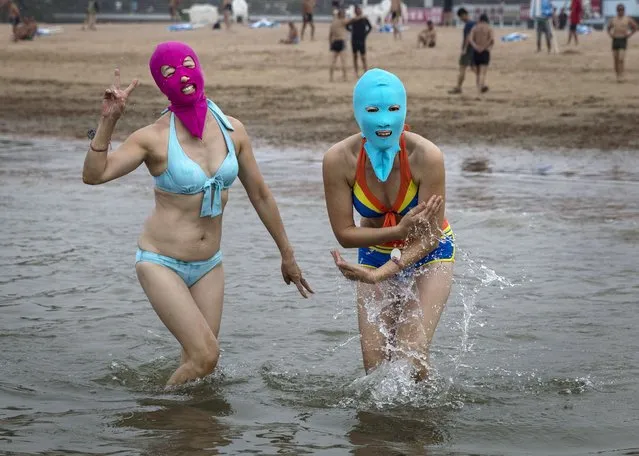
Chinese women wear face-kinis as they walk in to the water to swim at the beach on August 20, 2014 in the Yellow Sea in Qingdao, China. The locally designed mask is worn by many local women to protect them from jellyfish stings, algae and the sun's ultraviolet rays. (Photo by Kevin Frayer/Getty Images)

Chinese women wear face-kinis as they walk in to the water to swim at the beach on August 20, 2014 in the Yellow Sea in Qingdao, China. The locally designed mask is worn by many local women to protect them from jellyfish stings, algae and the sun's ultraviolet rays. (Photo by Kevin Frayer/Getty Images)
Details
28 Aug 2014 11:08:00


For a long time the laws of Canada have explicitly banned gambling in any form. This may be the reason why the country does not have so many gambling establishments as the USA - but their quality surely makes up for the quantity. The first Canadian casino was opened in Dawson City, Yukon, in 1972 - it was the first one after gambling has been banned in the country in 1892. The Diamond Tooth Gertie's Gambling Casino did not operate for long, though. The first permanent commercial casino was opened in 1989, and it was the first of many - there are currently 75 casinos operating on Canadian soil.
Details
16 Sep 2014 12:19:00