Loading...
Done
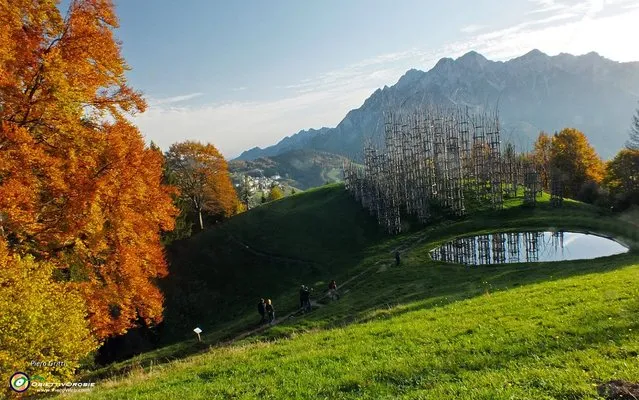
Cathedral Made From Trees By Giuliano Mauri

Italian artist Guiliano Mauri is the father of this spectacular Cattedrale Vegetale (Tree Cathedral), a unique building created out of rows of real living trees. Located at the foot of Mount Arera on the outskirts of Bergamo in Northern Italy, the cathedral is an ever-changing building that will be fully formed over the course of decades – when the trees outgrow their supporting columns and become a piece of natural architecture.
Details
02 Mar 2015 15:31:00
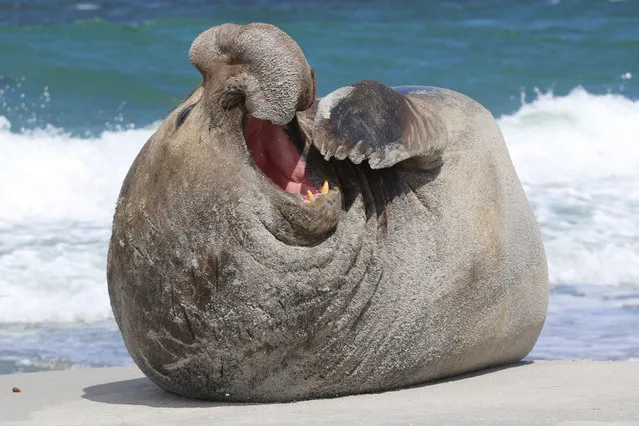
Elephant Seal. (Photo by David Crocker/Caters News Agency)

These hilarious photos show some of nature’s mightiest animals — yawning away! (Actually – not always; AvaxNews). The images were taken by photographers across the world, from the African savannas to the Pacific Ocean. Here: Elephant Seal. (Photo by David Crocker/Caters News Agency)
Details
20 Sep 2019 00:01:00
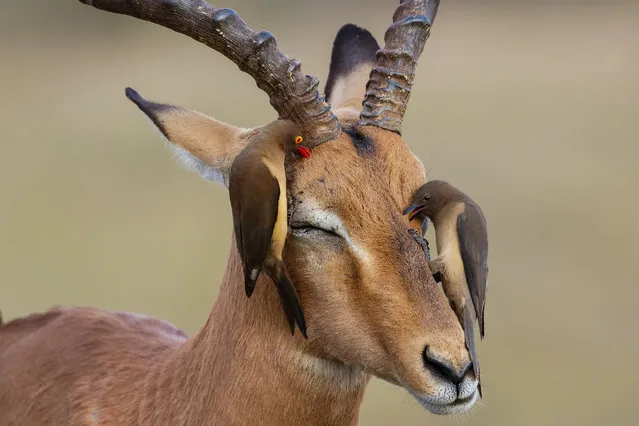
Red-billed oxpecker on an impala, Kruger National Park, South Africa. (Photo by Edmund Aylmer/BPOTY/Cover Images/The Guardian)

The shortlist for the coveted Bird Photographer of the Year awards has been announced by Nature Photographers and the British Trust for Ornithology. Here: Red-billed oxpecker on an impala, Kruger National Park, South Africa. (Photo by Edmund Aylmer/BPOTY/Cover Images/The Guardian)
Details
13 Mar 2018 00:05:00
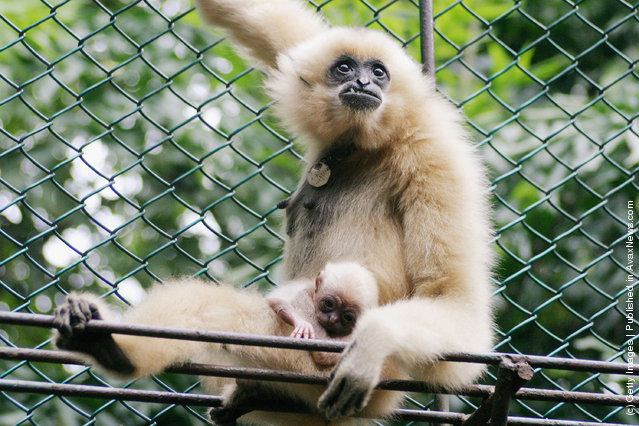
Newborn White-Cheeked Gibbon Nomascus

“Nomascus is the second most speciose genus of gibbons (family Hylobatidae). Originally this genus was a subgenus of Hylobates, and all individuals were considered one species, Hylobates concolor. Species within Nomascus are characterized by 52 chromosomes. Some species are all black, some light with a distinct black tuft of crown fur, and some by distinct, light-colored cheek patches. Nomascus is found from southern China (Yunnan) to southern Vietnam, and also on Hainan Island. One of the genus' species, Nomascus nasutus, has been deemed “the most critically endangered ape species in the world”. All of the species in this genus are endangered or critically endangered”. – Wikipedia

Photo: A newborn White-Cheeked Gibbon clings to its mother in the Nanning Zoo on April 12, 2004 in Nanning, Guangxi province, China. The White-Cheeked Gibbon's natural habitat is Southern China as well as Vietnam and Laos. They are classified as highly endangered and are on the brink of extinction due to poaching and reduction of natural rainforests. (Photo by Getty Images)

Details
12 Aug 2011 11:51:00
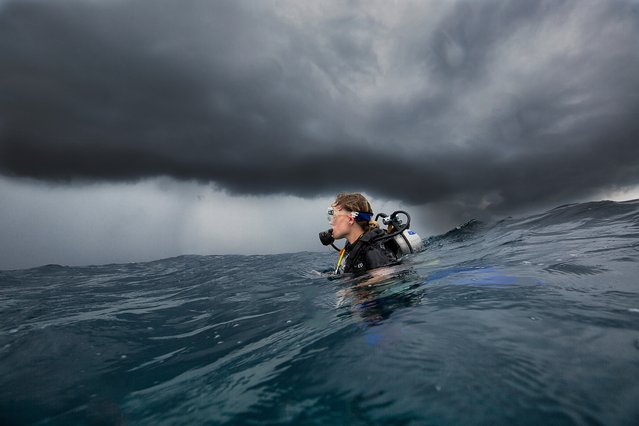
Winner. “This was taken in the South Ari Atolls, Maldives, as the south-west monsoon season was setting in. It features my partner – and dive buddy – Emma after surfacing at the end of the last dive of the day to find 1.5 metre swells and dark monsoon clouds. MICK RYAN, JUDGE: This beautiful portrait of a diver in an ocean swell below a menacing sky stands out this month for its emotional and elemental beauty. It is a reminder that while we may play among nature we are always dwarfed by its power and must be constantly on our guard”. (Photo by Simon Dunn/The Guardian)

Winner. “This was taken in the South Ari Atolls, Maldives, as the south-west monsoon season was setting in. It features my partner – and dive buddy – Emma after surfacing at the end of the last dive of the day to find 1.5 metre swells and dark monsoon clouds. MICK RYAN, JUDGE: This beautiful portrait of a diver in an ocean swell below a menacing sky stands out this month for its emotional and elemental beauty. It is a reminder that while we may play among nature we are always dwarfed by its power and must be constantly on our guard”. (Photo by Simon Dunn/The Guardian)
Details
04 Oct 2016 10:55:00
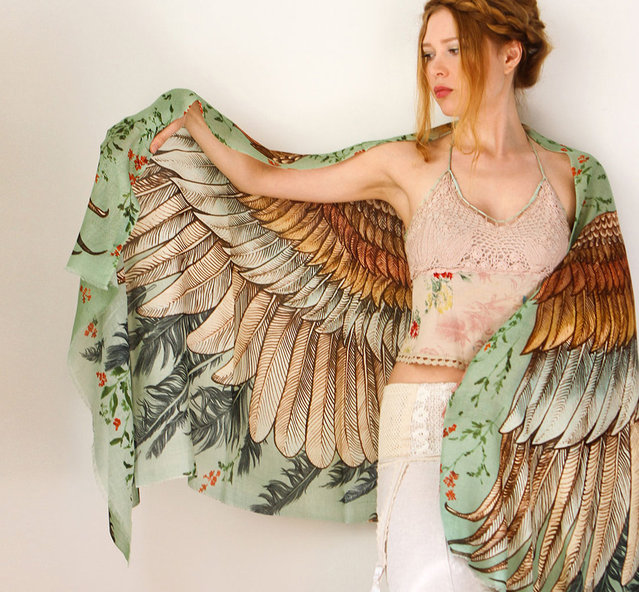
Shovava Wing Scarves By Roza Khamitova

Roza Khamitova was born into a family of artists in Kazakhstan. After finishing design school in Manhattan, New York, she was working in fashion industry for about 8 years. As a visual artist Roza had always drawn most of her inspiration from the natural world around her in the mountains of Kazakhstan. In 2011 she launched Shovava, her personal line of women’s clothing based on her hand drawn paintings and prints of the animals, plants and patterns found in nature. Roza was enchanted by the beauty of wings, its structure and symbolism. First, she sketches big wide-spread wings on paper with a light pencil, adds black ink to create a three-dimensional feel and fills with stunning watercolors.
Details
06 Dec 2015 10:42:00
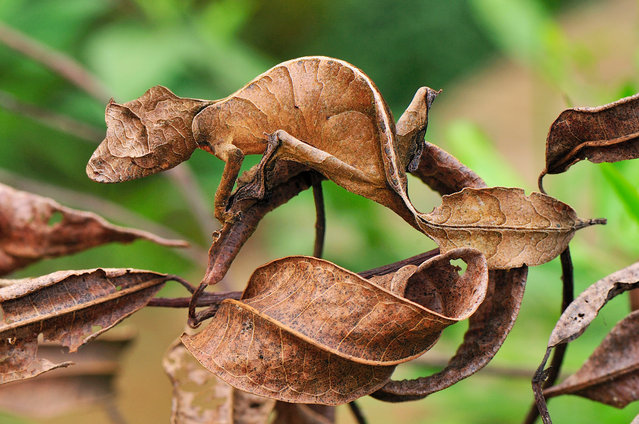
Is it a leaf? Is it tree bark? No, it’s the Satanic leaf-tailed gecko. Cleverly disguised as a rotting leaf, Madagascar’s camouflage king has red eyes, pointy horns and a taste for night hunting: it’s nature’s most devilish deceiver. (Photo by Thomas Marent/ARDEA)

Is it a leaf? Is it tree bark? No, it’s the Satanic leaf-tailed gecko. Cleverly disguised as a rotting leaf, Madagascar’s camouflage king has red eyes, pointy horns and a taste for night hunting: it’s nature’s most devilish deceiver. The twisted body and veiny skin echo the detail of a dry leaf, which ensures the gecko blends in with its forest home. The mottled tail appears to have sections missing, as though it has withered over time. This mini-monster epitomises survival of the fittest, having adapted gradually to become today’s extraordinary leaf impersonator. (Photo by Thomas Marent/ARDEA)
Details
20 Nov 2015 08:03:00
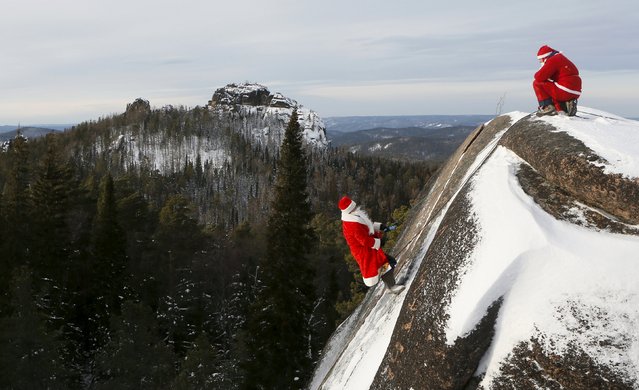
A member of the “Sibspas” Siberian search and rescue group dressed as Santa Claus (R), waits for his team mate, dressed as Father Frost, the Russian equivalent of Santa Claus, as he climbs the rock named “The Fourth Stolb” (the Fourth Pillar) at the Stolby national nature reserve during a training session of the Russian Emergencies Ministry, outside the Siberian city of Krasnoyarsk, Russia December 15, 2015. (Photo by Ilya Naymushin/Reuters)

A member of the “Sibspas” Siberian search and rescue group dressed as Santa Claus (R), waits for his team mate, dressed as Father Frost, the Russian equivalent of Santa Claus, as he climbs the rock named “The Fourth Stolb” (the Fourth Pillar) at the Stolby national nature reserve during a training session of the Russian Emergencies Ministry, outside the Siberian city of Krasnoyarsk, Russia December 15, 2015. (Photo by Ilya Naymushin/Reuters)
Details
16 Dec 2015 12:32:00