Loading...
Done
A woman shows her inked finger after casting her ballot to vote in the first phase of India's general election at a polling station in Kalamati village, Dinhata district of Cooch Behar in the country's West Bengal state on April 19, 2024. (Photo by Dibyangshu Sarkar/AFP Photo)

A woman shows her inked finger after casting her ballot to vote in the first phase of India's general election at a polling station in Kalamati village, Dinhata district of Cooch Behar in the country's West Bengal state on April 19, 2024. (Photo by Dibyangshu Sarkar/AFP Photo)
Details
05 May 2024 04:21:00
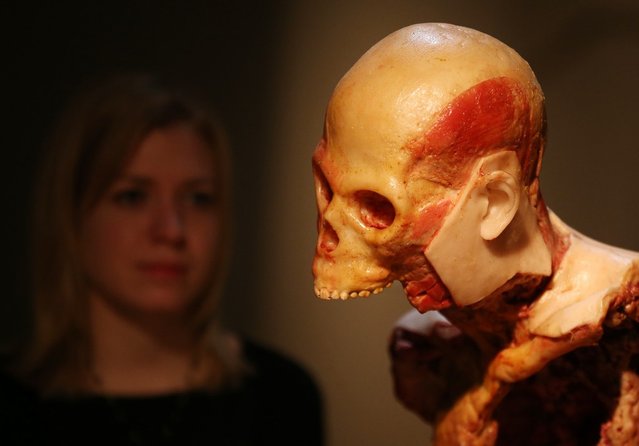
An artwork entitled 'Are you still mad at me ?' by John Isaacs is displayed at the Death: A Self-portrait exhibition at the Wellcome Collection on November 14, 2012 in London, England. The exhibition showcases 300 works from a unique collection by Richard Harris, a former antique print dealer from Chicago, devoted to the iconography of death. The display highlights art works, historical artifacts, anatomical illustrations and ephemera from around the world and opens on November 15, 2012 until February 24, 2013.  (Photo by Peter Macdiarmid)

An artwork entitled “Are you still mad at me?” by John Isaacs is displayed at the Death: A Self-portrait exhibition at the Wellcome Collection on November 14, 2012 in London, England. The exhibition showcases 300 works from a unique collection by Richard Harris, a former antique print dealer from Chicago, devoted to the iconography of death. The display highlights art works, historical artifacts, anatomical illustrations and ephemera from around the world and opens on November 15, 2012 until February 24, 2013. (Photo by Peter Macdiarmid)
Details
15 Nov 2012 09:41:00
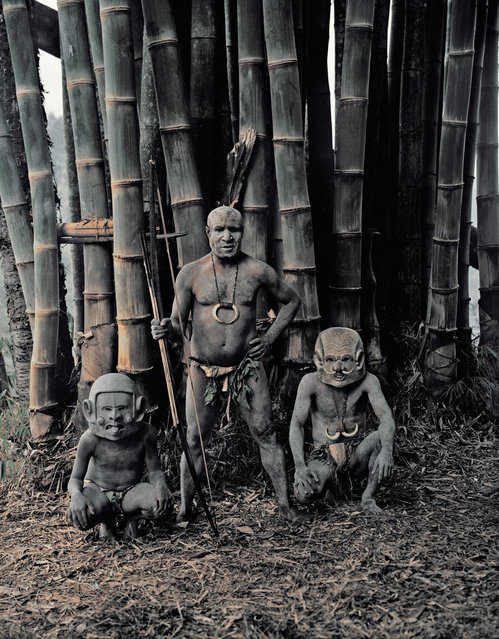
“Asaro from the Eastern Highlands”. The mudmen could not cover their faces with mud because the people of Papua New Guinea thought that the mud from the Asaro river was poisonous. So instead of covering their faces with this alleged poison, they made masks from pebbles that they heated and water from the waterfall, with unusual designs such as long or very short ears either going down to the chin or sticking up at the top, long joined eyebrows attached to the top of the ears, horns and sideways mouths. (Jimmy Nelson)

“Asaro from the Eastern Highlands”. The mudmen could not cover their faces with mud because the people of Papua New Guinea thought that the mud from the Asaro river was poisonous. So instead of covering their faces with this alleged poison, they made masks from pebbles that they heated and water from the waterfall, with unusual designs such as long or very short ears either going down to the chin or sticking up at the top, long joined eyebrows attached to the top of the ears, horns and sideways mouths. (Photo and caption by Jimmy Nelson)
Details
20 Oct 2013 08:54:00
A chimp motions for Santa to deliver his gift during Lion Country Safari's annual Christmas with the Chimps on Thursday, December 20, 2012. (Bruce R. Bennett/The Palm Beach Post)

A chimp motions for Santa to deliver his gift during Lion Country Safari's annual Christmas with the Chimps on Thursday, December 20, 2012. (Photo by Bruce R. Bennett/The Palm Beach Post)
Details
21 Dec 2012 10:20:00
A passenger aircraft passes over a residential house as it prepares to land at London Heathrow Airport in west London on October 17, 2016. Britain's government is considering whether to approve a third runway at Heathrow or expand air capacity in southeast England at another airport such as London Gatwick. (Photo by Daniel Leal-Olivas/AFP Photo)

A passenger aircraft passes over a residential house as it prepares to land at London Heathrow Airport in west London on October 17, 2016. Britain's government is considering whether to approve a third runway at Heathrow or expand air capacity in southeast England at another airport such as London Gatwick. (Photo by Daniel Leal-Olivas/AFP Photo)
Details
18 Oct 2016 12:52:00
U.S. Army soldiers with the 1st Battalion, 501st Infantry Regiment deployed to Combat Outpost Sabari, Afghanistan scan their area as they begin a multi-day air assault mission near the Pakistani border of eastern Afghanistan's Khost province May 2, 2012. (Photo by Staff Sgt. Joshua L. DeMotts/U.S. Air Force)

U.S. Army soldiers with the 1st Battalion, 501st Infantry Regiment deployed to Combat Outpost Sabari, Afghanistan scan their area as they begin a multi-day air assault mission near the Pakistani border of eastern Afghanistan's Khost province May 2, 2012. (Photo by Staff Sgt. Joshua L. DeMotts/U.S. Air Force)
Details
08 Apr 2014 11:16:00
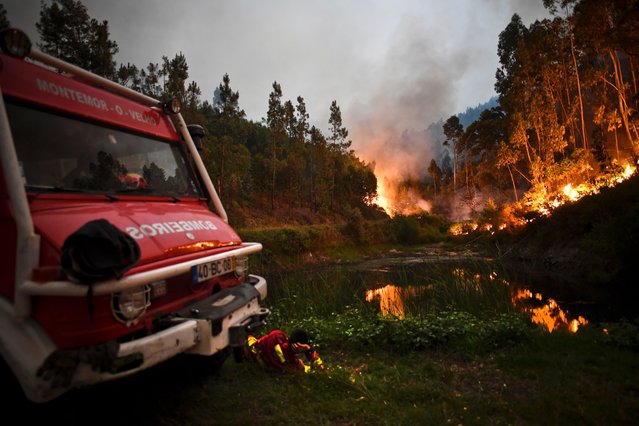
A firefighter rests next to fire combat truck during a wildfire at Penela, Coimbra, central Portugal, on June 18, 2017. A wildfire in central Portugal killed at least 25 people and injured 16 others, most of them burning to death in their cars, the government said on June 18, 2017. Several hundred firefighters and 160 vehicles were dispatched late on June 17 to tackle the blaze, which broke out in the afternoon in the municipality of Pedrogao Grande before spreading fast across several fronts. (Photo by Patricia De Melo Moreira/AFP Photo)

A firefighter rests next to fire combat truck during a wildfire at Penela, Coimbra, central Portugal, on June 18, 2017. A wildfire in central Portugal killed at least 25 people and injured 16 others, most of them burning to death in their cars, the government said on June 18, 2017. Several hundred firefighters and 160 vehicles were dispatched late on June 17 to tackle the blaze, which broke out in the afternoon in the municipality of Pedrogao Grande before spreading fast across several fronts. (Photo by Patricia De Melo Moreira/AFP Photo)
Details
19 Jun 2017 09:04:00
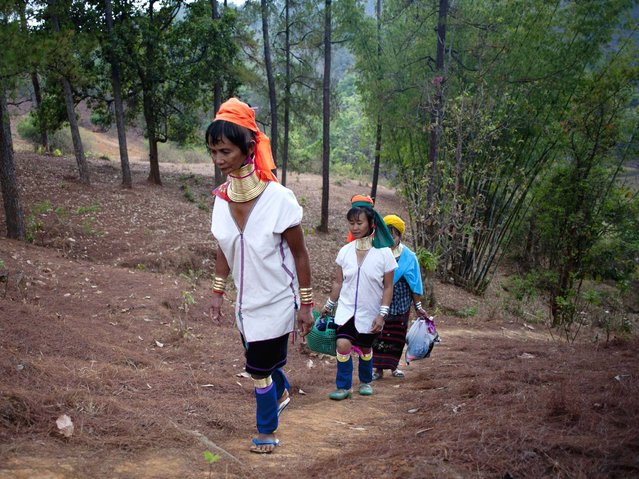
One of the theories says that the coils originate from the desire to look more attractive by exaggerating sexual dimorphism, as women have more slender necks than men. (Photo by Ye Aung Thu/AFP Photo)

This photo taken on April 16, 2014 shows ethnic Kayan women wearing traditional clothes and bronze rings around tbeir neck in Panpet village, Demoso township in Kayah state, eastern Myanmar. Some ethnic Kayan women, also known as Padaung, begin wearing the bronze rings on their neck and legs from a young age. Usually they start wearing six to ten rings when they are five to ten-years-old and then they put on one more ring a year for years after then. (Photo by Ye Aung Thu/AFP Photo)
Details
23 Apr 2014 08:56:00