Loading...
Done
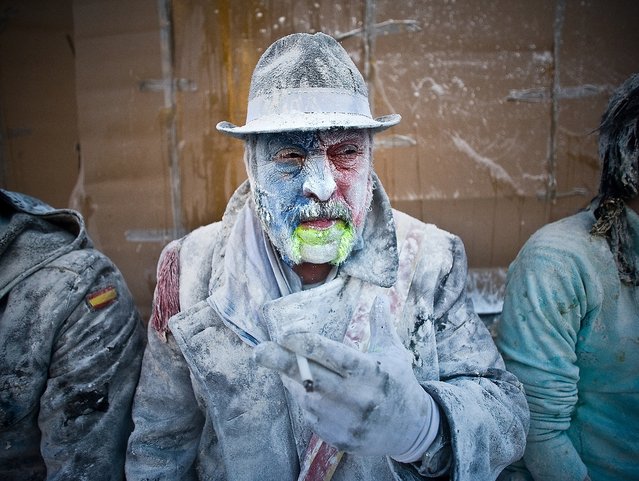
A Reveller smokes during the battle of “Enfarinats”, a flour fight in celebration of the Els Enfarinats festival. (Photo by David Ramos)

It’s a classic tale of dictatorship gone wrong and the fight for freedom. Like in any good battle, there’s fire, albeit from firecrackers, but the ammunition in this one is – flour. It takes place in a Hemingway-esque Spanish village. The battle of “Enfarinats” in celebration of the Els Enfarinats festival, rages on on December 28, 2012 in Ibi, Spain. Citizens of Ibi annually celebrate the festival with a fight using flour, eggs and firecrackers. The battle takes place between two groups, a group of married men called “Els Enfarinats” who take the control of the village for one day pronouncing a number of ridiculous laws and fining the citizens that infringe them and a group called “La Oposicio” who try to restore order. At the end of the day the money collected from the fines is donated to charitable causes in the village. The festival has been celebrated since 1981 after the town of Ibi recovered the tradition but the origins remain unknown.

Photo: A Reveller smokes during the battle of “Enfarinats”, a flour fight in celebration of the Els Enfarinats festival. (Photo by David Ramos)
Details
30 Dec 2012 10:28:00


“Henri Marie Raymond de Toulouse-Lautrec-Monfa or simply Henri de Toulouse-Lautrec (24 November 1864 – 9 September 1901) was a French painter, printmaker, draughtsman, and illustrator, whose immersion in the colourful and theatrical life of fin de siècle Paris yielded an œuvre of exciting, elegant and provocative images of the modern and sometimes decadent life of those times. Toulouse-Lautrec is known along with Cézanne, Van Gogh, and Gauguin as one of the greatest painters of the Post-Impressionist period. In a 2005 auction at Christie's auction house a new record was set when “La blanchisseuse”, an early painting of a young laundress, sold for $22.4 million U.S” – Wikipedia.

Photo: Full-length portrait of French artist Henri Toulouse-Lautrec wearing an overcoat, a bowler hat, and pince-nez eyeglasses while holding a cane. (Photo by Hulton Archive/Getty Images). Circa 1895
Details
20 Mar 2011 09:28:00
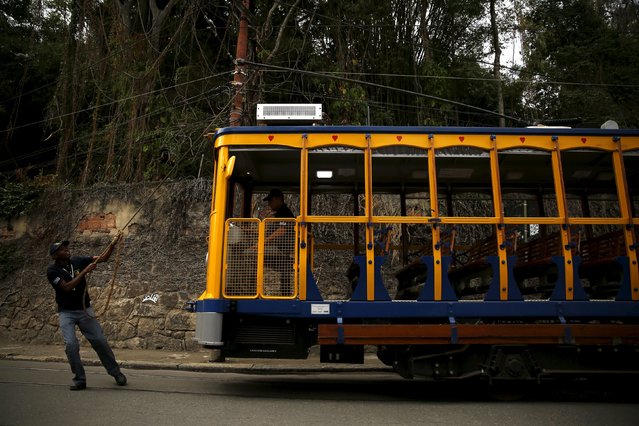
A worker manually changes the direction of the bonde, the typical tram line in Santa Teresa neighborhood, using a rope in Rio de Janeiro, Brazil, September 9, 2015. (Photo by Pilar Olivares/Reuters)

A worker manually changes the direction of the bonde, the typical tram line in Santa Teresa neighborhood, using a rope in Rio de Janeiro, Brazil, September 9, 2015. The Santa Teresa bonde, called “Bondinho” in Portuguese, is running with passengers as a part of a test period, after the service was suspended in 2011 following an accident that killed six people, according to residents. (Photo by Pilar Olivares/Reuters)
Details
11 Sep 2015 12:53:00
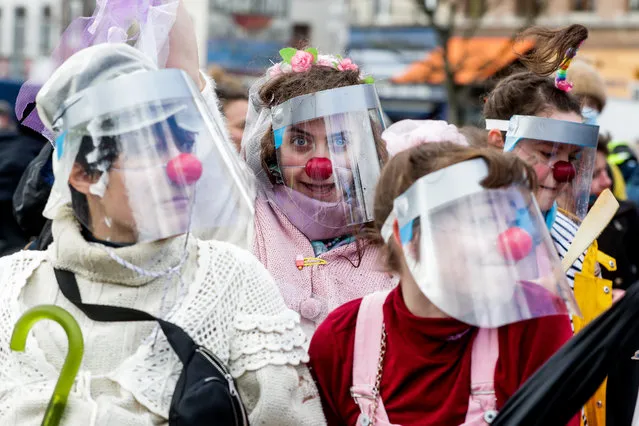
Participants of the “Still Standing for Culture” action of the cultural sector rally in Les Marolles neighborhood of Brussels, Belgium, 13 March 2021. Workers of the cultural sector along with second-hand dealers of the Jeu de Balle place gathered in Les Marolles to denounce the lack of financial support and call for solutions to the impact of the coronavirus crisis on culture professionals and the sector as a whole one year after the Covid-19 pandemic lockdowns started. (Photo by Stephanie Lecocq/EPA/EFE)

Participants of the “Still Standing for Culture” action of the cultural sector rally in Les Marolles neighborhood of Brussels, Belgium, 13 March 2021. Workers of the cultural sector along with second-hand dealers of the Jeu de Balle place gathered in Les Marolles to denounce the lack of financial support and call for solutions to the impact of the coronavirus crisis on culture professionals and the sector as a whole one year after the Covid-19 pandemic lockdowns started. (Photo by Stephanie Lecocq/EPA/EFE)
Details
14 Mar 2021 09:19:00
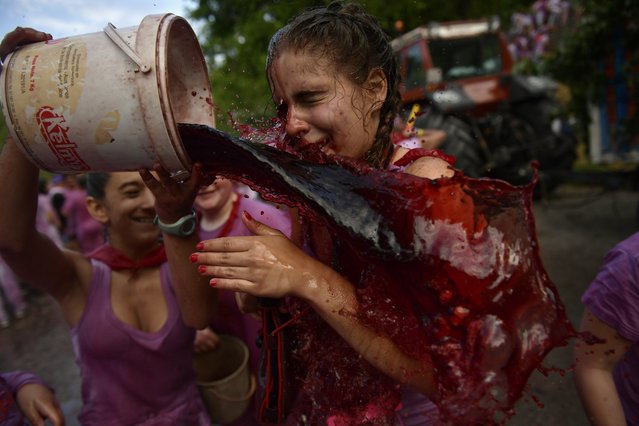
A female is doused with wine as people take part in a wine battle, in the small village of Haro, northern Spain, Friday, June 29, 2018. (Photo by Alvaro Barrientos/AP Photo)

A female is doused with wine as people take part in a wine battle, in the small village of Haro, northern Spain, Friday, June 29, 2018. La Batalla de Vino is held each June in the town of Haro on the feast of St Peter, an event organizers say draws thousands of people. On Friday, participants soaked each other with buckets and toy spray guns, turning their clothes a shade of purple. (Photo by Alvaro Barrientos/AP Photo)
Details
02 Jul 2018 06:03:00
This diver almost got sucked into the mouth of a massive whale shark as it feeds on plankton. But far from staring into the jaws of death – the shark, which are the  sea's largest fish, is actually vegetarian. The relieved diver escaped from the encounter unscathed and continued to  enjoy the presence of the incredibly docile animals. The stunning photograph, by Mauricio Handler, was taken during a feeding session where more than 600 of the huge creatures  gathered to feed on tuna spawn. (Photo by Mauricio Handler/Daily Mail/Solent)

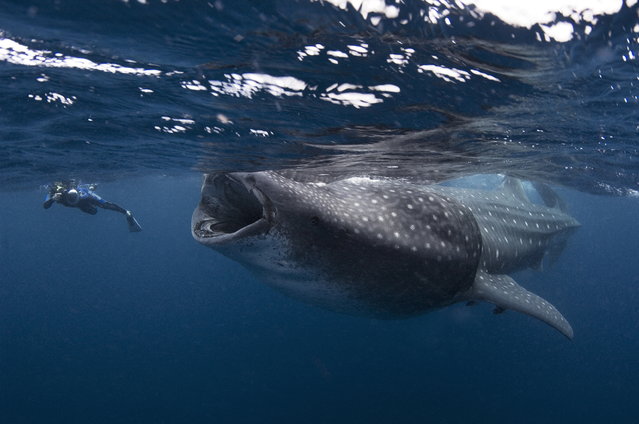
This diver almost got sucked into the mouth of a massive whale shark as it feeds on plankton. But far from staring into the jaws of death – the shark, which are the sea's largest fish, is actually vegetarian. The relieved diver escaped from the encounter unscathed and continued to enjoy the presence of the incredibly docile animals. The stunning photograph, by Mauricio Handler, was taken during a feeding session where more than 600 of the huge creatures gathered to feed on tuna spawn. (Photo by Mauricio Handler/Daily Mail/Solent)
Details
16 Feb 2014 12:23:00
The Hot Tub Tug Boat

Slow walks along the river or lake in a small boat, meant for two passengers, this is a very nice and romantic. This game is very popular among honeymooners or couples who have recently together and have not lost to the heat and intensity of feelings that push young people to the incredible things. How to convert such travel in a more romantic, and healthy, invented Dutch designer Frank de Bruijn , “crossed” a boat and a bath-tub and calling a hybrid HotTug Boat.
Details
02 Nov 2012 11:56:00
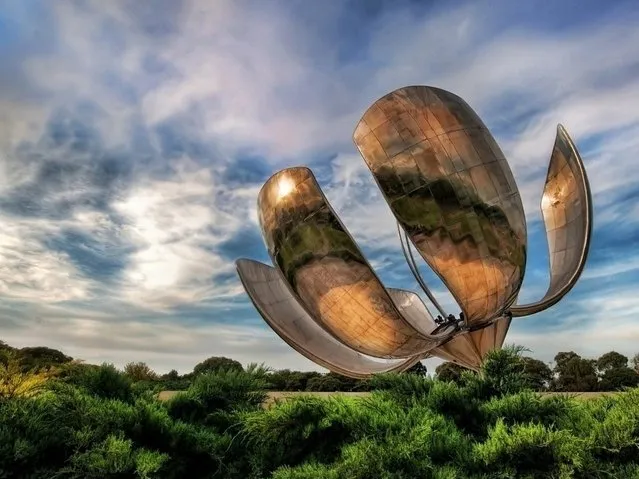
Floralis Generica - Buenos Aires

Floralis Genérica is a sculpture made of steel and aluminum located in Plaza de las Naciones Unidas, Avenida Figueroa Alcorta, Buenos Aires, a gift to the city by the Argentine architect Eduardo Catalano. Catalano once said that the flower "is a synthesis of all the flowers and is both a hope that is reborn every day to open." It was created in 2002. The sculpture moves closing its petals in the evening and opening them in the morning, although this mechanism is currently disabled. The sculpture is located in the center of a park of four acres of wooded boundaries, surrounded by paths that get closer and provide different perspectives of the monument, and placed above a reflecting pool, which apart from fulfilling its aesthetic function, protects it. It represents a large flower made of stainless steel with aluminum skeleton and reinforced concrete, which looks at the sky, extending to it its six petals. Weighs eighteen tons and is 23 meters high.
Details
20 Oct 2013 18:32:00