Loading...
Done
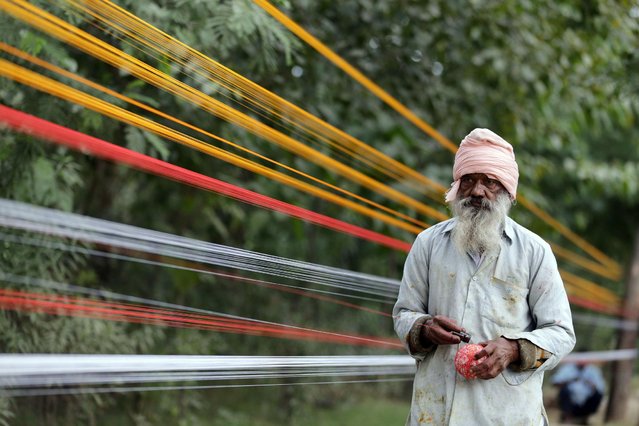
An Indian worker makes a roll of the kite thread being prepared on a roadside on the outskirts of Amritsar, India, 24 November 2020. The kite string or the “Dor”, in the local language, is made of crushed glass, glue, colors, and egg to make it strong enough to hold the kite. With the onset of the winter season, kite flying enthusiasts especially in northern Punjab, ranging from children to aged people, start flying kites as a leisure activity from their homes' rooftops and from open spaces, enjoying warmth of the winter sun at the same time. Kite flying season peaks in Amritsar on Lohri festival which marks the culmination of winter and is celebrated in the month of January every year. (Photo by Raminder Pal Singh/EPA/EFE)

An Indian worker makes a roll of the kite thread being prepared on a roadside on the outskirts of Amritsar, India, 24 November 2020. The kite string or the “Dor”, in the local language, is made of crushed glass, glue, colors, and egg to make it strong enough to hold the kite. (Photo by Raminder Pal Singh/EPA/EFE)
Details
07 Dec 2020 00:01:00
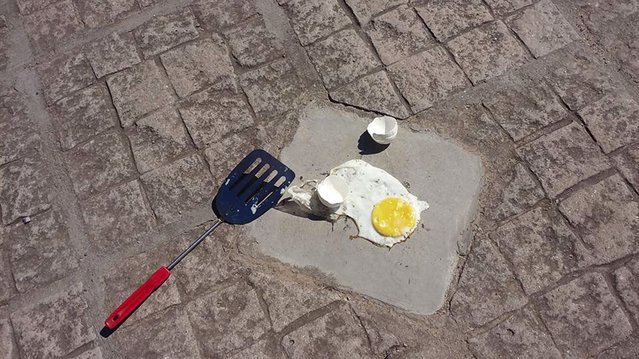
View of an egg fried on the pavement in Pozo Hondo, Santiago del Estero, Argentina on January 23, 2016, while the real feel was 57 degrees Celsius. Pozo Hondo's Mayor Claudio Nicolau fried an egg on the pavement of the main square of the city Saturday. (Photo by AFP Photo/Stringer)

View of an egg fried on the pavement in Pozo Hondo, Santiago del Estero, Argentina on January 23, 2016, while the real feel was 57 degrees Celsius. Pozo Hondo's Mayor Claudio Nicolau fried an egg on the pavement of the main square of the city Saturday. (Photo by AFP Photo/Stringer)
Details
26 Jan 2016 12:43:00
Contestants of a tourism beauty pageant balance eggs on their collarbones as they cruise along the Yellow River in Jiyuan, Henan province, China, June 22, 2015. The contestants believe that if they are slim enough, their collarbones will allow them to balance the eggs securely on their bodies. (Photo by Reuters/Stringer)

Contestants of a tourism beauty pageant balance eggs on their collarbones as they cruise along the Yellow River in Jiyuan, Henan province, China, June 22, 2015. The contestants believe that if they are slim enough, their collarbones will allow them to balance the eggs securely on their bodies. (Photo by Reuters/Stringer)
Details
30 Jun 2015 12:09:00
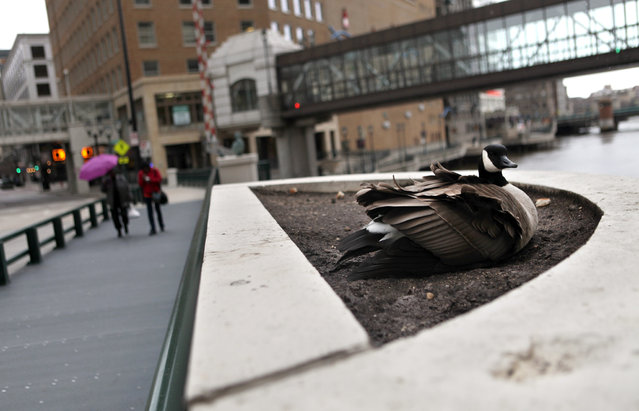
A goose sits atop eggs in a flower bed on the Wisconsin Ave. bridge, Friday, April 19, 2013, feathers ruffled in the cold blowing wind and snowflakes. (Photo by Mike De Sisti)

A goose sits atop eggs in a flower bed on the Wisconsin Ave. bridge, Friday, April 19, 2013, feathers ruffled in the cold blowing wind and snowflakes. The goose is near to the statues dedicated to Gertie the duck who made international news when she built her nest next to the same bridge in 1945 and captured the attention of Milwaukee at the end of the war. A statue commemorating “Gertie the Duck” sits on the other side of the bridge. The goose has several eggs she is sitting on. (Photo by Mike De Sisti)
Details
01 May 2013 09:29:00
Agence SEARCH

Another step further into the world of lattice shell structures: From Buckminster Fuller to Massimiliano Fuksas and James Law’s ‘Cybertecture Egg’, Agence SEARCH express their fascination by experimenting with the retail world proposing their version of ‘Cybertecture Egg’ for the interior of Beaugrenelle Shopping Mall without modifying the existing architecture. Thus the visitor’s first perception goes beyond the scale of the building, to encompass its referential universe, its status, and its identity.
Details
09 Jun 2015 10:30:00
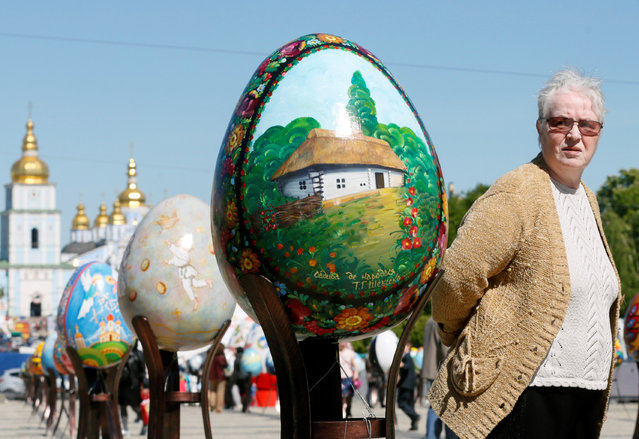
A woman looks at traditional Ukrainian Easter eggs “Pysanka”, installed as part of the upcoming celebrations of Easter, in central Kiev, Ukraine, April 29, 2016. A pysanka is a Ukrainian Easter egg, decorated with traditional Ukrainian folk designs using a wax-resist (batik) method. The word pysanka comes from the verb pysaty, “to write”, as the designs are not painted on, but written with beeswax. Many other eastern European ethnic groups decorate eggs using wax resist for Easter. These include the Belarusians, Bulgarians, Croats, Czechs, Hungarians, Lithuanians, Poles, Romanians, Serbs, Slovaks, Slovenes and Sorbs. (Photo by Valentyn Ogirenko/Reuters)

A woman looks at traditional Ukrainian Easter eggs “Pysanka”, installed as part of the upcoming celebrations of Easter, in central Kiev, Ukraine, April 29, 2016. A pysanka is a Ukrainian Easter egg, decorated with traditional Ukrainian folk designs using a wax-resist (batik) method. The word pysanka comes from the verb pysaty, “to write”, as the designs are not painted on, but written with beeswax. Many other eastern European ethnic groups decorate eggs using wax resist for Easter. These include the Belarusians, Bulgarians, Croats, Czechs, Hungarians, Lithuanians, Poles, Romanians, Serbs, Slovaks, Slovenes and Sorbs. (Photo by Valentyn Ogirenko/Reuters)
Details
30 Apr 2016 09:00:00
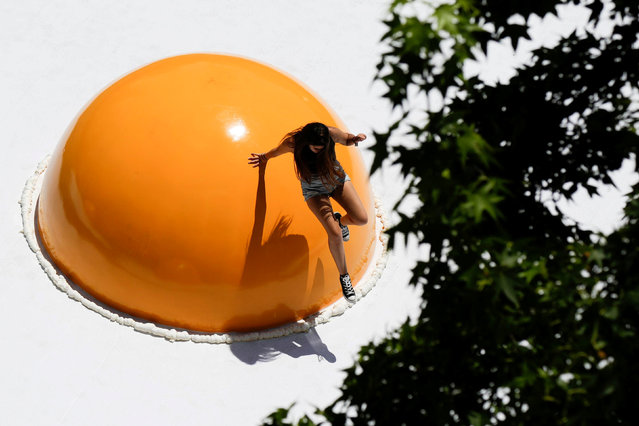
A woman jumps on a giant fried egg art installation as part of “Hecho en Casa” (Made at home) urban artwork festival in downtown Santiago, Chile, November 8, 2016. (Photo by Pablo Sanhueza/Reuters)

A woman jumps on a giant fried egg art installation as part of “Hecho en Casa” (Made at home) urban artwork festival in downtown Santiago, Chile, November 8, 2016. (Photo by Pablo Sanhueza/Reuters)
Details
09 Nov 2016 06:44:00
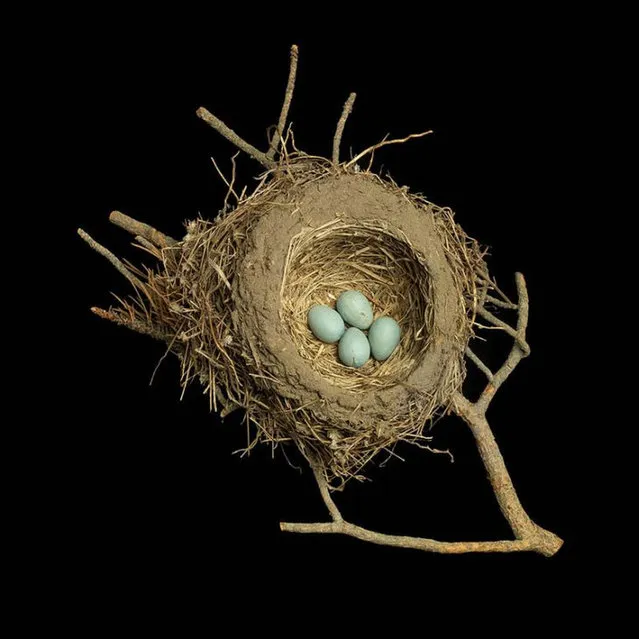
Bird Nest By Sharon Beals

Sharon Beals is a San Francisco based photographer who has photographed nest and eggs specimens collected over the last two centuries at The California Academy of Sciences, The Museum of Vertebrate Zoology, and The Western Foundation of Vertebrate Zoology. While few nests are collected today, these nests and eggs are used for research, providing important information about their builder’s habitats, DNA, diseases and other survival issues.
Details
20 Aug 2013 09:49:00