Loading...
Done
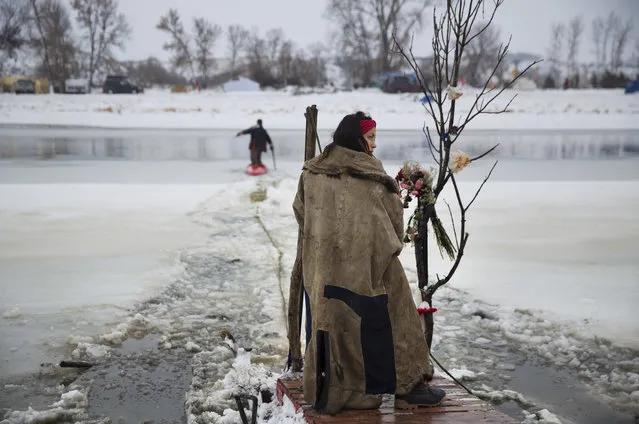
In this Thursday, December 1, 2016 photo, Cat Bigney, part of the Oglala Native American tribe, waits on the shore of the Cannonball river for travelers to arrive by canoe at the Oceti Sakowin camp where people have gathered to protest the Dakota Access oil pipeline in Cannon Ball, N.D. So far, those at the camp have shrugged off the heavy snow, icy winds and frigid temperatures. But if they defy next week's government deadline to abandon the camp, demonstrators know the real deep freeze lies ahead. Life-threatening wind chills and towering snow drifts could mean the greatest challenge is simple survival. (Photo by David Goldman/AP Photo)

In this Thursday, December 1, 2016 photo, Cat Bigney, part of the Oglala Native American tribe, waits on the shore of the Cannonball river for travelers to arrive by canoe at the Oceti Sakowin camp where people have gathered to protest the Dakota Access oil pipeline in Cannon Ball, N.D. So far, those at the camp have shrugged off the heavy snow, icy winds and frigid temperatures. But if they defy next week's government deadline to abandon the camp, demonstrators know the real deep freeze lies ahead. Life-threatening wind chills and towering snow drifts could mean the greatest challenge is simple survival. (Photo by David Goldman/AP Photo)
Details
06 Dec 2016 10:22:00
The face of a graduating student is displayed on a tablet attached to a robot during a “cyber graduation” ceremony at a school on May 22, 2020 in Taguig, Metro Manila, Philippines. Robots represented some 179 graduating students of the Senator Rene Cayetano Science and Technology High School during a graduation ceremony that was streamed online, as mass gatherings remain prohibited in the country under the Philippine government's lockdown to curb the spread of the coronavirus. The robots were developed by alumni of the school's robotics club, which used tablets to display the faces of the graduating students as they “marched” on stage to receive their diplomas. The Philippines' Department of Health has so far reported 13,434 cases of the coronavirus in the country, with at least 846 recorded fatalities. (Photo by Ezra Acayan/Getty Images)

The face of a graduating student is displayed on a tablet attached to a robot during a “cyber graduation” ceremony at a school on May 22, 2020 in Taguig, Metro Manila, Philippines. Robots represented some 179 graduating students of the Senator Rene Cayetano Science and Technology High School during a graduation ceremony that was streamed online, as mass gatherings remain prohibited in the country under the Philippine government's lockdown to curb the spread of the coronavirus. The robots were developed by alumni of the school's robotics club, which used tablets to display the faces of the graduating students as they “marched” on stage to receive their diplomas. The Philippines' Department of Health has so far reported 13,434 cases of the coronavirus in the country, with at least 846 recorded fatalities. (Photo by Ezra Acayan/Getty Images)
Details
24 May 2020 00:07:00
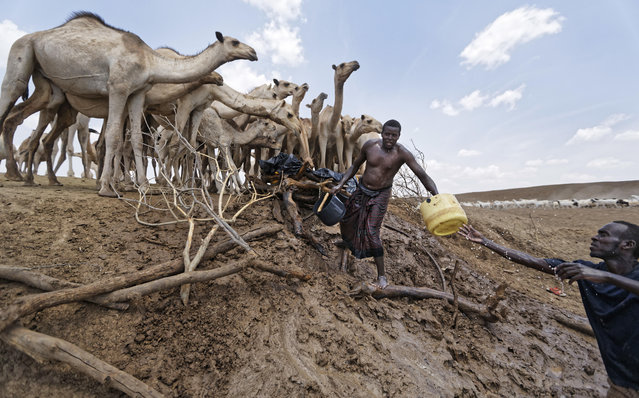
Camel herders scoop up water in plastic buckets from one of the few watering holes in the area, to water their animals near the drought-affected village of Bandarero, near Moyale town on the Ethiopian border, in northern Kenya, Friday, March 3, 2017. The U.N. humanitarian chief, Stephen O'Brien, toured Bandarero village on Friday and called on the international community to act to “avert the very worst of the effects of drought and to avert a famine to make sure we don't go from what is deep suffering to a catastrophe”. (Photo by Ben Curtis/AP Photo)

Camel herders scoop up water in plastic buckets from one of the few watering holes in the area, to water their animals near the drought-affected village of Bandarero, near Moyale town on the Ethiopian border, in northern Kenya, Friday, March 3, 2017. The U.N. humanitarian chief, Stephen O'Brien, toured Bandarero village on Friday and called on the international community to act to “avert the very worst of the effects of drought and to avert a famine to make sure we don't go from what is deep suffering to a catastrophe”. (Photo by Ben Curtis/AP Photo)
Details
05 Mar 2017 00:03:00
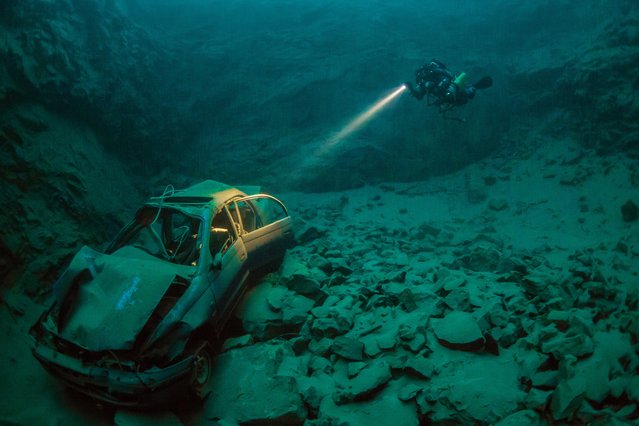
Wide-angle category winner. Part of the Illusion by Marcus Blatchford (UK). Location: National Dive & Activity Centre, Chepstow, Wales. “This is the deepest inland dive centre in the UK. The dive plan was to explore the deep end, but this time I dived ‘unplugged’ (without my strobes). With the exception of this change to my camera technique, there were no planned shots I wanted to achieve – just a fun dive with ad-hoc photos along the way. Shortly after this photo was captured, in 6C water and two hours of decompression ahead of us, we turned and started the long ascent back to the surface”. (Photo by Marcus Blatchford/Underwater Photographer of the Year 2016)

Wide-angle category winner. Part of the Illusion by Marcus Blatchford (UK). Location: National Dive & Activity Centre, Chepstow, Wales. “This is the deepest inland dive centre in the UK. The dive plan was to explore the deep end, but this time I dived ‘unplugged’ (without my strobes). With the exception of this change to my camera technique, there were no planned shots I wanted to achieve – just a fun dive with ad-hoc photos along the way. Shortly after this photo was captured, in 6C water and two hours of decompression ahead of us, we turned and started the long ascent back to the surface”. (Photo by Marcus Blatchford/Underwater Photographer of the Year 2016)
Details
18 Feb 2016 13:44:00
GIF Art By James Kerr

James Kerr started his project “Scorpion Dagger” without any real direction, except for the intention to make one GIF everyday(ish) for one year. He had been making collages for some time and “Scorpion Dagger” started out to be a test of discipline and a way for him to learn how to animate. Making GIFs was a logical evolution to him. The project represents many different things to him, the works from which he draws upon are so powerful and inspirational to him, that he is now nearly obsessed with repurposing them to share his vision of the world, and perhaps inspire people to look at art differently. The project is tremendously personal to him, it’s a lot more than the humor that’s at its surface and he is still trying to work out what “Scorpion Dagger” really is.
Details
23 Dec 2013 10:39:00
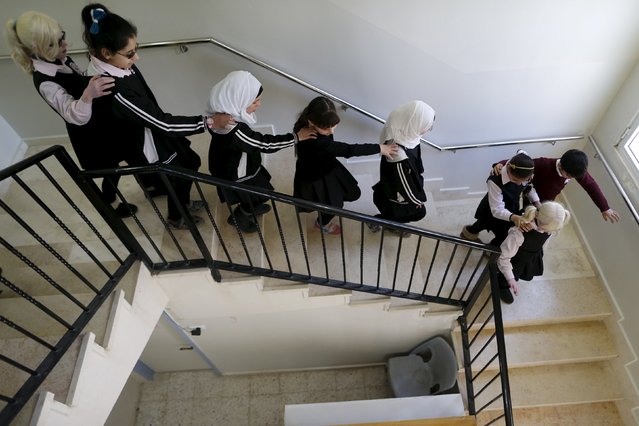
Blind and visually impaired Palestinian students walk down the stairs at a school, where they are taught English through song and music, at a school in the West Bank city of Hebron March 2, 2016. (Photo by Ammar Awad/Reuters)

Blind and visually impaired Palestinian students walk down the stairs at a school, where they are taught English through song and music, at a school in the West Bank city of Hebron March 2, 2016. Palestinian students at a school for the blind in the West Bank are learning English through song, a welcome departure from using braille and memorising grammar rules. While students are delighted with the change, some parents in the religiously conservative town of Hebron are concerned that using music in the classroom jars with Islamic tradition. (Photo by Ammar Awad/Reuters)
Details
03 Mar 2016 11:20:00
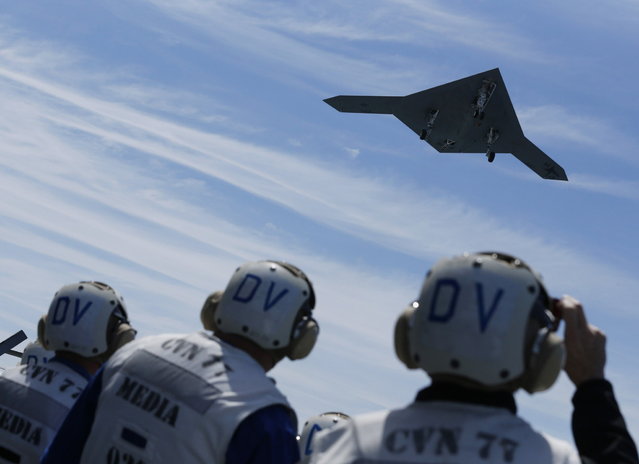
An X-47B pilot-less drone combat aircraft is launched for the first time off an aircraft carrier, the USS George H. W. Bush, in the Atlantic Ocean off the coast of Virginia, May 14, 2013. The U.S. Navy made aviation history on Tuesday by catapulting an unmanned jet off an aircraft carrier for the first time, testing a long-range, stealthy, bat-winged plane that represents a jump forward in drone technology. (Photo by Jason Reed/Reuters)

The X-47B prototype on Tuesday flew off an aircraft carrier and into the history books. Today's achievement, the first-ever catapult launch of an unmanned aircraft from the flight deck of a carrier, promises to open up a new chapter in the annals of naval aviation. Photo: An X-47B pilot-less drone combat aircraft is launched for the first time off an aircraft carrier, the USS George H. W. Bush, in the Atlantic Ocean off the coast of Virginia, May 14, 2013. The U.S. Navy made aviation history on Tuesday by catapulting an unmanned jet off an aircraft carrier for the first time, testing a long-range, stealthy, bat-winged plane that represents a jump forward in drone technology. (Photo by Jason Reed/Reuters)
Details
16 May 2013 12:39:00
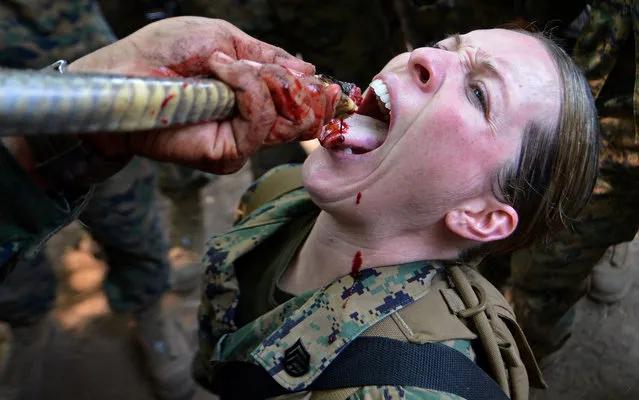
In a military base in the Thai province of Chon Buri February 20 U.S. Marines Navy with Thailand began their studies in jungle survival. The event is held in joint military exercises “Cobra Gold 2013”. During a jungle survival program February 20, 2013 taught by Royal Thai Special Forces in Sannapit, Thailand, U.S. Marines learned to catch cobras and drink their fresh blood, not to mention eat forest insects and pull the heads off of chicken. The training was part of Operation Cobra Gold 13, the 32nd edition of international military exercises hosted by the Thai. According to a U.S. Marines press release, Cobra Gold is the largest exercise of its kind in Asia and incorporates troops from five other nations in addition to the U.S. and Thailand. The Daily Mail reports that the Marines were invited to experience the local custom of drinking cobra blood after being taught to catch and kill cobras in the wild. As CNN notes, Cobra blood is believed to be a panacea and aphrodiasic in parts of Southeast Asia. In Jakarta, vendors can earn over $100 a night selling shots of cobra blood mixed with liquor. (Photo by Pornchai Kittiwongsakul/AFP Photo)

During a jungle survival program February 20, 2013 taught by Royal Thai Special Forces in Sannapit, Thailand, U.S. Marines learned to catch cobras and drink their fresh blood, not to mention eat forest insects and pull the heads off of chicken. The training was part of Operation Cobra Gold 13, the 32nd edition of international military exercises hosted by the Thai. According to a U.S. Marines press release, Cobra Gold is the largest exercise of its kind in Asia and incorporates troops from five other nations in addition to the U.S. and Thailand. The Daily Mail reports that the Marines were invited to experience the local custom of drinking cobra blood after being taught to catch and kill cobras in the wild. As CNN notes, Cobra blood is believed to be a panacea and aphrodiasic in parts of Southeast Asia. In Jakarta, vendors can earn over $100 a night selling shots of cobra blood mixed with liquor. (Photo by Pornchai Kittiwongsakul/AFP Photo)
Details
23 Feb 2013 11:52:00