Loading...
Done
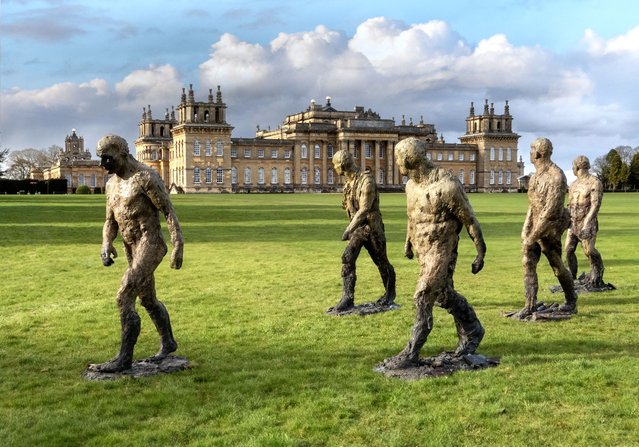
British sculptor Laurence Edwards' striking bronze figures, Walking Men, at Blenheim Palace in Oxfordshire, UK on April 9, 2024. The 8ft tall figures are seen to be anti-heroic and seem to have come from the earth itself. Branches, leaves and clods of clay are woven through them, making it unclear where human and ground begin and end. (Photo by Pete Seaward/South West News Service)

British sculptor Laurence Edwards' striking bronze figures, Walking Men, at Blenheim Palace in Oxfordshire, UK on April 9, 2024. The 8ft tall figures are seen to be anti-heroic and seem to have come from the earth itself. Branches, leaves and clods of clay are woven through them, making it unclear where human and ground begin and end. (Photo by Pete Seaward/South West News Service)
Details
21 May 2024 13:56:00


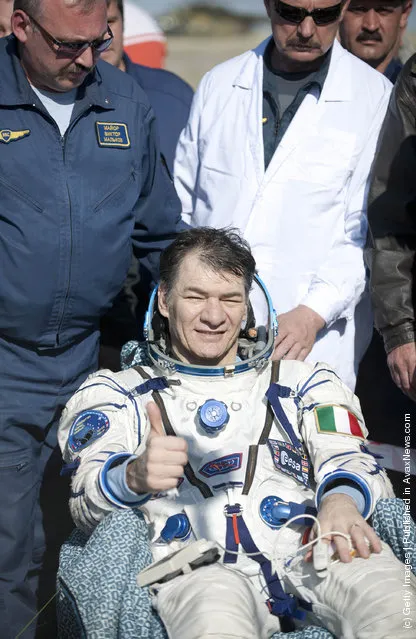
ESA astronaut Paolo Nespoli looks on after landing back on Earth from their Soyuz TMA-20 spacecraft on May 24, 2011 in Zhezkazgan, Kazakhstan. The mission of the Soyuz TMA-20 was launched last December to the International Space Station with the flight engineers Catherine Coleman from the United States, Russian cosmonaut Dmitry Kondratyev and Italian astronaut Paolo Nespoli. The next expedition is expected to launch this June. (Photo by Stephane Corvaja/ESA via Getty Images)
Details
24 May 2011 10:06:00
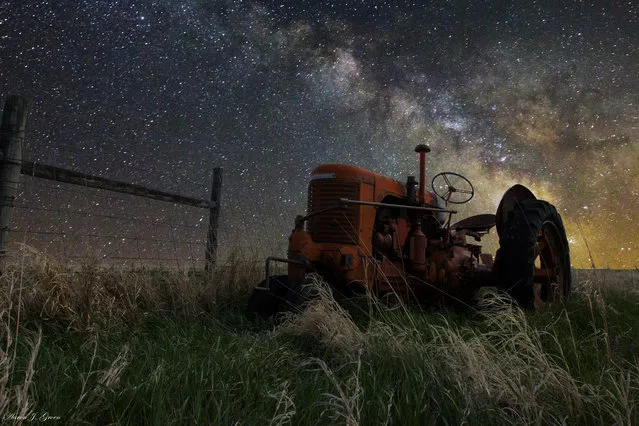
Dark Places By Aaron Groen

Looking at the photos taken by Aaron Groenom, very easy to get lost in this starry wonderland. A series of photos Dark Places - a collection of works in which the artist from South Dakota contrasts the beauty of the universe to various natural or man-made forms on Earth. Using long exposures, it captures the magical landscape filled with fabulous atmosphere, striking color palettes and far-distant galaxies.
Details
06 Jul 2013 17:56:00
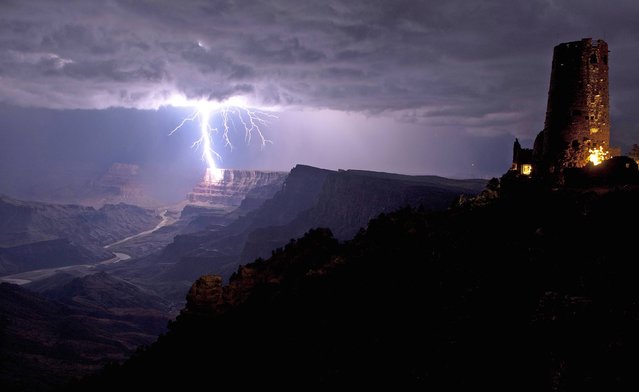
This is the incredible moment a fierce lightning bolt crashed against the Grand Canyon illuminating the steep canyon walls. Shrouded in darkness, the breath-taking landscape was shocked into life as mother nature sent the bolt storming down to Earth. (Photo by Travis Roe/U.S. Dept. of the Interior/Caters News)

This is the incredible moment a fierce lightning bolt crashed against the Grand Canyon illuminating the steep canyon walls. Shrouded in darkness, the breath-taking landscape was shocked into life as mother nature sent the bolt storming down to Earth. As it cracked against the rocks the bright blue bolt illuminated the South Rim of the canyon, considered one of the Seven Natural Wonders of the World. With just the Desert View Watchtower in the foreground, the lightning was perfectly framed by the canyon which is located in Arizona, USA. (Photo by Travis Roe/U.S. Dept. of the Interior/Caters News)
Details
14 May 2013 11:00:00
An offering of a dried baby llama and fake U.S. burn in honor of Pachamama, or Mother Earth, during a New Year ritual on Turriturrini Mountain on the outskirts of Huarina, Bolivia, Friday, June 21, 2024. Aymara Indigenous communities are celebrating the Andean New Year 5,532 or “Willka Kuti” which translates to “Return of the sun” in Aymara. (Photo by Juan Karita/AP Photo)

An offering of a dried baby llama and fake U.S. burn in honor of Pachamama, or Mother Earth, during a New Year ritual on Turriturrini Mountain on the outskirts of Huarina, Bolivia, Friday, June 21, 2024. Aymara Indigenous communities are celebrating the Andean New Year 5,532 or “Willka Kuti” which translates to “Return of the sun” in Aymara. (Photo by Juan Karita/AP Photo)
Details
31 Jul 2024 06:29:00
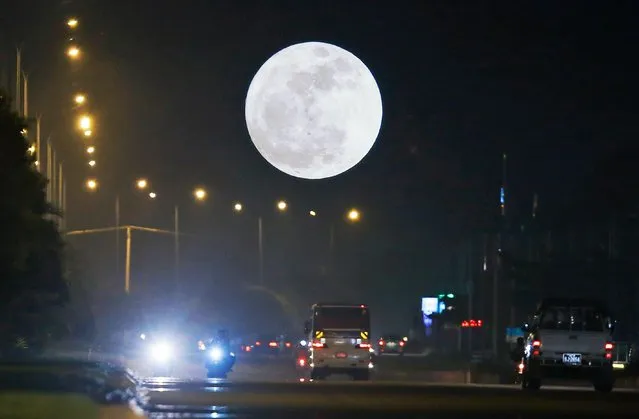
A so-called “Supermoon” dominates the sky while traffic rolls in the streets in Naypyitaw, Myanmar, 03 December 2017. According to the National Aeronautics and Space Administration (NASA) a series of three “Supermoons” – dubbed the “Supermoon trilogy” – will appear in the sky on 03 December 2017, on 01 January 2018 and and 31 January 2018. A 'Supermoon' commonly is a full moon at its closest distance to the earth with the moon appearing larger than usual. (Photo by Hein Htet/EPA/EFE)

A so-called “Supermoon” dominates the sky while traffic rolls in the streets in Naypyitaw, Myanmar, 03 December 2017. According to the National Aeronautics and Space Administration (NASA) a series of three “Supermoons” – dubbed the “Supermoon trilogy” – will appear in the sky on 03 December 2017, on 01 January 2018 and and 31 January 2018. A “Supermoon” commonly is a full moon at its closest distance to the earth with the moon appearing larger than usual. (Photo by Hein Htet/EPA/EFE)
Details
05 Dec 2017 07:45:00
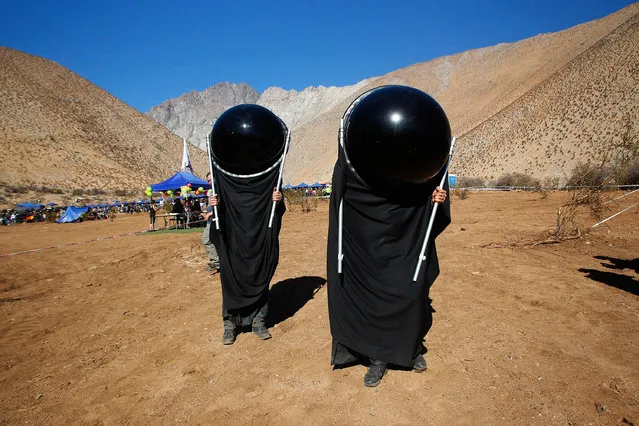
Chileans watch the sky with special suits prior to a total solar eclipse on July 2, 2019 in Paiguano, Chile. Around 25,0000 tourists arrived to Paiguano, a small town of around 1,000 inhabitants in the Elqui Valley, 650 km away Santiago. This is the only Earth's total solar eclipse of 2019 and the first one since 2017. From this point, the sun will fully disappear for around two minutes. It is best visible from a stripe in the South Pacific, Chile and Argentina. (Photo by Marcelo Hernandez/Getty Images)

Chileans watch the sky with special suits prior to a total solar eclipse on July 2, 2019 in Paiguano, Chile. Around 25,0000 tourists arrived to Paiguano, a small town of around 1,000 inhabitants in the Elqui Valley, 650 km away Santiago. This is the only Earth's total solar eclipse of 2019 and the first one since 2017. From this point, the sun will fully disappear for around two minutes. It is best visible from a stripe in the South Pacific, Chile and Argentina. (Photo by Marcelo Hernandez/Getty Images)
Details
04 Jul 2019 00:05:00
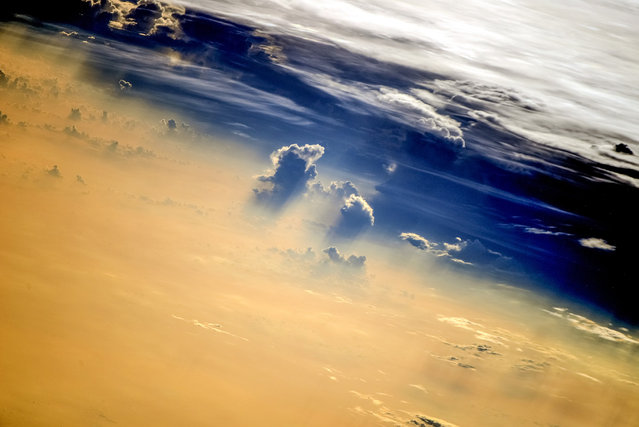
Image of the Clouds taken in August 2014 by astronauts on board the International Space Station (ISS).  A year from space photographs of hurricanes, typhoons and meteorite craters show an astronauts-eye view of our planet from hundreds of miles above the earth. The illuminating images were taken by astronauts onboard the International Space Station (ISS) over the course of 2014. (Photo by NASA/SPL/Barcroft Media)

Image of the Clouds taken in August 2014 by astronauts on board the International Space Station (ISS). A year from space photographs of hurricanes, typhoons and meteorite craters show an astronauts-eye view of our planet from hundreds of miles above the earth. The illuminating images were taken by astronauts onboard the International Space Station (ISS) over the course of 2014. (Photo by NASA/SPL/Barcroft Media)
Details
31 Dec 2014 14:47:00