Loading...
Done
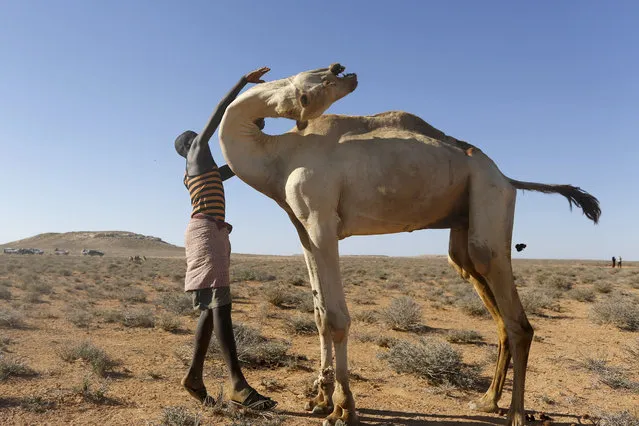
Ali Asair, who has left his family behind and traveled hundreds of kilometers in search for a pasture for his animals, attends to his camel in a pastoralists' settlement in the Bandarbeyla district in Somalia's semi-autonomous region of Puntland, Somalia, 24 March 2017. According to media reports, the United Nations says only 31 percent of 864 million US dollars appeal for a drought-hit Somalia is funded. The UN said the world is facing the largest humanitarian crisis since 1945, adding that more than 20 million people are facing the threat of famine in Somalia, Yemen, South Sudan and Nigeria and 1.4 million children could die from starvation this year. (Photo by Dai Kurokawa/EPA)

Ali Asair, who has left his family behind and traveled hundreds of kilometers in search for a pasture for his animals, attends to his camel in a pastoralists' settlement in the Bandarbeyla district in Somalia's semi-autonomous region of Puntland, Somalia, 24 March 2017. According to media reports, the United Nations says only 31 percent of 864 million US dollars appeal for a drought-hit Somalia is funded. The UN said the world is facing the largest humanitarian crisis since 1945, adding that more than 20 million people are facing the threat of famine in Somalia, Yemen, South Sudan and Nigeria and 1.4 million children could die from starvation this year. (Photo by Dai Kurokawa/EPA)
Details
28 Mar 2017 09:01:00
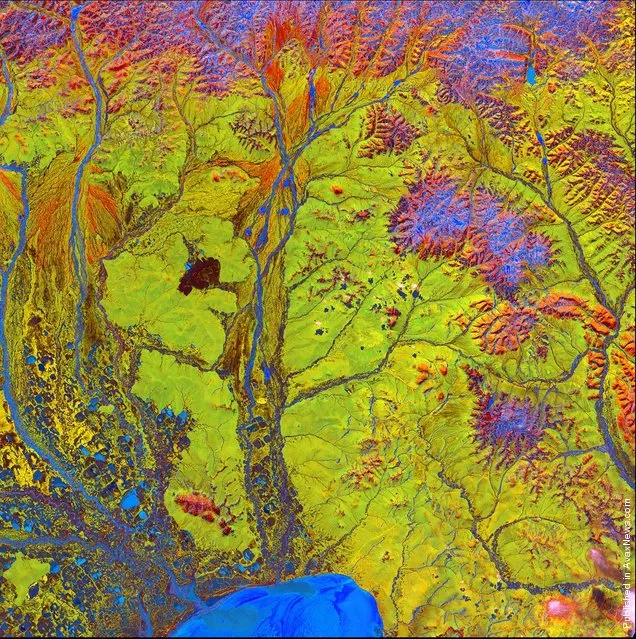
Vivid colors and bizarre shapes come together in a false-color image that could be an illustration for a fantasy story

Vivid colors and bizarre shapes come together in a false-color image that could be an illustration for a fantasy story. This labyrinth of exotic features winds its way along the edge of Russia’s Chaunskaya Bay in northeastern Siberia, seen as a vivid blue half-circle at the bottom of the image Two major rivers, the Chaun and Palyavaam, flow into the bay, which in turn opens into the Arctic Ocean. Ribbon lakes and bogs are present throughout the area, created by depressions left by receding glaciers. (Photo by USGS/NASA)
Details
14 Apr 2012 11:02:00
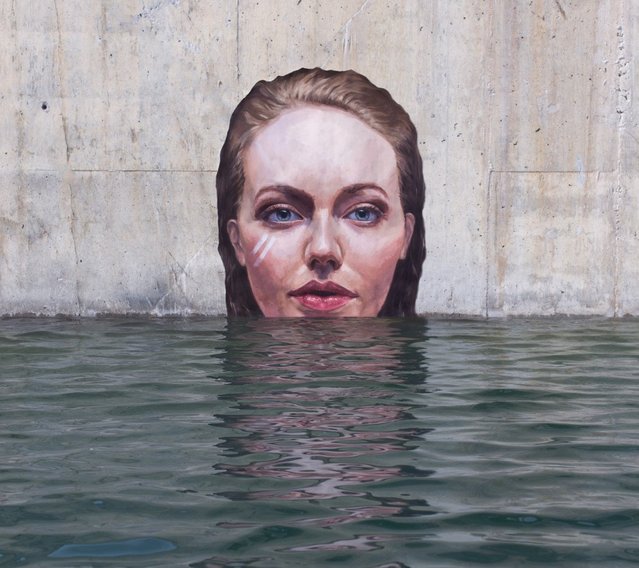
Hyperrealistic Portraits By Sean Yoro aka Hula

Hawaiian surfer Sean Yoro aka Hula combines his love of surfing and his artistic talent, creating hyperrealistic portraits of bathing women at different seaside locations. His work is inspired by street art and abandoned spaces that he uses as his hard-to-reach canvases. Carefully carrying cans of colored paint on the edge of his board, the New York-based artist applies his half submerged female portraits onto the wall.
Details
15 Sep 2015 11:15:00
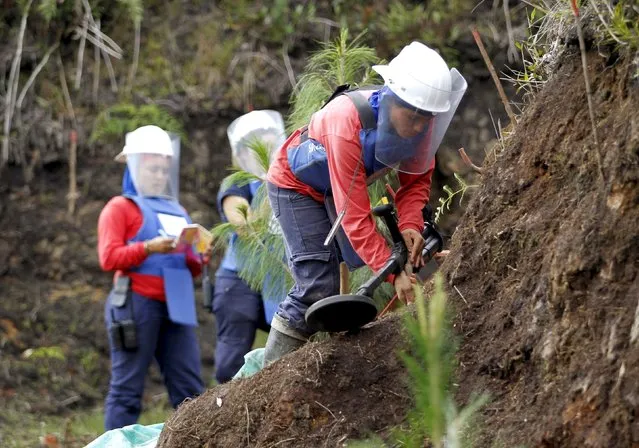
Natalia Arango works with her mine detector in a zone of landmines planted by rebels groups near Sonson in Antioquia province, November 19, 2015. (Photo by Fredy Builes/Reuters)

Natalia Arango works with her mine detector in a zone of landmines planted by rebels groups near Sonson in Antioquia province, November 19, 2015. Women's work takes on a nontraditional meaning for fifteen Colombian women who work to rid the Antioquia Mountains of deadly landmines as the country edges closer to a peace agreement with Marxist rebels to end over a decade of conflict which has claimed 220,000 lives. (Photo by Fredy Builes/Reuters)
Details
27 Nov 2015 04:44:00
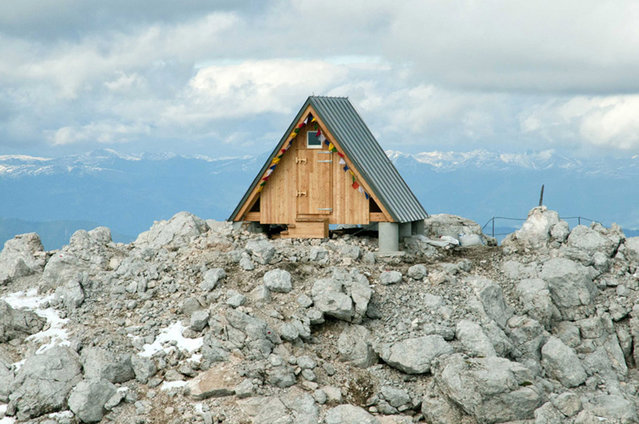
Camping Luca Vuerich By Giovanni Pesamosca

Italian architect Giovanni Pesamosca’s work is reaching scenic new heights. His cabin is perched on the edge of Foronon Buinz in Italy’s Julian Alps. The pre fabricated structure was placed at the spectacular location in memory of deceased climber Luka Vuerich, and is now providing free accommodation complete with jaw dropping panoramic views for up to nine people… the intrepid kind willing to make a long trek to 8303 feet (2531 meters) above sea level.
Details
12 Oct 2014 10:26:00
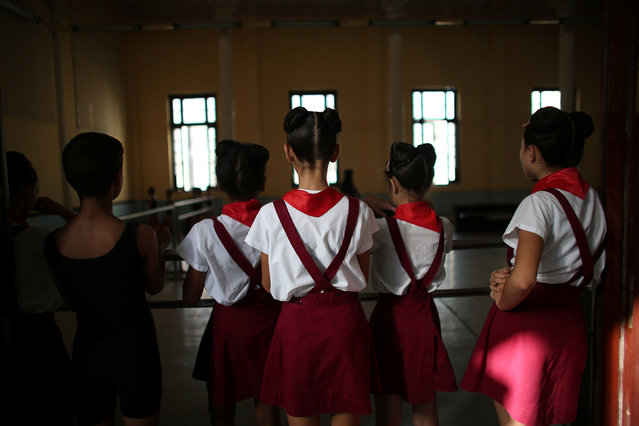
Students at the Cuba's National Ballet School (ENB) watch a class from outside the classroom in Havana, Cuba, October 12, 2016. (Photo by Alexandre Meneghini/Reuters)

Students at the Cuba's National Ballet School (ENB) watch a class from outside the classroom in Havana, Cuba, October 12, 2016. Catherine Conley, the first American full-time student at Cuba's prestigious National Ballet School, hopes to gain an edge back home by learning the powerful Cuban style with its dazzling turns and jumps. (Photo by Alexandre Meneghini/Reuters)
Details
19 Oct 2016 11:46:00
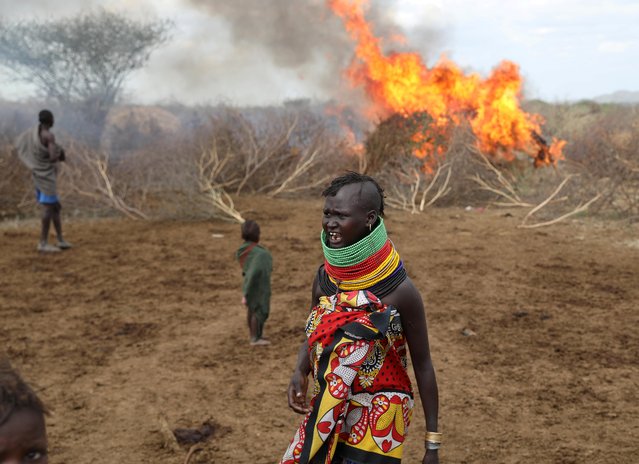
A Turkana tribeswoman reacts after an accidental fire of a shelter in Turkana settlement in Ilemi Triangle, Kenya, July 15, 2019. (Photo by Goran Tomasevic/Reuters)

A Turkana tribeswoman reacts after an accidental fire of a shelter in Turkana settlement in Ilemi Triangle, Kenya, July 15, 2019. The Ilemi Triangle, a disputed sliver of land along the border with Ethiopia and South Sudan, is the northernmost tip of Turkana, Kenya's poorest county. A series of deadly clashes between the Turkana community and other ethnic groups that they said had crossed from South Sudan have put people on edge, to the point of posting lookouts. (Photo by Goran Tomasevic/Reuters)
Details
25 Sep 2019 00:05:00
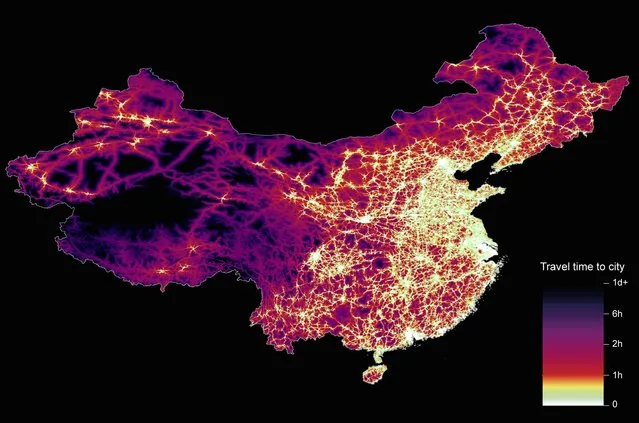
From Britain to China to Mali, new maps showing travel times to the nearest urban centre reveal huge differences between countries. Using Open Street Map and Google, a University of Oxford team have created a visual breakdown that suggests major inequalities when it comes to commuting. Here: China. The dataset used for China was unique as it relied solely on Open Street Map, due to restrictions on accessing Google data. The population is densely concentrated in the east and accessibility is increased, whereas rural provinces in the west remain remote. (Photo by Daniel Weiss/Jennifer Rozier/Malaria Atlas Project/University of Oxford )

From Britain to China to Mali, new maps showing travel times to the nearest urban centre reveal huge differences between countries. Using Open Street Map and Google, a University of Oxford team have created a visual breakdown that suggests major inequalities when it comes to commuting. Here: China. The dataset used for China was unique as it relied solely on Open Street Map, due to restrictions on accessing Google data. The population is densely concentrated in the east and accessibility is increased, whereas rural provinces in the west remain remote. (Photo by Daniel Weiss/Jennifer Rozier/Malaria Atlas Project/University of Oxford)
Details
12 Jan 2018 06:43:00