Loading...
Done
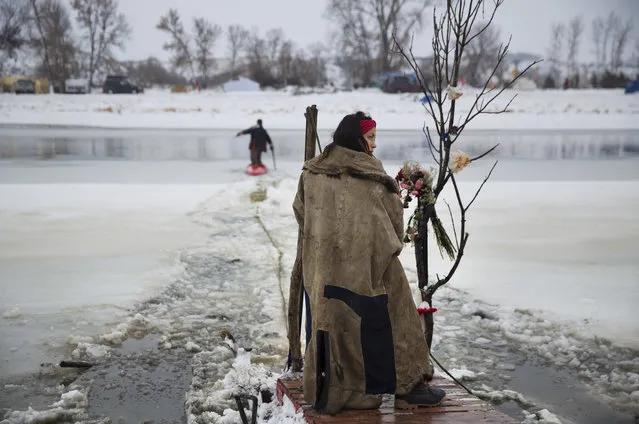
In this Thursday, December 1, 2016 photo, Cat Bigney, part of the Oglala Native American tribe, waits on the shore of the Cannonball river for travelers to arrive by canoe at the Oceti Sakowin camp where people have gathered to protest the Dakota Access oil pipeline in Cannon Ball, N.D. So far, those at the camp have shrugged off the heavy snow, icy winds and frigid temperatures. But if they defy next week's government deadline to abandon the camp, demonstrators know the real deep freeze lies ahead. Life-threatening wind chills and towering snow drifts could mean the greatest challenge is simple survival. (Photo by David Goldman/AP Photo)

In this Thursday, December 1, 2016 photo, Cat Bigney, part of the Oglala Native American tribe, waits on the shore of the Cannonball river for travelers to arrive by canoe at the Oceti Sakowin camp where people have gathered to protest the Dakota Access oil pipeline in Cannon Ball, N.D. So far, those at the camp have shrugged off the heavy snow, icy winds and frigid temperatures. But if they defy next week's government deadline to abandon the camp, demonstrators know the real deep freeze lies ahead. Life-threatening wind chills and towering snow drifts could mean the greatest challenge is simple survival. (Photo by David Goldman/AP Photo)
Details
06 Dec 2016 10:22:00
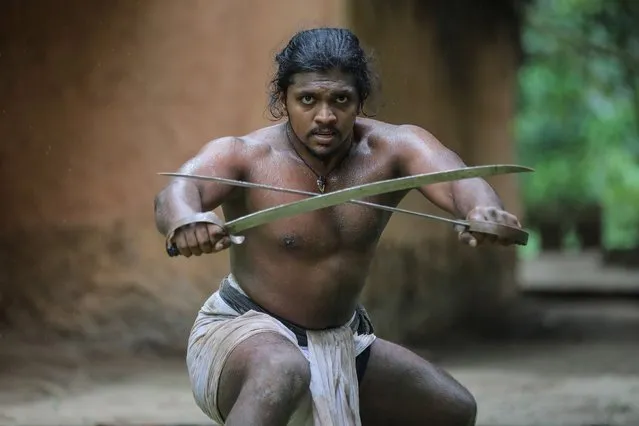
A student of the Sri Lankan ancient martial art “Angampora” performs during a practice session at the angam maduwa or fighting field, in Korathota, a suburb of Colombo, Sri Lanka, 07 September 2022. Sri Lanka's ancient martial art, Angampora, is thought to be thousands of years old. Anga translates to “body parts” and Angampora is a fighting art that uses body parts. Martial arts practitioners in Angampora were mostly in the king's service, and they were tasked with protecting the king and his kingdom. Angampora was practiced in secret for most centuries because the British, who colonized Sri Lanka, banned it in 1818 after seeing it as a threat. (Photo by Chamila Karunarathne/EPA/EFE)

A student of the Sri Lankan ancient martial art “Angampora” performs during a practice session at the angam maduwa or fighting field, in Korathota, a suburb of Colombo, Sri Lanka, 07 September 2022. Sri Lanka's ancient martial art, Angampora, is thought to be thousands of years old. Anga translates to “body parts” and Angampora is a fighting art that uses body parts. Martial arts practitioners in Angampora were mostly in the king's service, and they were tasked with protecting the king and his kingdom. Angampora was practiced in secret for most centuries because the British, who colonized Sri Lanka, banned it in 1818 after seeing it as a threat. (Photo by Chamila Karunarathne/EPA/EFE)
Details
14 Oct 2022 04:47:00
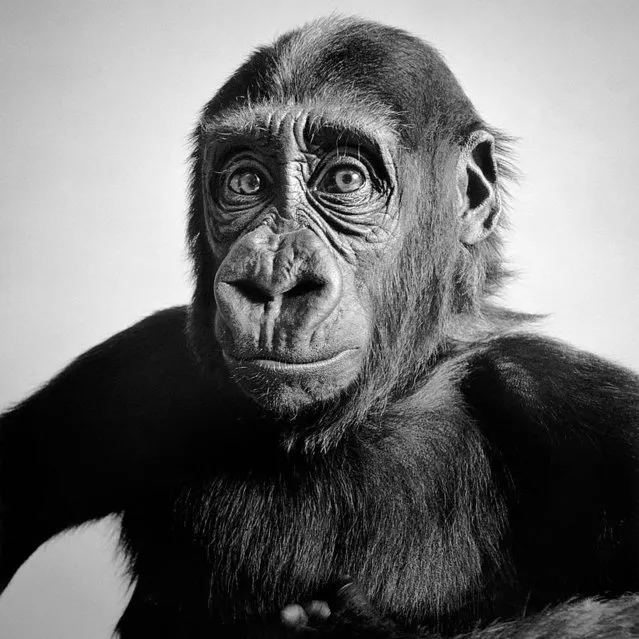
Animal Photographers By Alexander Von Reiswitz

Spanish born photographer and architect, Alexander von Reiswitz, lives in Berlin and has many bodies of wonderful work.
Details
19 Feb 2013 10:34:00
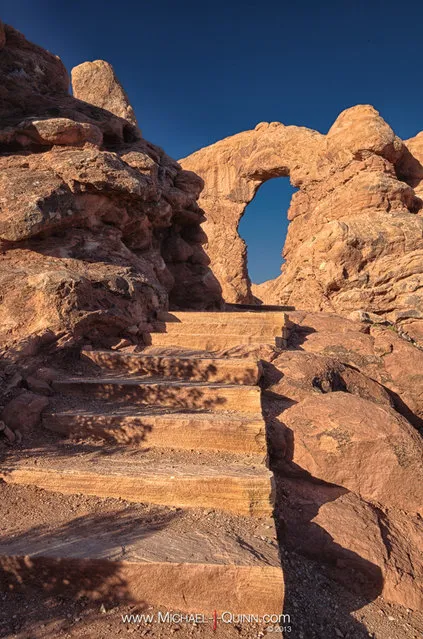
Michael Quinn By Pathways in Arches

Images from my travels with John Paul Caponigro in the spring of 2011. During that week JP inspired me to create this body of work. This is my path, my pathways in arches.

Michael Quinn
Details
18 Dec 2013 14:11:00

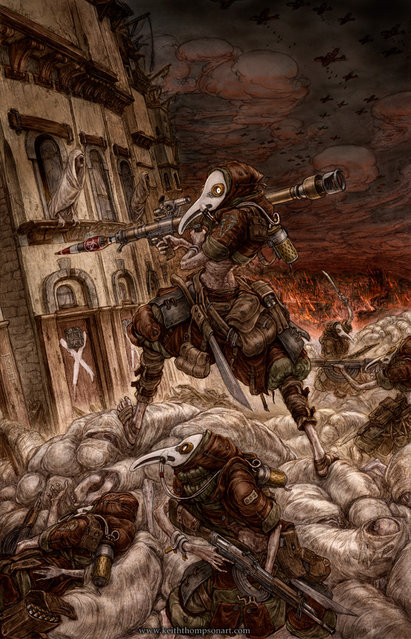
VIRAEMIA

The civilised world lies on its knees, a sickness wracking its body. The affliction causes a necrotising of tissues so perfectly uniform in distribution that victims take on the appearance of corpses long before death occurs due to organ failure or secondary infections. ...
Details
03 May 2012 22:54:00


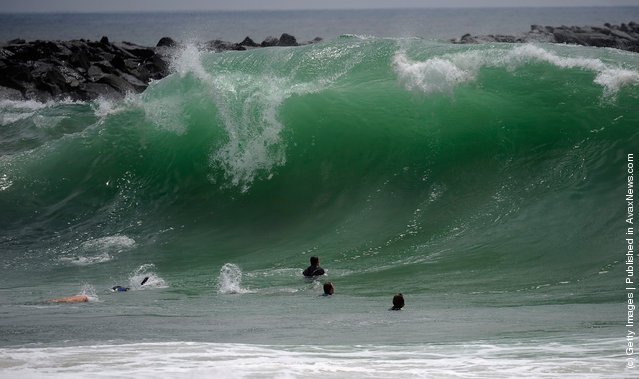
Body surfers ride a large wave at the Wedge in Newport Beach of the Southland coast on May 20, 2011 in Newport, California. Surfers have been lured to the south facing beaches for the biggest swells of the season. (Photo by Kevork Djansezian/Getty Images)
Details
21 May 2011 07:24:00
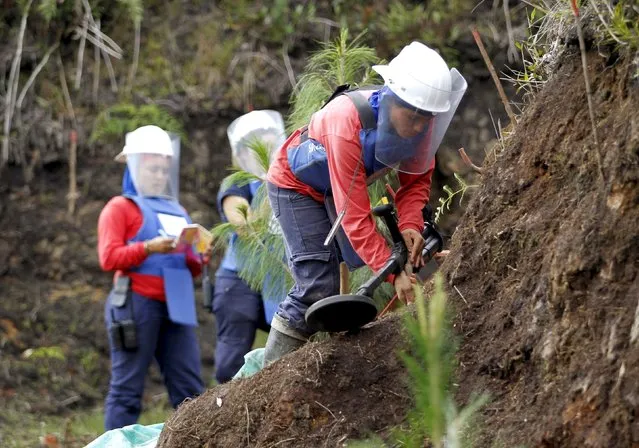
Natalia Arango works with her mine detector in a zone of landmines planted by rebels groups near Sonson in Antioquia province, November 19, 2015. (Photo by Fredy Builes/Reuters)

Natalia Arango works with her mine detector in a zone of landmines planted by rebels groups near Sonson in Antioquia province, November 19, 2015. Women's work takes on a nontraditional meaning for fifteen Colombian women who work to rid the Antioquia Mountains of deadly landmines as the country edges closer to a peace agreement with Marxist rebels to end over a decade of conflict which has claimed 220,000 lives. (Photo by Fredy Builes/Reuters)
Details
27 Nov 2015 04:44:00
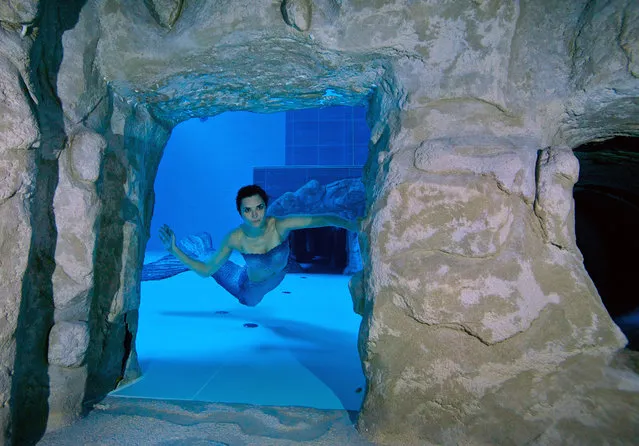
The Y-40 Deep Joy features several levels and grottos. (Photo by Courtesy Y40 Deep Joy)

The Y-40 Deep Joy is the worlds deepest pool. Y-40 is projected by Architect Emanuele Boaretto and supported by the “Boaretto Group Hotel and Resort”. The name Y-40 is inspired by mathematical symbols. “Y” is the ordinate axis of the Cartesian system and “–40” means the world's record depth or our pool- that is 40 meters underground. (Photo by Courtesy Y40 Deep Joy)
Details
07 Oct 2014 11:09:00