Loading...
Done
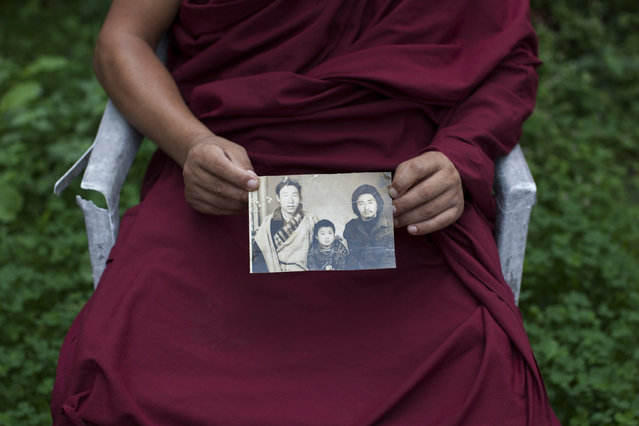
In this Saturday, September 27, 2014 photo, Tibetan monk Dorjee, 38, displays a photograph of his father, left, and himself, center, taken in Tibet, in Dharamsala, India. Dorjee said he held back his tears when he spoke with his parents on the phone after a separation period of 27 years. He exchanged a few words with his father but said his mother fainted on hearing his voice. (Photo by Tsering Topgyal/AP Photo)

“When I was 8 years old, my parents paid a smuggler to take me across the Himalayas, a weekslong walk over the mountains from Tibet to India. It was a trek that tens of thousands of other Tibetans have taken since the Dalai Lama fled a failed 1959 uprising against Chinese rule. My parents must have had their reasons to send me here; they must have had the best of intentions. But 18 years later, I still don't know why they did it. They are not political people. They are small farmers who raise barley and a few yak in a rural area not far from Lhasa, the Tibetan capital. I have not seen them since I left...”. – Tsering Topgyal via The Associated Press. (Photo by Tsering Topgyal/AP Photo)
Details
05 Nov 2014 12:27:00
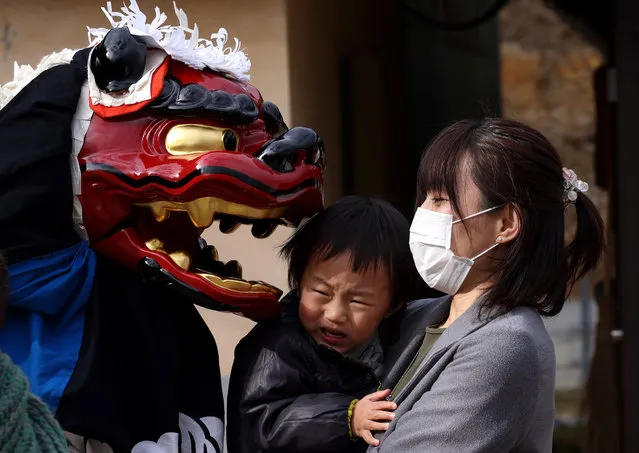
A performer wearing a lion mask performs the Ise Daikagura lion dance at the remote village of Yamanawa on February 08, 2021 in Ryuo, Japan. Ise Daikagura is a group of traditional Lion Dance performers who pray in front of farmers houses and businesses for good grain harvests and disease-free lives. Performers play sacred music using drums and flutes with two lion mask dancers. A lion mask is considered a symbol of God, who enters the house and performs in front of the Shinto God, a statue placed inside the house, mostly in the kitchen. These prayers are called “Kamodo Barai”. After the prayers, they are gifted with money, rice, sake and Japanese sweets from the householders. A group can travel for more than one hundred days to thousands of households and businesses throughout rural-villages in western Japan, and pray to those who are unable to visit the country’s most sacred shrine, the Grand Ise Shrine in Mie Prefecture. The group started its performance in the Edo era between 1603 to 1868 according to Japanese history. The Japanese government designated it as an important folk cultural national property in 1981. (Photo by Buddhika Weerasinghe/Getty Images)

A performer wearing a lion mask performs the Ise Daikagura lion dance at the remote village of Yamanawa on February 08, 2021 in Ryuo, Japan. Ise Daikagura is a group of traditional Lion Dance performers who pray in front of farmers houses and businesses for good grain harvests and disease-free lives. (Photo by Buddhika Weerasinghe/Getty Images)
Details
18 Feb 2021 09:27:00
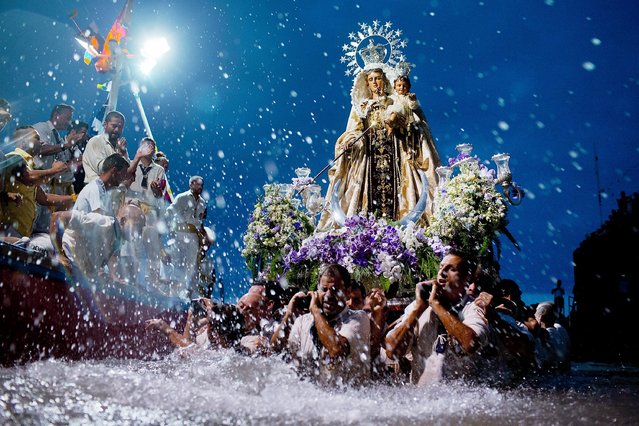
Carriers of the Great God Power brotherhood unload Virgen del Carmen statue after its journey on July 15, 2014 at Puerto de la Cruz dock on the Canary island of Tenerife, Spain. Since 1921, the statue of the Virgen del Carmen, patron saint of fishermen, has been carried with great fanfare annually as part of July Festivities to the Puerto de la Cruz dock where, at the end of its procession, it is hoisted aboard a decorated boat. (Photo by Gonzalo Arroyo Moreno/Getty Images)

Carriers of the Great God Power brotherhood unload Virgen del Carmen statue after its journey on July 15, 2014 at Puerto de la Cruz dock on the Canary island of Tenerife, Spain. Since 1921, the statue of the Virgen del Carmen, patron saint of fishermen, has been carried with great fanfare annually as part of July Festivities to the Puerto de la Cruz dock where, at the end of its procession, it is hoisted aboard a decorated boat. Weather permitting, the boat carrying the statue, accompanied by a flotilla of other boats, makes a short journey along the island coast before returning to the harbour. In recent years, attendance at the event has numbered more than 35,000 people. (Photo by Gonzalo Arroyo Moreno/Getty Images)
Details
21 Jul 2014 11:18:00
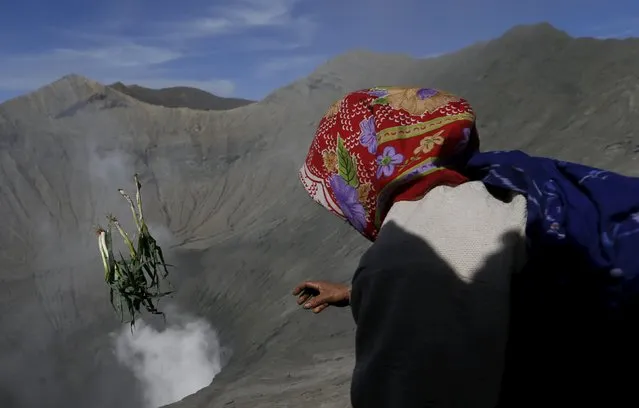
A Hindu worshipper throws vegetables into the crater as offerings during the Kasada Festival at Mount Bromo in Probolinggo, Indonesia's East Java province, August 1, 2015. (Photo by Reuters/Beawiharta)

A Hindu worshipper throws vegetables into the crater as offerings during the Kasada Festival at Mount Bromo in Probolinggo, Indonesia's East Java province, August 1, 2015. Every year people gather for the annual festival where offerings of rice, fruit, vegetables, livestock or money are made to Hindu gods at the active volcano to ask for blessings and assure a bountiful harvest. (Photo by Reuters/Beawiharta)
Details
02 Aug 2015 12:34:00
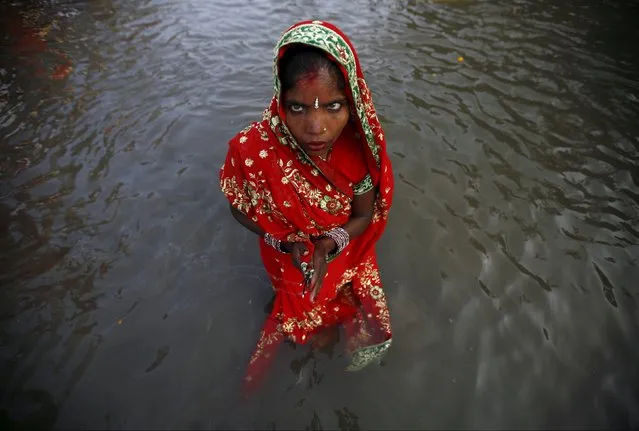
A devotee offers prayers to the setting sun during the "Chhat" festival at Bagmati river in Kathmandu, Nepal November 17, 2015. (Photo by Navesh Chitrakar/Reuters)

A devotee offers prayers to the setting sun during the "Chhat" festival at Bagmati river in Kathmandu, Nepal November 17, 2015. Hindus in Nepal celebrate "Chhat", a four-day festival that honours the sun god, by praying at sunrise and sunset, and seek blessings for one's family by giving offerings. (Photo by Navesh Chitrakar/Reuters)
Details
19 Nov 2015 08:01:00
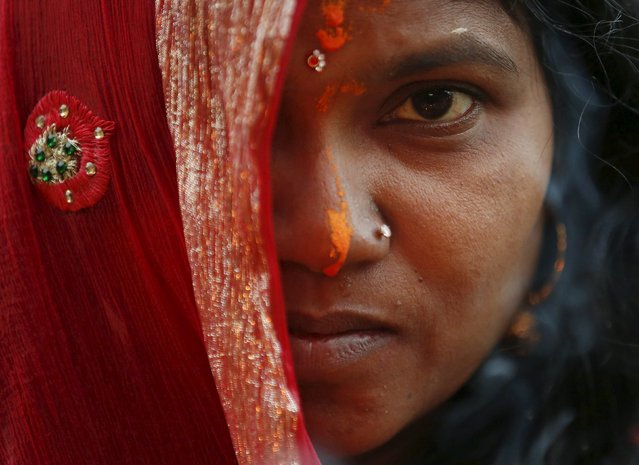
A face of a devotee covered with her cloth is pictured as she offers prayers to the rising sun during the "Chhat" festival in Kathmandu, Nepal November 18, 2015. (Photo by Navesh Chitrakar/Reuters)

A face of a devotee covered with her cloth is pictured as she offers prayers to the rising sun during the "Chhat" festival in Kathmandu, Nepal November 18, 2015. Hindus in Nepal celebrate "Chhat", a four-day festival that honours the sun god by praying at sunrise and sunset and seeking blessings for ones family by giving offerings. (Photo by Navesh Chitrakar/Reuters)
Details
20 Nov 2015 08:00:00
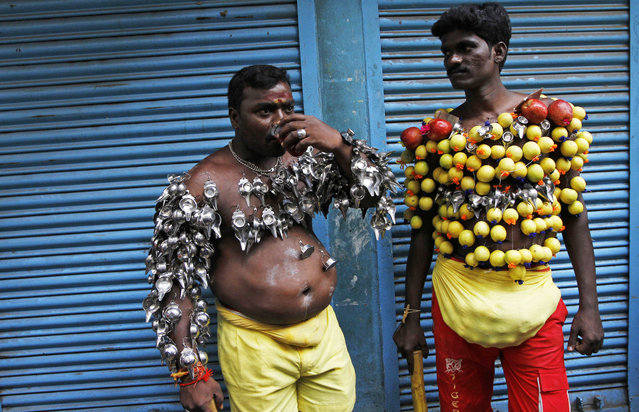
Hindu devotees, their bodies pierced with lemon and paladai, or bowl with a spout mainly used to feed milk to infants, wait to participate in a procession to mark Shivratri, or the night of Shiva, in Chennai, India, Wednesday, February 18, 2015. (Photo by Arun Sankar K./AP Photo)

Hindu devotees, their bodies pierced with lemon and paladai, or bowl with a spout mainly used to feed milk to infants, wait to participate in a procession to mark Shivratri, or the night of Shiva, in Chennai, India, Wednesday, February 18, 2015. Such processions are held as an offering and show of devotion by devotees on the day dedicated to the worship of Lord Shiva, the Hindu god of destruction. (Photo by Arun Sankar K./AP Photo)
Details
21 Feb 2015 11:41:00
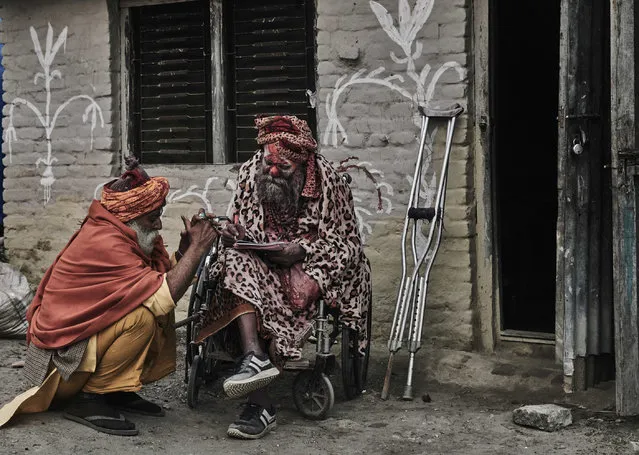
Two holy men with a decorative faces and headdresses, taken in Kathmandu, Nepal. (Photo by Jan Moeller Hansen/Barcroft Images)

Two holy men with a decorative faces and headdresses, taken in Kathmandu, Nepal. Wandering through the cities and forests of Nepal are the holy men, or Sadhus, who have left all materialistic pleasures behind to live a life devoted to God. Their appearances vary from brightly coloured face paints, and decorations, to minimalistic practical clothing, but they all represent the fundamental values and meanings of Hinduism. Danish photographer Jan Moeller Hansen visited the ancient capital city of Kathmandu between 2013 and 2016 and documented the mysterious holy wanderers. (Photo by Jan Moeller Hansen/Barcroft Images)
Details
02 Feb 2017 05:02:00