Loading...
Done
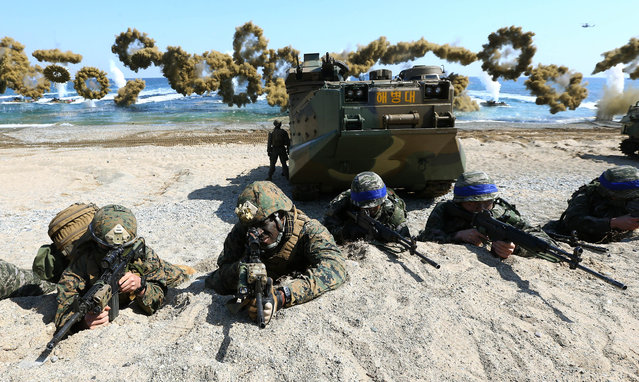
U.S. Marines, left, and South Korean Marines, wearing blue headbands on their helmets, take positions after landing on the beach during the joint military combined amphibious exercise, called Ssangyong, part of the Key Resolve and Foal Eagle military exercises, in Pohang, South Korea, Saturday, March 12, 2016. North Korea said Saturday its military is ready to pre-emptively attack and “liberate” the South in its latest outburst against the annual joint military drills by the United States and South Korea. (Photo by Kim Jun-bum/Yonhap via AP Photo)

U.S. Marines, left, and South Korean Marines, wearing blue headbands on their helmets, take positions after landing on the beach during the joint military combined amphibious exercise, called Ssangyong, part of the Key Resolve and Foal Eagle military exercises, in Pohang, South Korea, Saturday, March 12, 2016. North Korea said Saturday its military is ready to pre-emptively attack and “liberate” the South in its latest outburst against the annual joint military drills by the United States and South Korea. (Photo by Kim Jun-bum/Yonhap via AP Photo)
Details
12 Mar 2016 15:17:00
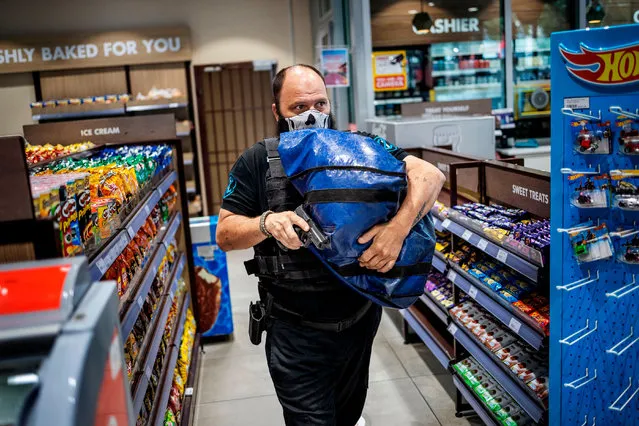
A CIT guard carries his gun handgun while bringing a bag containing cash inside an armoured vehicle during a money collection in Johannesburg's CBD, on December 8, 2020. As the Christmas festive season approaches, cash-in-transit (CIT) companies are gearing up as they continue to be target of crime, with about 3000 money vans traveling daily nationwide. Despite the COVID-19 lockdown, there have been 260 cash-in-transit heist incidents in South Africa this year, with 19 CIT crew members killed. Cash-in-transit heists in the country are often military-style planned operations with criminals recurring to bomb making and assault rifles attacks. (Photo by Michele Spatari/AFP Photo)

A CIT guard carries his gun handgun while bringing a bag containing cash inside an armoured vehicle during a money collection in Johannesburg's CBD, on December 8, 2020. As the Christmas festive season approaches, cash-in-transit (CIT) companies are gearing up as they continue to be target of crime, with about 3000 money vans traveling daily nationwide. Despite the COVID-19 lockdown, there have been 260 cash-in-transit heist incidents in South Africa this year, with 19 CIT crew members killed. Cash-in-transit heists in the country are often military-style planned operations with criminals recurring to bomb making and assault rifles attacks. (Photo by Michele Spatari/AFP Photo)
Details
18 Dec 2020 00:01:00
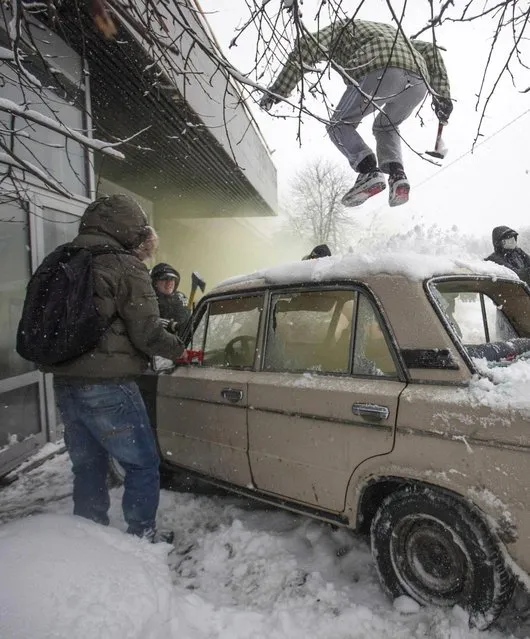
In this photo taken on Friday, March 15, 2013, members of a pro-Kremlin youth group attack pushers of spice, a synthetic drug, in Moscow, Russia. Russian officials and anti-drugs campaigners say that spice has become one of the most dangerous drugs widely available to youngsters and almost impossible to ban because of the constantly changing chemical ingredients. (Photo by Alexander Zemlianichenko Jr/AP Photo)

In this photo taken on Friday, March 15, 2013, members of a pro-Kremlin youth group attack pushers of spice, a synthetic drug, in Moscow, Russia. Russian officials and anti-drugs campaigners say that spice has become one of the most dangerous drugs widely available to youngsters and almost impossible to ban because of the constantly changing chemical ingredients. (Photo by Alexander Zemlianichenko Jr/AP Photo)
Details
26 Apr 2013 08:39:00
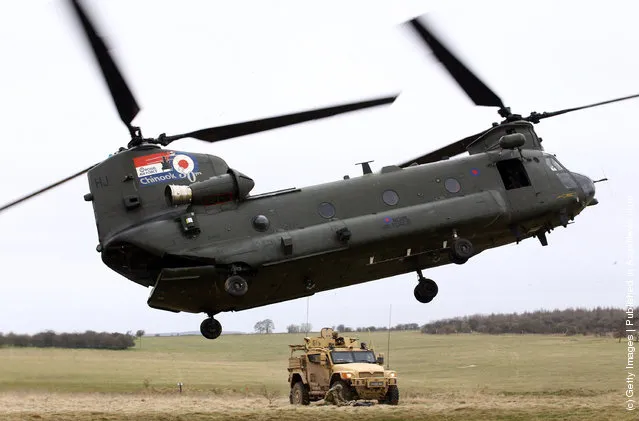
Soldiers from 12 Mechanized Brigade perform a simulated casualty evacuation at the Ministry of Defence training area at Copehill Down on Salisbury Plain on March 9, 2012 in Wiltshire, England. The Defence Secretary Philip Hammond visited the military facility to meet soldiers from the Brigade who are shortly to deploy to Afghanistan for Operation Herrick 16, and troops from the 3rd Battalion, the Yorkshire regiment which lost five of the six men who died this week in the deadliest single attack in Afghanistan since 2001

Soldiers from 12 Mechanized Brigade perform a simulated casualty evacuation at the Ministry of Defence training area at Copehill Down on Salisbury Plain on March 9, 2012 in Wiltshire, England. The Defence Secretary Philip Hammond visited the military facility to meet soldiers from the Brigade who are shortly to deploy to Afghanistan for Operation Herrick 16, and troops from the 3rd Battalion, the Yorkshire regiment which lost five of the six men who died this week in the deadliest single attack in Afghanistan since 2001. (Photo by Matt Cardy/Getty Images)
Details
10 Mar 2012 12:55:00
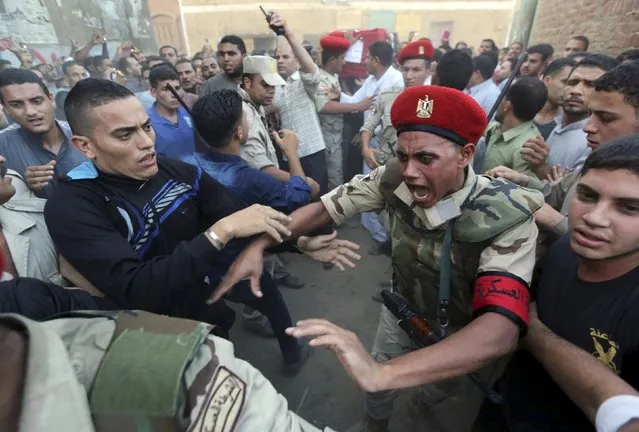
Military policemen try to open a path ahead for the funeral of 21-year-old Mohamed Adel, one of the army officers who died in yesterday's Sinai attacks, in Al-Kaliobeya, near Cairo, Egypt, July 2, 2015. (Photo by Mohamed Abd El Ghany/Reuters)

Military policemen try to open a path ahead for the funeral of 21-year-old Mohamed Adel, one of the army officers who died in yesterday's Sinai attacks, in Al-Kaliobeya, near Cairo, Egypt, July 2, 2015. Egypt launched air strikes on Islamist militant targets in the Sinai peninsula on Thursday, killing 23 fighters a day after the deadliest clashes in the region in years, security sources said. The sources said those killed had taken part in Wednesday's fighting in which 100 militants and 17 soldiers, including four officers, were killed, according to the army spokesman. (Photo by Mohamed Abd El Ghany/Reuters)
Details
03 Jul 2015 13:19:00
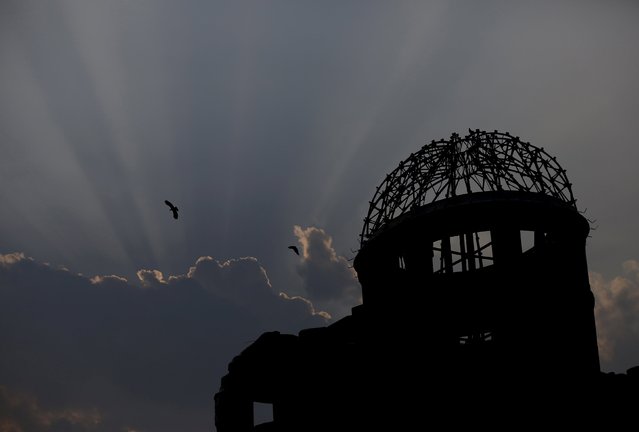
Birds fly over the Atomic Bomb Dome in Hiroshima, western Japan July 29, 2015. On August 6, 1945, the U.S. dropped the atomic bomb on Hiroshima, killing about 140,000 by the end of the year in a city of 350,000 residents, in the world's first nuclear attack. (Photo by Issei Kato/Reuters)

Birds fly over the Atomic Bomb Dome in Hiroshima, western Japan July 29, 2015. On August 6, 1945, the U.S. dropped the atomic bomb on Hiroshima, killing about 140,000 by the end of the year in a city of 350,000 residents, in the world's first nuclear attack. Three days later, a second atomic bomb was dropped on Nagasaki. Influenced by the shadows scorched into outdoor surfaces by the heat of the blasts 70 years ago, Reuters photographer Issei Kato pays homage to survivors, residents and historic buildings in both cities in a personal project that captures the shadows of today. (Photo by Issei Kato/Reuters)
Details
04 Aug 2015 12:01:00
Drag queen Lior Israelov (L), who goes by the stage name Suzi Boum, and his transgender sister Arizona pose for a photo in a studio In Tel Aviv June 3, 2015. While Tel Aviv has become a world-class destination for gay tourism, the holy city of Jerusalem was the scene of an attack by an ultra-Orthodox Jew that killed an Israeli teenager at an annual Gay Pride parade on July 30. The assailant, who called the parade an abomination against God, has been charged with murder. (Photo by Baz Ratner/Reuters)

Drag queen Lior Israelov (L), who goes by the stage name Suzi Boum, and his transgender sister Arizona pose for a photo in a studio In Tel Aviv June 3, 2015. While Tel Aviv has become a world-class destination for gay tourism, the holy city of Jerusalem was the scene of an attack by an ultra-Orthodox Jew that killed an Israeli teenager at an annual Gay Pride parade on July 30. The assailant, who called the parade an abomination against God, has been charged with murder. (Photo by Baz Ratner/Reuters)
Details
17 Sep 2015 10:35:00
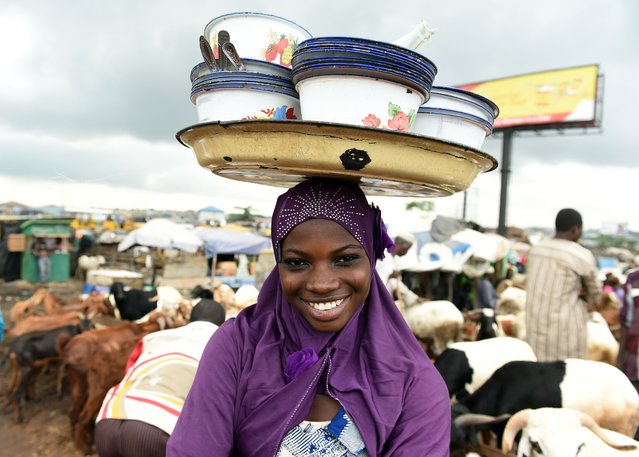
A young vendor hawks food on a market in Kara in the state of Ogun, on September 23, 2015. Nigeria imposed tight movement restrictions in the restive northeast after Boko Haram bombings that killed more than 100 raised fears of fresh attacks over the Eid al-Adha festival. The military said the use of all vehicles would be banned throughout Borno state during the Muslim festival, which is known as Sallah in Nigeria and marked with two days' public holiday from Thursday. (Photo by Pius Utomi Ekpei/AFP Photo)

A young vendor hawks food on a market in Kara in the state of Ogun, on September 23, 2015. Nigeria imposed tight movement restrictions in the restive northeast after Boko Haram bombings that killed more than 100 raised fears of fresh attacks over the Eid al-Adha festival. The military said the use of all vehicles would be banned throughout Borno state during the Muslim festival, which is known as Sallah in Nigeria and marked with two days' public holiday from Thursday. (Photo by Pius Utomi Ekpei/AFP Photo)
Details
24 Sep 2015 12:08:00