Loading...
Done
Surreal Floating Room Sculptures By Leandro Erlich

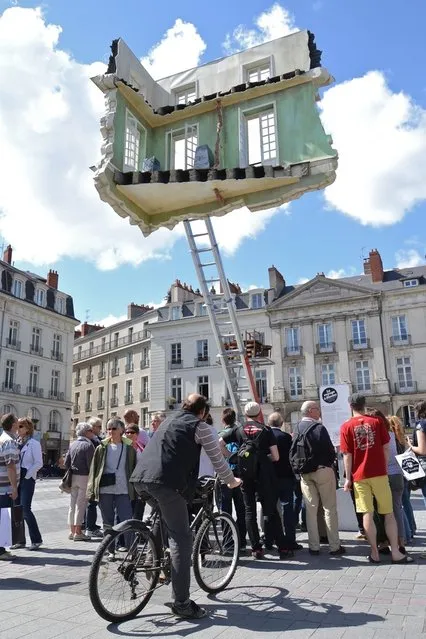
Like a scene from a fantasy movie, a dilapidated room that appears to have been literally ripped out of a building remains suspended in mid air above Nantes, France. Its walls were torn apart, revealing bricks below the plaster, and wood floors reveal the joists inside. The floating room is accessible via a ladder. The gravity defying surreal installation is the work of Argentinean artist Leandro Erlich. The large-scale piece, called “Monte-meubles – L’ultime déménagement” (literally - The Furniture Lift – The Ultimate Moving Out), was created for the biannual Le Voyage a Nantes, an art festival which turns the entire French city into an art gallery.
Details
30 Apr 2014 12:55:00
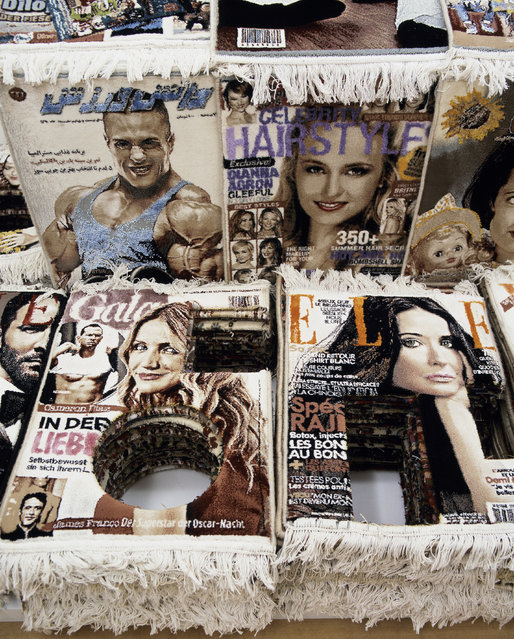
Magazine Store By Farhad Moshiri

Farhad Moshiri, an Iranian artist working a lot with carpet media using it as a mean to joke about consumerism culture, was one of the participants of the group show Love Me Love Me Not of Yarat! pavilion curate by Dina Nasser-Khadivi (read on her curating Lalla Essaydi's Harem here) at Venice 2013 Art Biennial. The installation consists of more than 500 carpets depicting celebrities-covered magazines from all over the world.
Details
02 Oct 2014 12:15:00


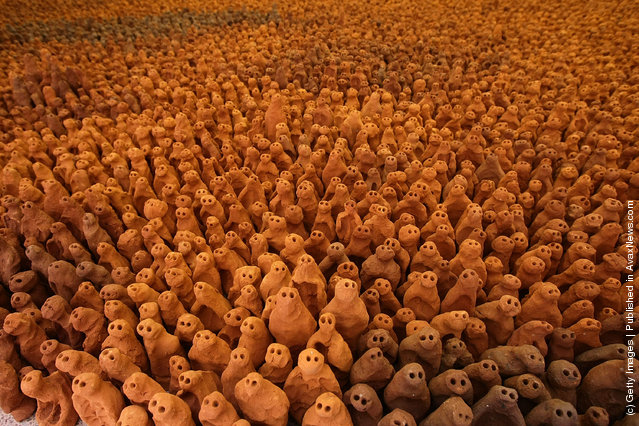
Figures from Antony Gormley's “Field For The British Isles” adorns an exhibition space in St Helen's College in the town of it's creation 15 years ago, June 23, 2008, St Helens, England. The installation of over 40,000 clay figures has returned to the place where it was made by local people from local clay. Artist Antony Gormley describes his creation as “25 tons of clay energised by fire, sensitised by touch and made conscious by being given eyes ... a field of gazes which looks at the observer making him or her its subject”. (Photo by Christopher Furlong/Getty Images)
Details
10 May 2011 09:20:00
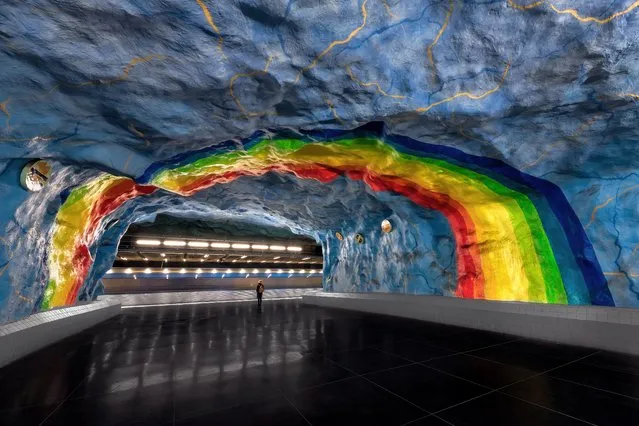
A rainbow arcs over a girl on the platform of Stadion station. (Photo by Conor MacNeill/The Observer)

Beneath the Swedish capital lies an intricate web of underground train lines. More than 90 of the 100 stations in the 110km tunnel system, sometimes referred to as “the world’s longest art gallery”, have been decorated with paintings, installations, mosaics and sculptures by 150 artists since the 1950s. After spending a couple of weeks exploring arctic Norway and Sweden, London-based travel photographer Conor MacNeill headed underground to capture images of the metro stations. Here: A rainbow arcs over a girl on the platform of Stadion station. (Photo by Conor MacNeill/The Observer)
Details
05 Jun 2016 13:21:00
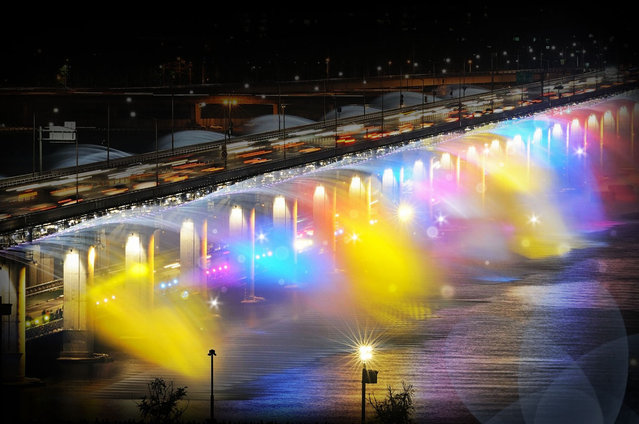
Moonlight Rainbow Fountain In Seoul South Korea

The Moonlight Rainbow Fountain is the world's longest bridge fountain that set a Guinness World Record with nearly 10,000 LED nozzles that run along both sides that is 1,140m long, shooting out 190 tons of water per minute. Installed in September 2009 on the Banpo Bridge, former mayor of Seoul Oh Se-hoon declared that the bridge will further beautify the city and showcase Seoul's eco-friendliness, as the water is pumped directly from the river itself and continuously recycled. The bridge has 38 water pumps and 380 nozzles on either side, which draw 190 tons of water per minute from the river 20 meters below the deck, and shoots as far as 43 meters horizontally.
Details
25 Jan 2014 18:48:00
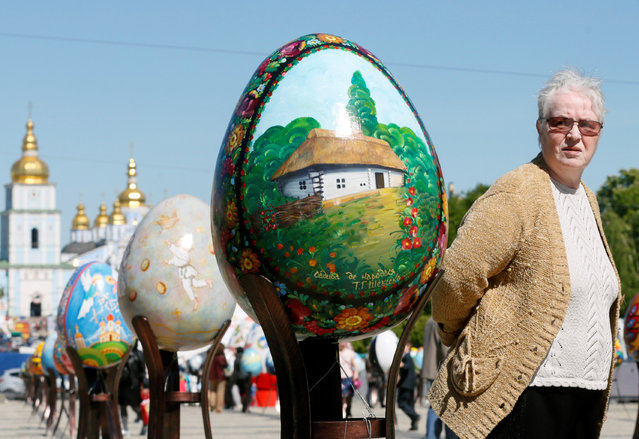
A woman looks at traditional Ukrainian Easter eggs “Pysanka”, installed as part of the upcoming celebrations of Easter, in central Kiev, Ukraine, April 29, 2016. A pysanka is a Ukrainian Easter egg, decorated with traditional Ukrainian folk designs using a wax-resist (batik) method. The word pysanka comes from the verb pysaty, “to write”, as the designs are not painted on, but written with beeswax. Many other eastern European ethnic groups decorate eggs using wax resist for Easter. These include the Belarusians, Bulgarians, Croats, Czechs, Hungarians, Lithuanians, Poles, Romanians, Serbs, Slovaks, Slovenes and Sorbs. (Photo by Valentyn Ogirenko/Reuters)

A woman looks at traditional Ukrainian Easter eggs “Pysanka”, installed as part of the upcoming celebrations of Easter, in central Kiev, Ukraine, April 29, 2016. A pysanka is a Ukrainian Easter egg, decorated with traditional Ukrainian folk designs using a wax-resist (batik) method. The word pysanka comes from the verb pysaty, “to write”, as the designs are not painted on, but written with beeswax. Many other eastern European ethnic groups decorate eggs using wax resist for Easter. These include the Belarusians, Bulgarians, Croats, Czechs, Hungarians, Lithuanians, Poles, Romanians, Serbs, Slovaks, Slovenes and Sorbs. (Photo by Valentyn Ogirenko/Reuters)
Details
30 Apr 2016 09:00:00
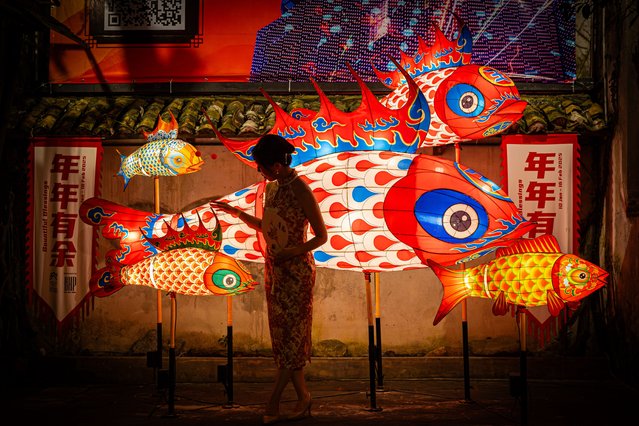
A woman dressed in a cheongsam interacts gracefully with vibrant fish lanterns at Kwai Chai Hong, a heritage revival alley in Chinatown, on January 09, 2025, in Kuala Lumpur, Malaysia. Kwai Chai Hong celebrates the Lunar New Year with an immersive art installation titled Bountiful Blessings, inspired by the idiom “Nian Nian You Yu”, which translates to “Wishing an Abundance Year After Year”, blending traditional fish lanterns with modern lights to inspire abundance and prosperity, inviting visitors to embark on a cultural journey of generosity and abundance for future generations. (Photo by Annice Lyn/Getty Images)

A woman dressed in a cheongsam interacts gracefully with vibrant fish lanterns at Kwai Chai Hong, a heritage revival alley in Chinatown, on January 09, 2025, in Kuala Lumpur, Malaysia. Kwai Chai Hong celebrates the Lunar New Year with an immersive art installation titled Bountiful Blessings, inspired by the idiom “Nian Nian You Yu”, which translates to “Wishing an Abundance Year After Year”, blending traditional fish lanterns with modern lights to inspire abundance and prosperity, inviting visitors to embark on a cultural journey of generosity and abundance for future generations. (Photo by Annice Lyn/Getty Images)
Details
12 Feb 2025 03:54:00
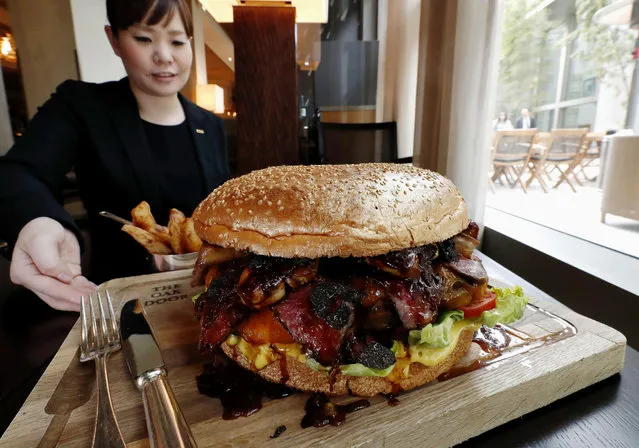
In this Thursday, March 28, 2019, photo, a “golden giant burger” is served at a restaurant of Hotel Grand Hyatt Tokyo in Tokyo. The $900 wagyu (Japanese-produced beef) burger was unveiled to commemorate the era change. What’s in a name? Quite a lot if you’re a Japanese citizen awaiting the official announcement Monday, April 1, 2019 of what the soon-to-be-installed new emperor’s next era will be called. It’s a proclamation that has happened only twice in nearly a century, and the new name will follow Emperor Naruhito, after his May 1 investiture, for the duration of his rule, attaching itself to much of what happens in Japan. (Photo by Kyodo News via AP Photo)

In this Thursday, March 28, 2019, photo, a “golden giant burger” is served at a restaurant of Hotel Grand Hyatt Tokyo in Tokyo. The $900 wagyu (Japanese-produced beef) burger was unveiled to commemorate the era change. What’s in a name? Quite a lot if you’re a Japanese citizen awaiting the official announcement Monday, April 1, 2019 of what the soon-to-be-installed new emperor’s next era will be called. It’s a proclamation that has happened only twice in nearly a century, and the new name will follow Emperor Naruhito, after his May 1 investiture, for the duration of his rule, attaching itself to much of what happens in Japan. (Photo by Kyodo News via AP Photo)
Details
02 Apr 2019 00:05:00