Loading...
Done
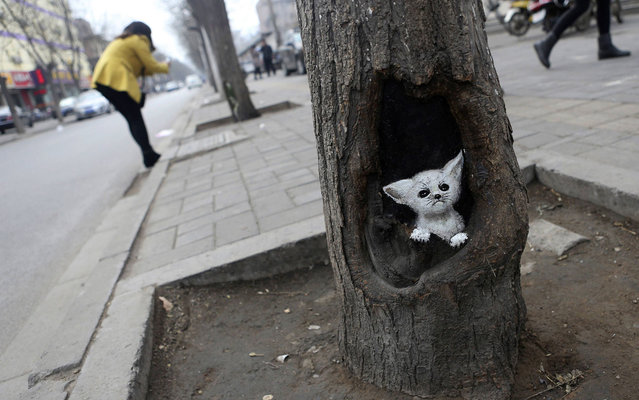
An image of a Fennec fox painted on a tree hole by Wang Yue is seen in Shijiazhuang, on March 13, 2013. Wang Yue, a senior at Dalian Industry University, uses her paintbrush to turn ugly tree holes into lovely views in Shijiazhuang, capital city of Hebei Province, China. Wang and her companions call the tree-hole paintings “meitu”, which means “beautiful journey”. The paintings on the trees have brightened the city during the dull, grey winter. (Photo by Pillar Lee/Reuters)

An image of a Fennec fox painted on a tree hole by Wang Yue is seen in Shijiazhuang, on March 13, 2013. Wang Yue, a senior at Dalian Industry University, uses her paintbrush to turn ugly tree holes into lovely views in Shijiazhuang, capital city of Hebei Province, China. Wang and her companions call the tree-hole paintings “meitu”, which means “beautiful journey”. The paintings on the trees have brightened the city during the dull, grey winter. (Photo by Pillar Lee/Reuters)

P.S. All pictures are presented in high resolution. To see Hi-Res images – just TWICE click on any picture. In other words, click small picture – opens the BIG picture. Click BIG picture – opens VERY BIG picture (if available; this principle works anywhere on the site AvaxNews).
Details
16 Mar 2013 11:27:00
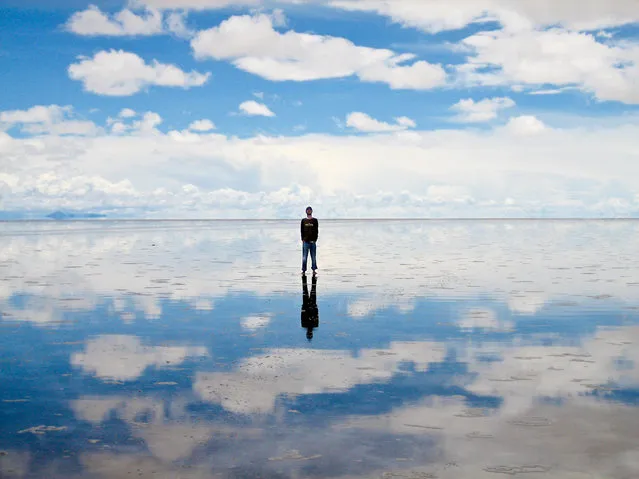
Salar de Uyuni

Salar de Uyuni (or Salar de Tunupa) is the world's largest salt flat at 10,582 square kilometers (4,086 sq mi). It is located in the Potosí and Oruro departments in southwest Bolivia, near the crest of the Andes, and is elevated 3,656 meters (11,995 ft) above mean sea level. The Salar was formed as a result of transformations between several prehistoric lakes. It is covered by a few meters of salt crust, which has an extraordinary flatness with the average altitude variations within one meter over the entire area of the Salar.
Details
04 Aug 2012 08:42:00


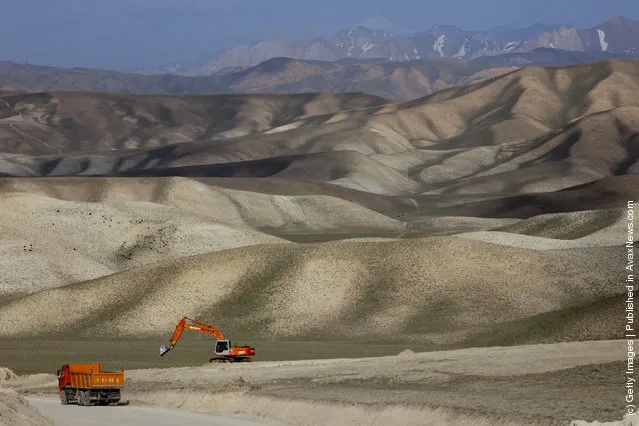
Heavy equipment works along the still under construction Bamiyan-Yakawlang road June 10, 2011 in Yakawlang, Afghanistan. The 69 Million US$ project is supported by the Government of Japan and World Bank. The 90K road project was started three years ago and is slated to be finished within another year. This new road means faster travel from Bamiyan to Afghanistan's only national park, Band-e-Amir. This is in of the safest parts of the country and the hope is to expand tourism in the region. (Photo by Paula Bronstein/Getty Images)
Details
11 Jun 2011 12:32:00
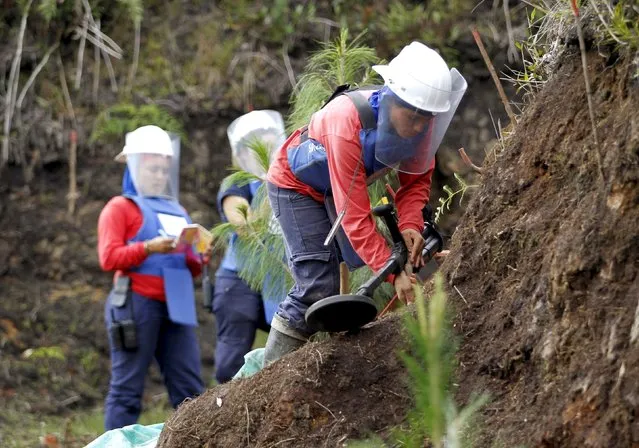
Natalia Arango works with her mine detector in a zone of landmines planted by rebels groups near Sonson in Antioquia province, November 19, 2015. (Photo by Fredy Builes/Reuters)

Natalia Arango works with her mine detector in a zone of landmines planted by rebels groups near Sonson in Antioquia province, November 19, 2015. Women's work takes on a nontraditional meaning for fifteen Colombian women who work to rid the Antioquia Mountains of deadly landmines as the country edges closer to a peace agreement with Marxist rebels to end over a decade of conflict which has claimed 220,000 lives. (Photo by Fredy Builes/Reuters)
Details
27 Nov 2015 04:44:00
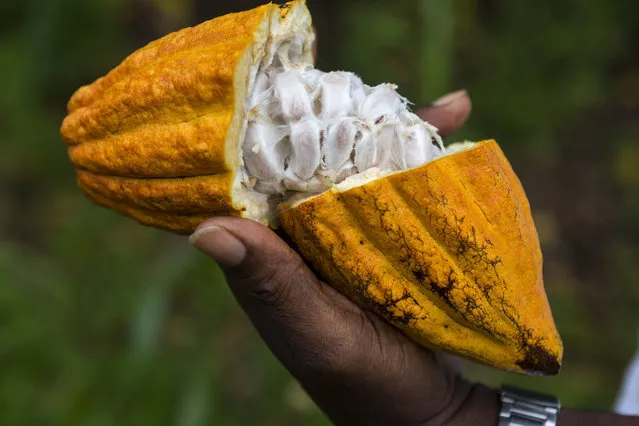
Farmer holding a freshly cut cocoa bean pod, revealing the pulp and seed inside on a rainforest farm. (Photo by Doug McKinlay/Getty Images)

Chocolate is the greatest gift the Earth has given us. The dessert table would be a sad sight without it. It’s so beloved, so appreciated, that the Swedish scientist who named the cocoa plant that gives us chocolate called it Theobroma cacao, which means “food of the gods”. Here: Farmer holding a freshly cut cocoa bean pod, revealing the pulp and seed inside on a rainforest farm. (Photo by Doug McKinlay/Getty Images)
Details
10 Aug 2016 10:20:00
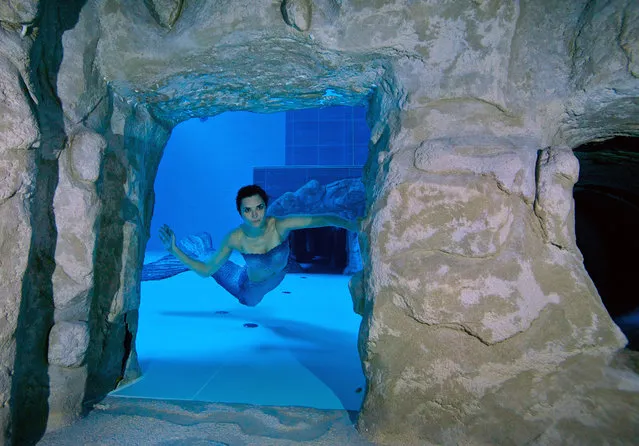
The Y-40 Deep Joy features several levels and grottos. (Photo by Courtesy Y40 Deep Joy)

The Y-40 Deep Joy is the worlds deepest pool. Y-40 is projected by Architect Emanuele Boaretto and supported by the “Boaretto Group Hotel and Resort”. The name Y-40 is inspired by mathematical symbols. “Y” is the ordinate axis of the Cartesian system and “–40” means the world's record depth or our pool- that is 40 meters underground. (Photo by Courtesy Y40 Deep Joy)
Details
07 Oct 2014 11:09:00
Ukrainian artist Dariya Marchenko works on a portrait of Russian President Vladimir Putin named “The Face of War” which is made out of 5,000 cartridges brought from the frontline in eastern Ukraine, in Kiev, July 23, 2015. The portrait will be presented along with a novel which will tell personal stories of six people involved in this project including Daria's own story and stories of people who helped her to collect shells from the frontline. (Photo by Gleb Garanich/Reuters)

Ukrainian artist Dariya Marchenko works on a portrait of Russian President Vladimir Putin named “The Face of War” which is made out of 5,000 cartridges brought from the frontline in eastern Ukraine, in Kiev, July 23, 2015. The portrait will be presented along with a novel which will tell personal stories of six people involved in this project including Daria's own story and stories of people who helped her to collect shells from the frontline. Daria Marchenko calls her art approach philosophic symbolism where every element has its hidden meaning. In her works cartridges mean human's life that was brutally ended. (Photo by Gleb Garanich/Reuters)
Details
28 Jul 2015 12:44:00
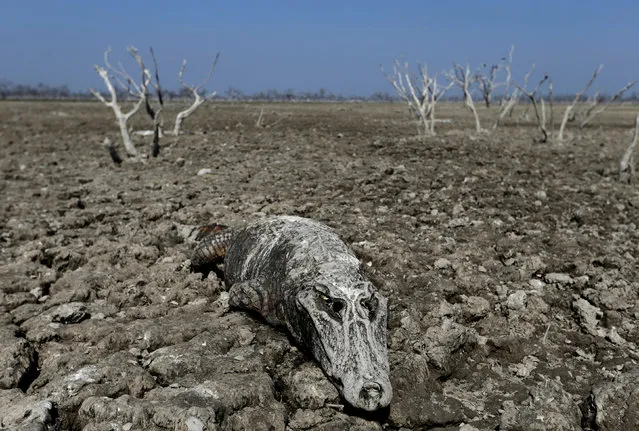
The carcass of a yacare caiman lies in the dried-up river bed of the Pilcomayo river in Boqueron, Paraguay, August 14, 2016. In Paraguay, alongside the Pilcomayo River, black vultures flew over a shrinking pond where a group of crocodilian reptiles known as yacare caimans sought refuge. Water from the river, which divides Paraguay and Argentina in the area of the Gran Chaco, was scarce. This is not an uncommon sight in the region of General Diaz, about 700 kilometres (435 miles) northwest of the country's capital Asuncion, where the Pilcomayo's waters form lakes and streams that give life to capybaras, birds and caimans. “The river's situation is critical. No water is forecast to enter the basin until December, as happens every year”, said Alcides Gonzalez, a resident of the area. (Photo by Jorge Adorno/Reuters)

The carcass of a yacare caiman lies in the dried-up river bed of the Pilcomayo river in Boqueron, Paraguay, August 14, 2016. In Paraguay, alongside the Pilcomayo River, black vultures flew over a shrinking pond where a group of crocodilian reptiles known as yacare caimans sought refuge. Water from the river, which divides Paraguay and Argentina in the area of the Gran Chaco, was scarce. This is not an uncommon sight in the region of General Diaz, about 700 kilometres (435 miles) northwest of the country's capital Asuncion, where the Pilcomayo's waters form lakes and streams that give life to capybaras, birds and caimans. (Photo by Jorge Adorno/Reuters)
Details
03 Nov 2016 12:40:00