Loading...
Done
A mudlark uses a torch to look for items on the bank of the River Thames in London, Britain June 06, 2016. Mudlarking is believed to trace its origins to the 18th and 19th century, when scavengers searched the Thames' shores for items to sell. These days, history and archaeology fans are the ones hoping to find old relics such as coins, ceramics, artifacts or everyday items from across centuries. They wait for the low tide and then scour specific areas of exposed shores. "If you're in a field you could be out all day long, with the river you're restricted to about two or three hours," mudlark Nick Stevens said. While many just use the naked eye for their searches, others rely on metal detectors for which a permit from the Port of London Authority is needed. Digging also requires consent. (Photo by Neil Hall/Reuters)

A mudlark uses a torch to look for items on the bank of the River Thames in London, Britain June 06, 2016. Mudlarking is believed to trace its origins to the 18th and 19th century, when scavengers searched the Thames' shores for items to sell. These days, history and archaeology fans are the ones hoping to find old relics such as coins, ceramics, artifacts or everyday items from across centuries. their finds with the Portable Antiquities Scheme. Any item over 300 years old must be recorded. (Photo by Neil Hall/Reuters)
Details
27 Aug 2016 10:43:00
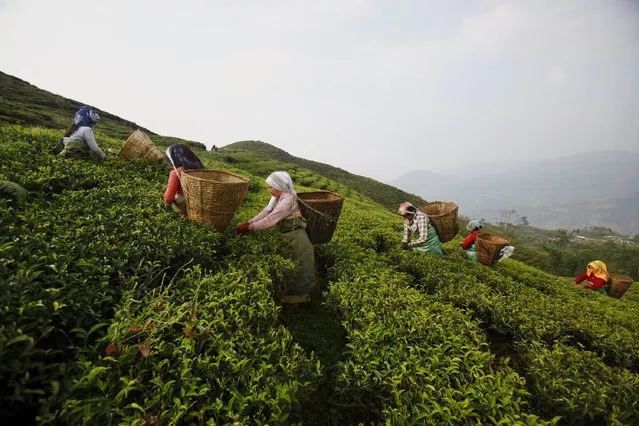
In this Sunday, November 16, 2014 photo, Nepalese women pick tea at a tea garden of Kanyam in Illam district, around 500 kilometers (310 miles) from Katmandu, Nepal. Illam is a hilly district of tea gardens and estates in eastern Nepal's Himalayan region with one of its largest and most productive tea estate being Kanyam estates. (Photo by Niranjan Shrestha/AP Photo)

In this Sunday, November 16, 2014 photo, Nepalese women pick tea at a tea garden of Kanyam in Illam district, around 500 kilometers (310 miles) from Katmandu, Nepal. Illam is a hilly district of tea gardens and estates in eastern Nepal's Himalayan region with one of its largest and most productive tea estate being Kanyam estates. The district produces orthodox tea, hand-processed or machine rolled, which is generally exported to international markets, specially Europe and the United States. Most of the tea pickers here are paid 186 Nepalese Rupees (US $ 2) for 8 hours of work everyday. (Photo by Niranjan Shrestha/AP Photo)
Details
19 Nov 2014 14:28:00
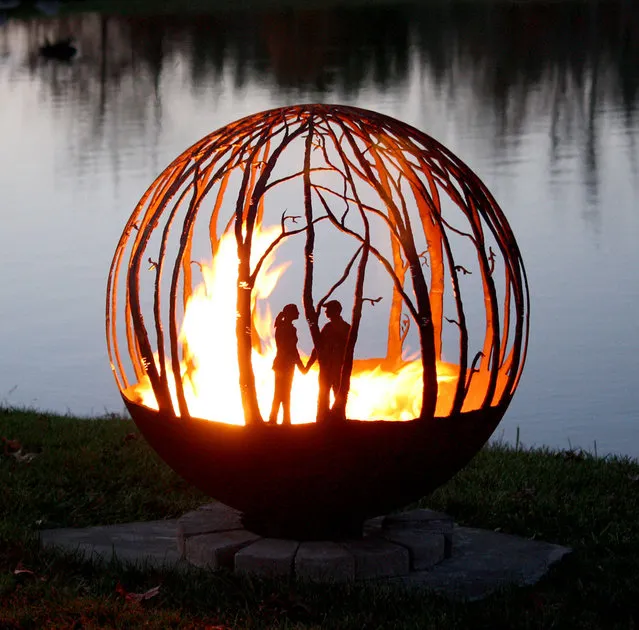
Fire Pit By Melissa Crisp

A burning flame and a broad expanse of water are among the few things which do not tire us with their beauty. However, while we have many sources of water around us, it is quite hard to marvel at a burning flame on a daily basis. Melissa Crisp is one of the few people who were able to subdue the element of fire. She is the person who is behind the design of the uniquely-shaped fire pits, which feature mystifying themes, including a pair of lovers, a fire on the rodeo arena, a forest fire, a fiery flower, and a number of others. Each of the fire pits entrances you, and it almost seems like the characters are alive, as the hot fire burns deep within the spheres, casting dancing shadows all around. (Photo by Melissa Crisp)
Details
15 Jan 2015 13:35:00
“Whether that means getting up way before the sun, like I do most days, going out somewhere that I’m not comfortable or just trying to get different angles or styles of photos, I am trying to display the crazy beauty of the ocean, and usually moments that literally last less than a split second”. (Photo by Ryan Pernoski/Caters News Agency)

These kaleidoscopic images are the work of one persistent photographer’s efforts to capture vibrant hues at the exact moment a wave breaks. Ryan Pernofski‘s stunning shots feature brilliant yellows, reds, blues and purples as an array of sunlight hits the water at the perfect time. What’s even more impressive: Ryan, a 27-year-old Australian, began shooting his popular masterpieces without using a professional camera, taking his iPhone out into the water instead. Ryan began experimenting with this method in 2012, using an underwater housing to protect his phone, as he could not afford a professional camera. (Photo by Ryan Pernoski/Caters News Agency)
Details
09 Jun 2018 00:05:00
Farmers use tractors and burn tires, hay and manure as they block the highway between Morlaix and Brest during a demonstration against the market prices of their product, on July 22, 2015 in Morlaix, western of France. French farmers protesting over falling food prices threatened to step up blockades of cities, roads and tourist sites, as the government prepared to unveil emergency aid for them. (Photo by Fred Tanneau/AFP Photo)

Farmers use tractors and burn tires, hay and manure as they block the highway between Morlaix and Brest during a demonstration against the market prices of their product, on July 22, 2015 in Morlaix, western of France. French farmers protesting over falling food prices threatened to step up blockades of cities, roads and tourist sites, as the government prepared to unveil emergency aid for them. Farmers have dumped manure in cities, blocked access roads and motorways and hindered tourists from reaching Mont St-Michel in northern France, one of France's most visited sites. (Photo by Fred Tanneau/AFP Photo)
Details
23 Jul 2015 10:39:00
A 20 metre high spiral staircase in a tower used as an emergency exit, is seen inside a Federal Reserve bank (Bundesbank) bunker, prior to the bunker's official opening to the public in Cochem, Germany, March 18, 2016. (Photo by Kai Pfaffenbach/Reuters)

A 20 metre high spiral staircase in a tower used as an emergency exit, is seen inside a Federal Reserve bank (Bundesbank) bunker, prior to the bunker's official opening to the public in Cochem, Germany, March 18, 2016. West Germany's Central Bank (Deutsche Bundesbank) stored some 20 billion German marks of emergency notes in two underground bunkers, one in Frankfurt the other in Cochem, between 1964-1988 during the cold war. (Photo by Kai Pfaffenbach/Reuters)
Details
19 Mar 2016 12:36:00
Model Bianca Gavrilas wears a a hand-embroidered cape made from the silk of the Golden Orb Spider in the V&A Museum's Medieval and Renaissance Gallery

Model Bianca Gavrilas wears a a hand-embroidered cape made from the silk of the Golden Orb Spider in the V&A Museum's Medieval and Renaissance Gallery on January 23, 2012 in London, England. The cape is one of two golden spider silk textiles that exist in the world, it was made in Madagascar over a period of 8 years and using the silk of silk of 1.2million spiders. (Photo by Oli Scarff/Getty Images)
Details
26 Jan 2012 12:02:00
Loi Krathong Festival In Thailand

We are all drawn to fire, entranced by its beauty and ferociousness. Its brilliance draws us in like moths to a candle flame. Thus, many of the celebrations that humans have involve lighting fires. They can be big or small; there could be many little lights or one giant inferno; they may float on water, burn on land, or rise high into the skies. Loi Krathong is a festival that is held each year in Thailand and a number of other places. During this festival thousands of little fires are lighted, presenting a marvelous sight for all the onlookers. It is believed that this tradition is an adaptation of Brahmanical festival, which was adopted by Thai Buddhists to honor Buddha.
Details
30 Jan 2015 10:38:00