Loading...
Done
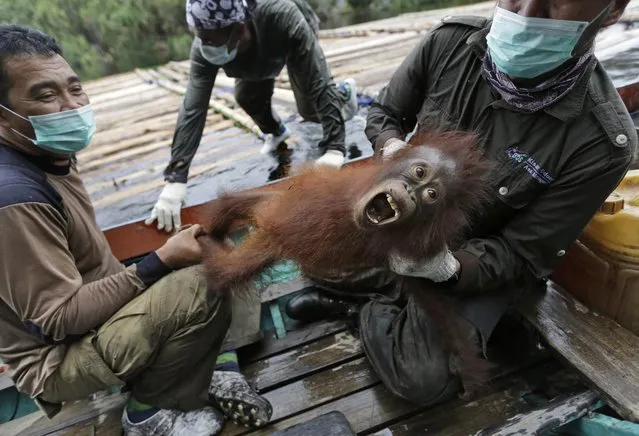
In this January 7, 2016, photo, conservationists of Borneo Orangutan Survival Foundation hold a baby orangutan rescued along with its mother during a rescue and release operation for orangutans trapped in a swath of jungle in Sungai Mangkutub, Central Kalimantan, Indonesia. Last year's forest fires drove orangutans closer to the river bank, where they had to live in an over-populated swath of forest as thin as 30 meters wide along the river. (Photo by Dita Alangkara/AP Photo)

In this January 7, 2016, photo, conservationists of Borneo Orangutan Survival Foundation hold a baby orangutan rescued along with its mother during a rescue and release operation for orangutans trapped in a swath of jungle in Sungai Mangkutub, Central Kalimantan, Indonesia. Last year's forest fires drove orangutans closer to the river bank, where they had to live in an over-populated swath of forest as thin as 30 meters wide along the river. (Photo by Dita Alangkara/AP Photo)
Details
25 Jan 2016 11:36:00
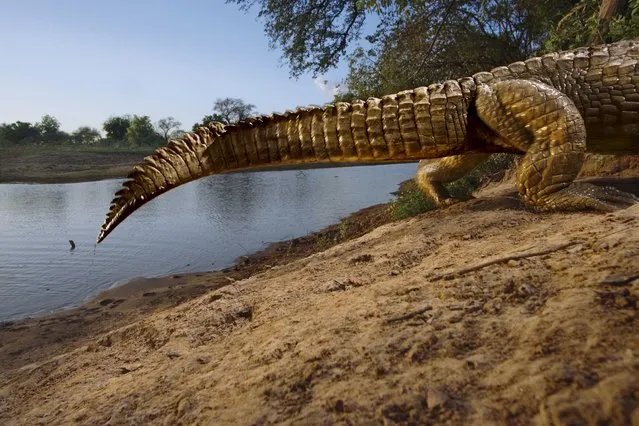
CT4 Crocodile cave on the Salamat river. Set up with Nathan Williamson last chip rain came while we were with the nomads. (Photo by Michael Nichols/National Geographic)

National Geographic has created “Air, Land & Sea: the 50 greatest wildlife photographs” exhibition. Here: CT4 Crocodile cave on the Salamat river. Set up with Nathan Williamson last chip rain came while we were with the nomads. (Photo by Michael Nichols/National Geographic)
Details
13 Sep 2018 00:03:00
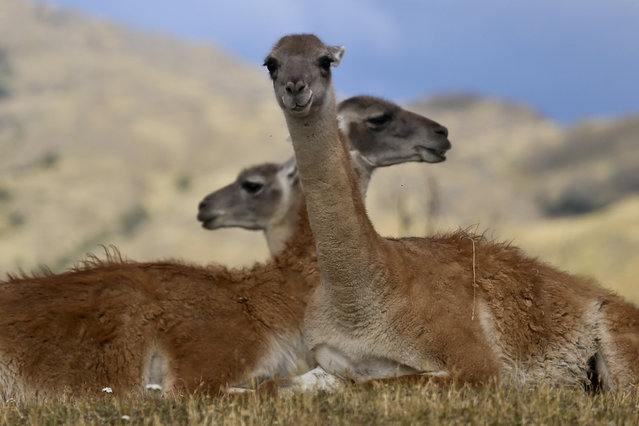
Guanacos sit during a signing ceremony in Patagonia Park, Chile, January 29, 2018. Chilean President Michelle Bachelet signed decrees Monday creating vast new national parks using lands donated by U.S. conservation organization Tompkins Conservation in what is believed to be the largest private donation of land ever from a private entity to a country. (Photo by Esteban Felix/AP Photo)

Guanacos sit during a signing ceremony in Patagonia Park, Chile, January 29, 2018. Chilean President Michelle Bachelet signed decrees Monday creating vast new national parks using lands donated by U.S. conservation organization Tompkins Conservation in what is believed to be the largest private donation of land ever from a private entity to a country. (Photo by Esteban Felix/AP Photo)
Details
27 Dec 2018 00:01:00
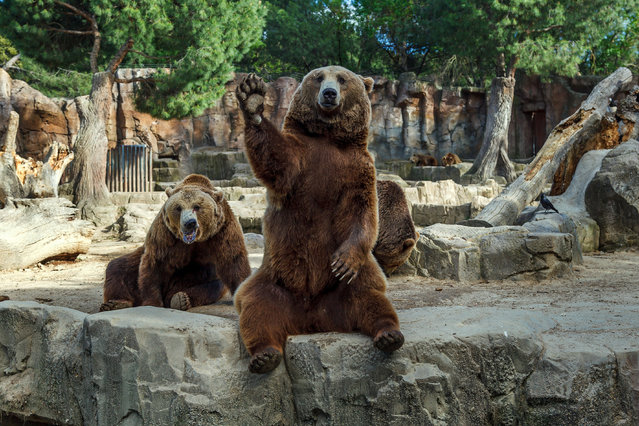
A photographer could bear-ly believe his eyes when a bear started waving at him. The friendly animal wandered to the front of his enclosure before sitting back in full view of zoo guests. He then lifts his powerful paw and excitedly waves in an almost human-like way at his new audience. The hilarious encounter was captured by keen photographer Andrey Slepnev, 31, while on a trip to Madrid Zoo, Spain on March 24, 2016. (Photo by Andrey Slepnev/Caters News)

A photographer could bear-ly believe his eyes when a bear started waving at him. The friendly animal wandered to the front of his enclosure before sitting back in full view of zoo guests. He then lifts his powerful paw and excitedly waves in an almost human-like way at his new audience. The hilarious encounter was captured by keen photographer Andrey Slepnev, 31, while on a trip to Madrid Zoo, Spain on March 24, 2016. (Photo by Andrey Slepnev/Caters News)
Details
11 Oct 2016 11:25:00
An undated handout picture released on January 10, 2017 by the Issekinicho publishing house shows an inter- species sexual behaviour between a male Japanese macaque and female sika deer, in Yakushima Scientists revealed on January 10, 2017 the “highly unusual” behaviour of a male monkey filmed trying to have s*x with female deer in Japan – a rare case of inter- species nookie. (Photo by Editions Issekinicho/AFP Photo)

An undated handout picture released on January 10, 2017 by the Issekinicho publishing house shows an inter- species sexual behaviour between a male Japanese macaque and female sika deer, in Yakushima Scientists revealed on January 10, 2017 the “highly unusual” behaviour of a male monkey filmed trying to have sеx with female deer in Japan – a rare case of inter- species nookie. (Photo by Editions Issekinicho/AFP Photo)
Details
15 Jan 2017 11:00:00
Five year old George holds an orange to feed the Owl butterflies at the Natural History Museum in London, Thursday, March 30, 2017. Hundreds of tropical butterflies were released to launch the Natural History Museum's Sensational Butterflies exhibition, starting for the public on March 31, 2017. (Photo by Frank Augstein/AP Photo)

Five year old George holds an orange to feed the Owl butterflies at the Natural History Museum in London, Thursday, March 30, 2017. Hundreds of tropical butterflies were released to launch the Natural History Museum's Sensational Butterflies exhibition, starting for the public on March 31, 2017. (Photo by Frank Augstein/AP Photo)
Details
31 Mar 2017 08:40:00
“Natural History”: Tiger. (Photo by Traer Scott)

“Natural History” is a series of completely candid single exposure images that merge the living and the dead to create allegorical narratives of our troubled co-existence with nature. Ghost-like reflections of modern visitors viewing wildlife dioramas are juxtaposed against the antique taxidermied subjects housed behind thick glass, their faces molded into permanent expressions of fear, aggression or fleeting passivity. After decades of over-hunting, climate change, poaching and destruction of habitat, many of these long dead diorama specimens now represent endangered or completely extinct species”. – Traer Scott. (Photo by Traer Scott)
Details
27 Oct 2014 11:39:00
It would seem to be something you'd see only in a cartoon or at a Phish concert, but according to park rangers in New South Wales, Australia, dozens of giant, fluorescent pink slugs have been popping up on a mountaintop there. (Photo by Michael Murphy/AFP Photo/NSW Environment Office)

It would seem to be something you'd see only in a cartoon or at a Phish concert, but according to park rangers in New South Wales, Australia, dozens of giant, fluorescent pink slugs have been popping up on a mountaintop there. The eight-inch creatures have been spotted only on Mount Kaputar, a 5,000-foot peak in the Nandewar Range in northern New South Wales. Scientists believe the eye-catching organisms are survivors from an era when Australia was home to rainforests. A series of volcanoes, millions of years of erosion and other geological changes “have carved a dramatic landscape at Mount Kaputar”, the park service wrote on its Facebook page, and unique arid conditions spared the slugs from extinction. (Photo by Michael Murphy/AFP Photo/NSW Environment Office)
Details
01 Jun 2013 14:09:00