Loading...
Done
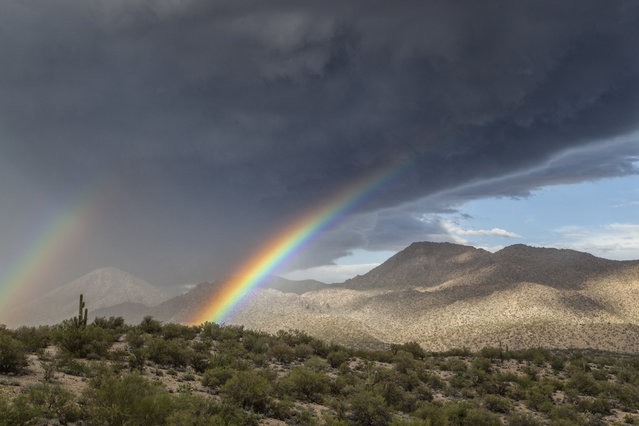
Two rainbows emerge from a black storm above the mountains, on August 19, 2014, in Kingman, Arizona.  Double tornadoes, lightning storms and rotating supercells – this is what it's like to chase storms for a year.(Photo by Roger Hill/Barcroft Media)

Two rainbows emerge from a black storm above the mountains, on August 19, 2014, in Kingman, Arizona. Double tornadoes, lightning storms and rotating supercells – this is what it's like to chase storms for a year. These dramatic images show apocalyptic weather throughout 2014 from a lightning storm to a pair of rainbows. Roger Hill, 57, has been chasing storms in the United States for thirty years and runs a tour operation with his wife Caryn. His favourite photograph of the year was also one of the most difficult to get – as two violent tornadoes tore through Pilger, Nebraska on June 16. The spiraling winds killed a five-year-old girl and injured at least 19 others, and as Roger tried to get the perfect shot debris began to rain down on his car. (Photo by Roger Hill/Barcroft Media)
Details
25 Feb 2015 09:27:00
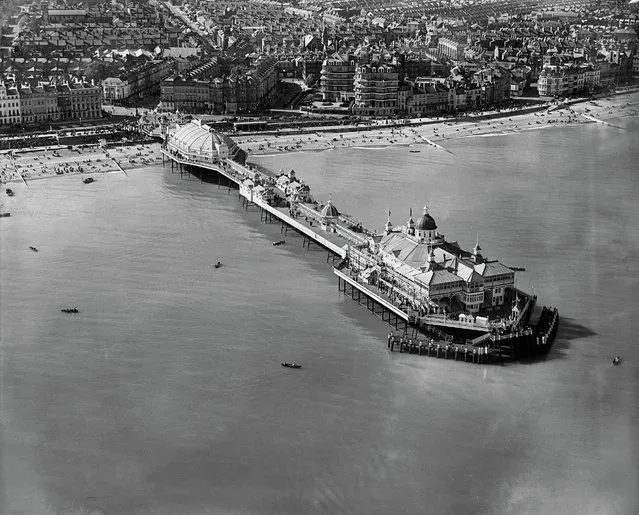
While the lido was described as bringing “modernism to the masses” on the British coast it was just the latest example of a trend that had been developing since Victorian times – transforming seaside towns into resorts for leisure and entertainment. In the latter half of the nineteenth century, the fashion was for local authorities to build great piers stretching from the promenade out into the sea

While the lido was described as bringing “modernism to the masses” on the British coast it was just the latest example of a trend that had been developing since Victorian times – transforming seaside towns into resorts for leisure and entertainment. In the latter half of the nineteenth century, the fashion was for local authorities to build great piers stretching from the promenade out into the sea. The Eastbourne Pier, pictured here in May 1931, was erected between 1866 and 1870 to an ingenious design by Eugenius Birch, which saw the structure sitting on special cups allowing the supporting struts to “move” in bad weather. Arranged on the pier's 1,000-foot length were kiosks, a theatre, a ballroom and a camera obscura. 1931. (Photo by Aerofilms Collection via “A History of Britain From Above”)
Details
25 Feb 2014 12:59:00
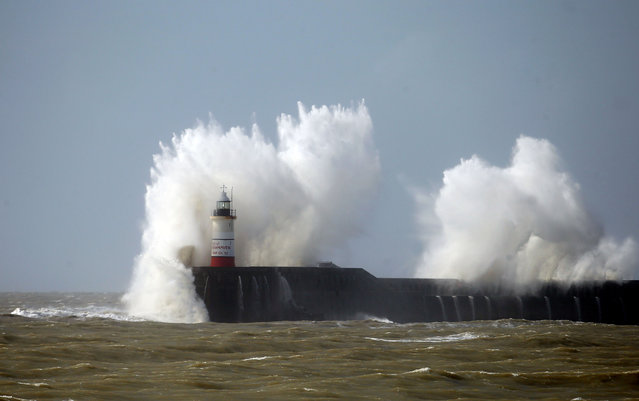
Waves crash against the lighthouse at Newhaven, England, Monday March 28, 2016. Some flights at London's Gatwick and Heathrow airports have been diverted due to high winds battering much of Britain and western France. The high winds from a storm caused 87 cancellations and 43 diversions at Gatwick and Heathrow because flights had trouble landing safely. (Photo by Steve Parsons/PA Wire via AP Photo)

Waves crash against the lighthouse at Newhaven, England, Monday March 28, 2016. Some flights at London's Gatwick and Heathrow airports have been diverted due to high winds battering much of Britain and western France. The high winds from a storm caused 87 cancellations and 43 diversions at Gatwick and Heathrow because flights had trouble landing safely. (Photo by Steve Parsons/PA Wire via AP Photo)
Details
30 Mar 2016 11:24:00
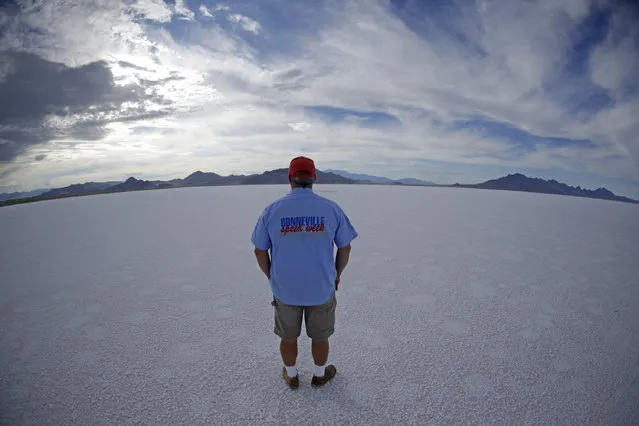
In this Monday, July 20, 2015 photo, Bill Lattin, the Southern California Timing Association president and Speed Week race director, stands in the Bonneville Salt Flats in Utah. (Photo by Rick Bowmer/AP Photo)

In this Monday, July 20, 2015 photo, Bill Lattin, the Southern California Timing Association president and Speed Week race director, stands in the Bonneville Salt Flats in Utah. A small city of tents, trailers and thousands of visitors appears almost every August in the Utah desert to watch cars, motorcycles and anything with wheels rocket across gleaming white sheets of salt at speeds of 400 mph. But wet weather has forced the cancellation of Speed Week for the second straight year and revived a debate about whether nearby mining is depleting the Bonneville Salt Flats of their precious resource. (Photo by Rick Bowmer/AP Photo)
Details
28 Jul 2015 13:01:00
Indigenous dancers participate in a traditional healing ceremony for the mother earth at El Salvador del Mundo Square in San Salvador, December 10, 2014. Salvadorean indigenous organizations participated in a ceremony to ask for solutions to stop climate change and respect planet earth as the U.N. Climate Change Conference COP 20 is bring held in Peru. (Photo by Jose Cabezas/Reuters)

Indigenous dancers participate in a traditional healing ceremony for the mother earth at El Salvador del Mundo Square in San Salvador, December 10, 2014. Salvadorean indigenous organizations participated in a ceremony to ask for solutions to stop climate change and respect planet earth as the U.N. Climate Change Conference COP 20 is bring held in Peru. The two-week long United Nations climate summit opened on December 1 in Lima, with experts and analysts from around the world gathering to discuss melting glaciers and extreme weather patterns. (Photo by Jose Cabezas/Reuters)
Details
12 Dec 2014 12:51:00
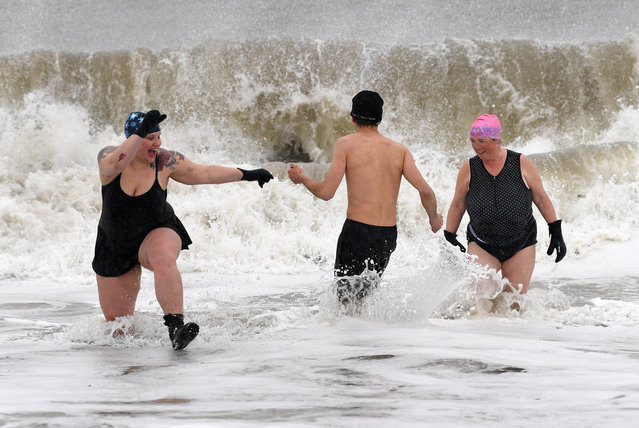
Despite the high winds and fright temperatures, about 1/2 dozen brave members of the Coney Island Polar Bear Club took a dip in the Atlantic Ocean at March 14, 2017, just of Stillwell avenue in Coney Island beach in Brooklyn NYC. Snow began blanketing northeastern United States on Tuesday as a winter storm packing blizzard conditions rolled into the region, prompting public officials to ask people to stay home while airlines grounded flights and schools canceled classes. The National Weather Service issued blizzard warnings for parts of eight states including New York, Pennsylvania, New Jersey and Connecticut, with forecasts calling for up to 2 feet of snow by early Wednesday, with temperatures 15 to 30 degrees below normal for this time of year. (Photo by Paul Martinka)

Despite the high winds and fright temperatures, about 1/2 dozen brave members of the Coney Island Polar Bear Club took a dip in the Atlantic Ocean at March 14, 2017, just of Stillwell avenue in Coney Island beach in Brooklyn NYC. (Photo by Paul Martinka)
Details
16 Mar 2017 00:00:00
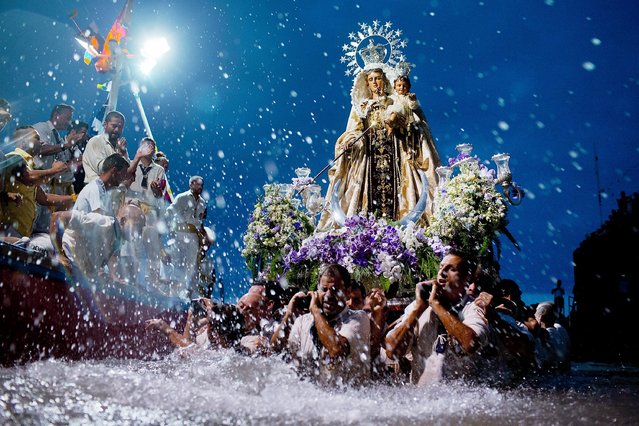
Carriers of the Great God Power brotherhood unload Virgen del Carmen statue after its journey on July 15, 2014 at Puerto de la Cruz dock on the Canary island of Tenerife, Spain. Since 1921, the statue of the Virgen del Carmen, patron saint of fishermen, has been carried with great fanfare annually as part of July Festivities to the Puerto de la Cruz dock where, at the end of its procession, it is hoisted aboard a decorated boat. (Photo by Gonzalo Arroyo Moreno/Getty Images)

Carriers of the Great God Power brotherhood unload Virgen del Carmen statue after its journey on July 15, 2014 at Puerto de la Cruz dock on the Canary island of Tenerife, Spain. Since 1921, the statue of the Virgen del Carmen, patron saint of fishermen, has been carried with great fanfare annually as part of July Festivities to the Puerto de la Cruz dock where, at the end of its procession, it is hoisted aboard a decorated boat. Weather permitting, the boat carrying the statue, accompanied by a flotilla of other boats, makes a short journey along the island coast before returning to the harbour. In recent years, attendance at the event has numbered more than 35,000 people. (Photo by Gonzalo Arroyo Moreno/Getty Images)
Details
21 Jul 2014 11:18:00
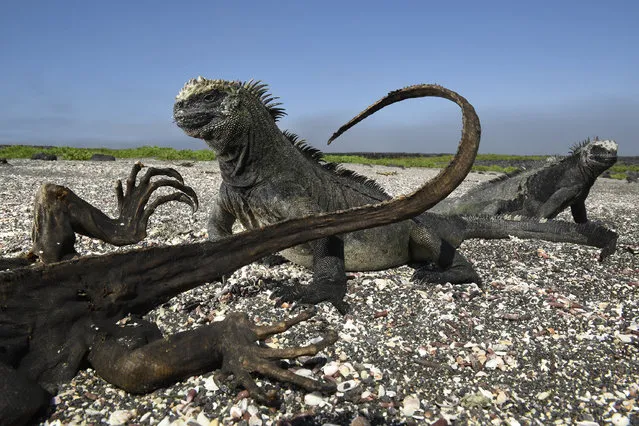
Galapagos – Rocking the Cradle: Four major ocean currents converge along the Galapagos archipelago, creating the conditions for an extraordinary diversity of animal life, April 25, 2016. The islands are home to at least 7,000 flora and fauna species, of which 97 percent of the reptiles, 80 percent of the land birds, 50 percent of the insects and 30 percent of the plants are endemic. The local ecosystem is highly sensitive to the changes in temperature, rainfall and ocean currents that characterize the climatic events known as El Niño and La Niña. These changes cause marked fluctuations in weather and food availability. Many scientists expect the frequency of El Niño and La Niña to increase as a result of climate change, making the Galapagos a possible early-warning location for its effects. (Photo by Thomas P. Peschak for National Geographic/World Press Photo)

Galapagos – Rocking the Cradle: Four major ocean currents converge along the Galapagos archipelago, creating the conditions for an extraordinary diversity of animal life, April 25, 2016. The islands are home to at least 7,000 flora and fauna species, of which 97 percent of the reptiles, 80 percent of the land birds, 50 percent of the insects and 30 percent of the plants are endemic. (Photo by Thomas P. Peschak for National Geographic/World Press Photo)
Details
16 Apr 2018 00:01:00