Loading...
Done
An iCub robot built by the Italian Institute of Technology tracks a ball in the Robotville exhibition at the Science Museum on November 29, 2011 in London, England

An iCub robot built by the Italian Institute of Technology tracks a ball in the Robotville exhibition at the Science Museum on November 29, 2011 in London, England. The Science Museum's Robotville exhibition showcases 20 unique and cutting-edge robots from European research laboratories, it is free to enter and runs from December 1–4, 2011. (Photo by Oli Scarff/Getty Images)
Details
30 Nov 2011 13:04:00
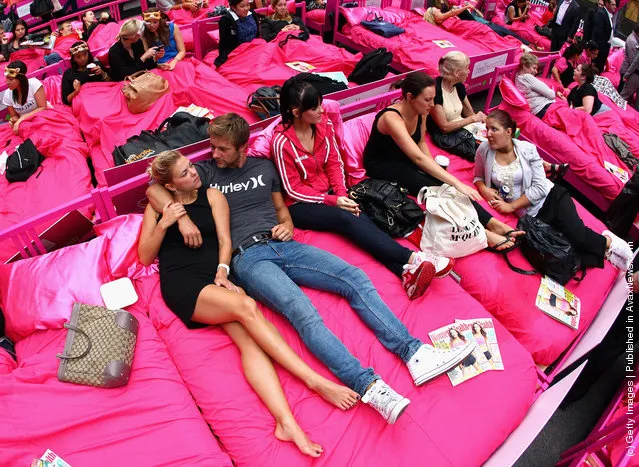
People wait in beds during the The World's Biggest Breakfast in Bed Guinness World Record Attempt at Martin Place in Sydney, Australia

People wait in beds during the The World's Biggest Breakfast in Bed Guinness World Record Attempt at Martin Place on March 2, 2012 in Sydney, Australia. 289 Australians join forces to create history as Martin Place is transformed into a giant bedroom. All participants was enjoy a substantial breakfast served in bed by celebrity chef “Fast” Ed Halmagyi and a free goodie bag valued at over $100. (Photo by Ryan Pierse/Getty Images)
Details
02 Mar 2012 10:51:00
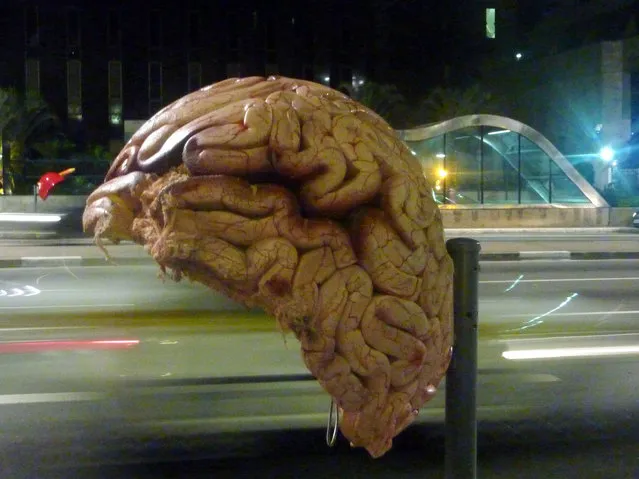
Call Paradei In Sao Paulo

Call Parade is an ongoing public art project in São Paulo sponsored by Brazilian telecommunications firm Vivo, that paired 100 artists with 100 street-side phone booths giving them free reign to transform the peculiar hooded fixtures into anything imaginable. The exhibition has proven to be extremely popular and Brazilian photographer Mariane Borgomani set out to capture a number of the phones, my favorite of which is the painted day/night treatment above by artist Maramgoní.
Details
26 Jun 2015 07:41:00
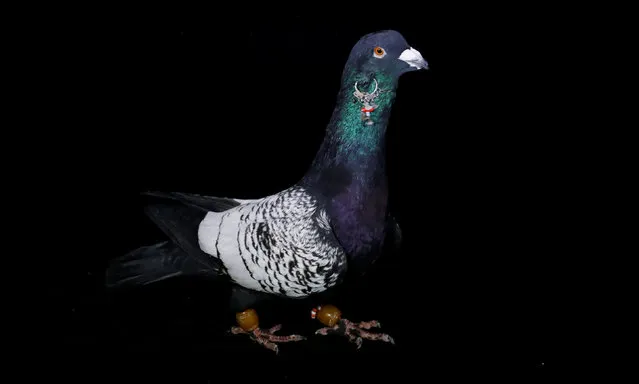
A pigeon, known as Siyah Kinifirli, with an approximate market value of 1000 Turkish Lira ($263), bred by 23-year-old Ismail Ozbek, is pictured in Sanliurfa, Turkey, December 23, 2016. As night-time approaches in Sanliurfa, southeastern Turkey, most of the alleyways of the city's old bazaar are emptying out of buyers and vendors, except for one. The bustle of daytime trading has died down, but on this little street, a stream of men carry cardboard boxes filled with pigeons to a cluster of three teahouses. Here, they sell the birds at Sanliurfa's famed auctions to a dedicated band of pigeon keepers and breeders, a pastime that has been thriving for hundreds of years across the region and over the nearby border into war-torn Syria. In a country where the minimum wage is about 1,400 Liras ($367) a month, enthusiasts regularly easily spend hundreds of dollars for one bird. “I once sold a pair of pigeons for 35,000 Turkish Lira”, says auctioneer Imam Dildas. “This is a passion, a hobby you cannot quit. I've been known to sell the fridge and my wife's gold bracelets to pay for pigeons”. (Photo by Umit Bektas/Reuters)

A pigeon, known as Siyah Kinifirli, with an approximate market value of 1000 Turkish Lira ($263), bred by 23-year-old Ismail Ozbek, is pictured in Sanliurfa, Turkey, December 23, 2016. As night-time approaches in Sanliurfa, southeastern Turkey, most of the alleyways of the city's old bazaar are emptying out of buyers and vendors, except for one. (Photo by Umit Bektas/Reuters)
Details
17 Jan 2017 12:05:00
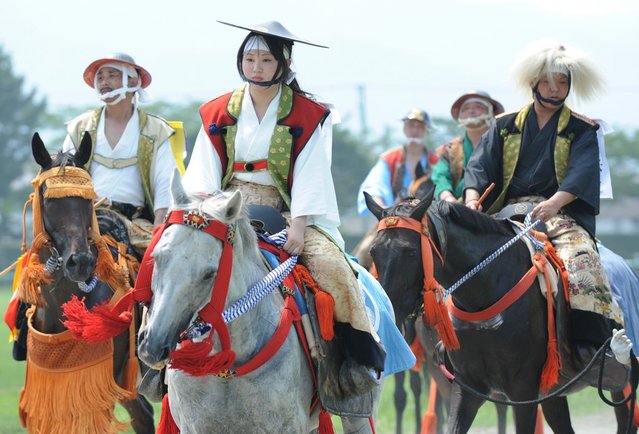
A young woman (C) clad in samurai costume leads other local poeple as she rides her horse during a parade at the annual Soma Nomaoi festival in Minamisoma, Fukushima Prefecture, on July 28, 2012.  The traditional full-scale festival kicked off for the first time after the accident of the Fukushima Dai-ichi Nuclear Power Plant following the massive earthquake and the tsunami on March 11, 2011. (Photo by Toru Yamanaka/AFP Photo)

Soma-Nomaoi is a festival that recreates a battle scene from more than 1,000 years ago. It is annually held for 4 days from July 22 to 25 in Haramachi City, Fukushima Prefecture, in the eastern part of Japan. In this historical event, 600 mounted samurai in traditional Japanese armor, with long swords at their side and ancestral flagstaffs streaming from their backs, ride across open fields. Soma-Nomaoi has been designated an Important Intangible Folk Cultural Property.

Photo: A young woman (C) clad in samurai costume leads other local poeple as she rides her horse during a parade at the annual Soma Nomaoi festival in Minamisoma, Fukushima Prefecture, on July 28, 2012. The traditional full-scale festival kicked off for the first time after the accident of the Fukushima Dai-ichi Nuclear Power Plant following the massive earthquake and the tsunami on March 11, 2011. (Photo by Toru Yamanaka/AFP Photo)
Details
02 Aug 2012 12:59:00


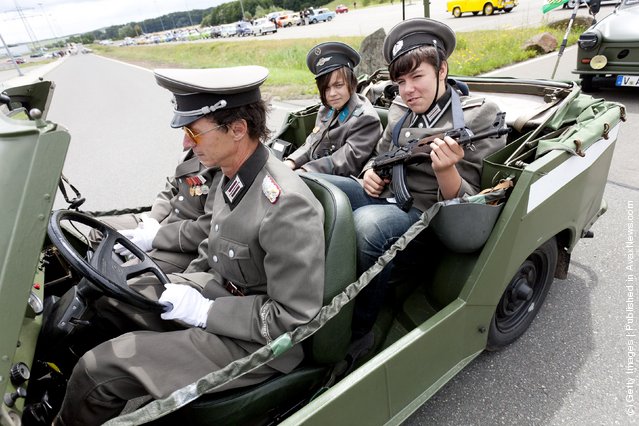
“The Trabant is a car that was produced by former East German auto maker VEB Sachsenring Automobilwerke Zwickau in Zwickau, Sachsen. It was the most common vehicle in East Germany, and was also exported to countries both inside and outside the communist bloc. The main selling points was that it had room for four adults and luggage in a compact, light and durable shell and that it was fast (when introduced) and durable. With its mediocre performance, smoky two-stroke engine, and production shortages, the Trabant is often cited as an example of the disadvantages of centralized planning; on the other hand, it is regarded with derisive affection as a symbol of the failed former East Germany and of the fall of communism (in former West Germany, as many East Germans streamed into West Berlin and West Germany in their Trabants after the opening of the Berlin Wall in 1989). It was in production without any significant changes for nearly 30 years with 3,096,099 Trabants produced in total”. – Wikipedia

Photo: Enthusiasts weared in uniforms of the former eastern german army trive in a military Trabant car as fans and owners of East German-era Trabant cars gather at the 2011 International Trabantfahrer Treffen (International Trabant Drivers Meeting) on June 26, 2011 in Zwickau, Germany. The Trabant, also known as the Trabi, was among the main cars produced in communist East Germany and built by VEB Sachsenring Automobilwerke in Zwickau for 30 years until 1989. Today the car has cult status for many followers and one company, IndiKar, is even seeking to revive the brand in a modern, electric version. (Photo by Carsten Koall/Getty Images)

Details
27 Jun 2011 12:21:00
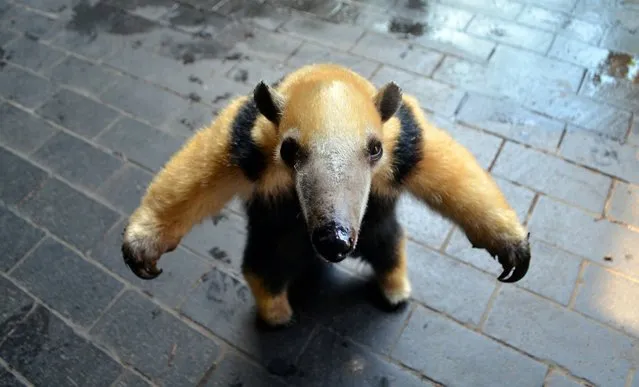
London Zoo photo of Tammy the tree-climbing anteater who is to be given her own minder during a series of late night events at ZSL London Zoo this summer. The twelve-year-old tree-climbing anteater is famed for her friendly disposition, but with naturally poor eyesight zookeepers will be giving Tammy help to steer her past any errant feet in the free-roaming exhibit. (Photo by ZSL London Zoo/PA Wire)

London Zoo photo of Tammy the tree-climbing anteater who is to be given her own minder during a series of late night events at ZSL London Zoo this summer. The twelve-year-old tree-climbing anteater is famed for her friendly disposition, but with naturally poor eyesight zookeepers will be giving Tammy help to steer her past any errant feet in the free-roaming exhibit. (Photo by ZSL London Zoo/PA Wire)

P.S. All pictures are presented in high resolution. To see Hi-Res images – just TWICE click on any picture. In other words, click small picture – opens the BIG picture. Click BIG picture – opens VERY BIG picture (if available; this principle works anywhere on the site AvaxNews)
Details
08 Jun 2013 11:16:00
Students of Yuba Pratibha School, wearing a face shield and masks at school during a coronavirus pandemic in Kathmandu, Nepal, 26 November 2020. The head Teacher of Yuba Pratibha School, Yanga Raj Dahal, started to conduct classes for students, who can’t afford and attend online classes, with strict sanitary regime, providing also free face masks and shields for students. However majority of schools have been conducting online classes in Nepal from 19 March 2020 as part of precautionary measures against the spread of the coronavirus Covid-19. (Photo by Narendra Shrestha/EPA/EFE)

Students of Yuba Pratibha School, wearing a face shield and masks at school during a coronavirus pandemic in Kathmandu, Nepal, 26 November 2020. The head Teacher of Yuba Pratibha School, Yanga Raj Dahal, started to conduct classes for students, who can’t afford and attend online classes, with strict sanitary regime, providing also free face masks and shields for students. However majority of schools have been conducting online classes in Nepal from 19 March 2020 as part of precautionary measures against the spread of the coronavirus Covid-19. (Photo by Narendra Shrestha/EPA/EFE)
Details
16 Dec 2020 00:05:00