Loading...
Done
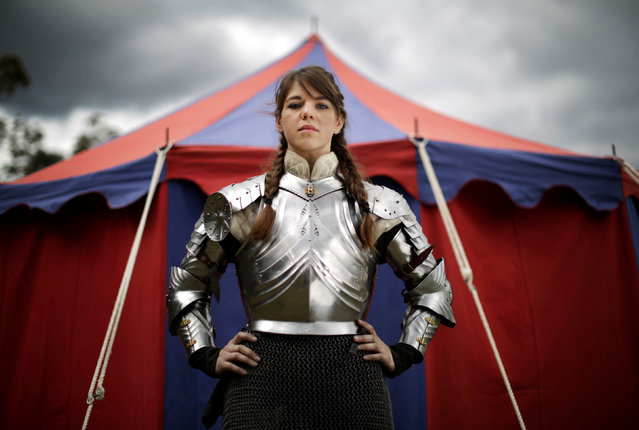
Australian jouster Kimberly Belcher poses for a portrait in her armour on the sidelines of the jousting tournament at the St Ives Medieval Fair in Sydney, one of the largest of its kind in Australia, September 22, 2016. (Photo by Jason Reed/Reuters)

Australian jouster Kimberly Belcher poses for a portrait in her armour on the sidelines of the jousting tournament at the St Ives Medieval Fair in Sydney, one of the largest of its kind in Australia, September 22, 2016. (Photo by Jason Reed/Reuters)
Details
25 Sep 2016 07:44:00
A young boy plays with soap bubbles near Hofburg Palace at Heldenplatz, one of the top tourists attractions in Vienna, Austria, January 26, 2016. (Photo by Christian Bruna/EPA)

A young boy plays with soap bubbles near Hofburg Palace at Heldenplatz, one of the top tourists attractions in Vienna, Austria, January 26, 2016. (Photo by Christian Bruna/EPA)
Details
26 May 2016 12:58:00
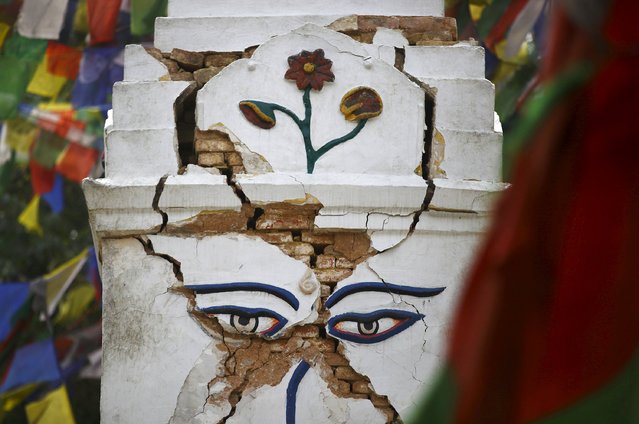
Cracks are seen on one of the shrines at Swoyambhunath Stupa, a UNESCO world heritage site, after Saturday's earthquake in Kathmandu, Nepal April 28, 2015. (Photo by Navesh Chitrakar/Reuters)

Cracks are seen on one of the shrines at Swoyambhunath Stupa, a UNESCO world heritage site, after Saturday's earthquake in Kathmandu, Nepal April 28, 2015. (Photo by Navesh Chitrakar/Reuters)
Details
29 Apr 2015 06:38:00
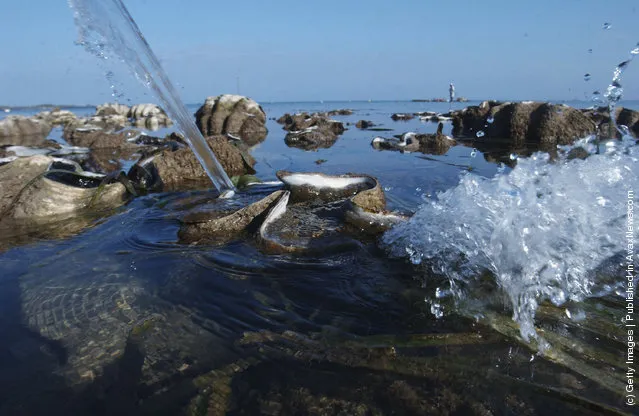
Tridacna Gigas, or Giant Clams

“The giant clam, Tridacna gigas (known as pā’ua in Cook Islands Māori), is the largest living bivalve mollusc. T. gigas is one of the most endangered clam species. It was mentioned as early as 1825 in scientific reports. One of a number of large clam species native to the shallow coral reefs of the South Pacific and Indian oceans, they can weigh more than 200 kilograms (440 lb) measure as much as 120 cm (47 in) across, and have an average lifespan in the wild of 100 years or more”. – Wikipedia

Photo: Tridacna Gigas, or Giant Clams spew water as a traditional fisherman passes by a small sanctuary on January 23, 2004 near Bolinao in the Northern Philippines. The clams, prime builders for coral reefs and providing shelter for spawning fish and other marine life, are exposed by low tides in the sanctuary. Overfishing and pollution throughout the country are not only threatening food security, but are also starting to choke one of the few working clam sanctuaries in the world. (Photo by David Greedy/Getty Images)

Details
01 Oct 2011 13:10:00
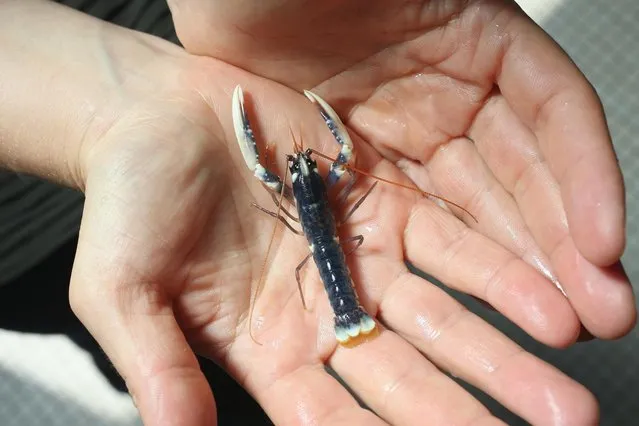
Isabel Schmalenbach, an environmental scientist with the Helgoland Biological Institute (Biologische Anstalt Helgoland), part of the Alfred Wegener Institute for Polar and Marine Research, holds a one-year old baby European lobster (Homarus gammarus) raised at the institute on August 3, 2013 on Helgoland Island, Germany. (Photo by Sean Gallup/Getty Images)

Isabel Schmalenbach, an environmental scientist with the Helgoland Biological Institute (Biologische Anstalt Helgoland), part of the Alfred Wegener Institute for Polar and Marine Research, holds a one-year old baby European lobster (Homarus gammarus) raised at the institute on August 3, 2013 on Helgoland Island, Germany. Later in the day Schmalenbach and her colleagues released a total of 415 one-year old lobsters into the North Sea as part of an effort to repopulate the lobster population around Helgoland (also called Heligoland). In the 19th century local fishermen caught up to 80,000 lobsters a year in the surrounding waters, combined with the heavy allied bombing of the island during and after World War II, as well as other environmental factors, decimated the lobster population. (Photo by Sean Gallup)
Details
05 Aug 2013 08:39:00
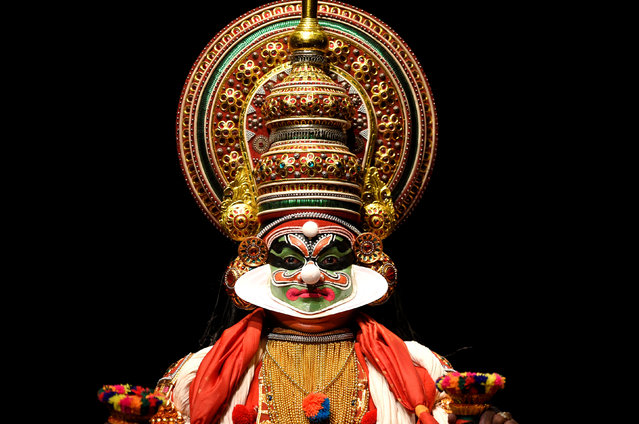
A member of the Indian company Margi Kathakali theatre performs during “Kijote Kathakali”, a Kathakali recital based on the Spanish classic “Don Quixote”, at the Niemeyer Center in Aviles, northern Spain, July 29, 2016. The performance and text captured the essence of the novel while sticking to the format of Kathakali. Kathakali is one of the major forms of classical Indian dance. It is another “story play” genre of art, but one distinguished by its elaborately colorful make-up, costumes and face masks wearing actor-dancers, who have traditionally been all males. (Photo by Eloy Alonso/Reuters)

A member of the Indian company Margi Kathakali theatre performs during “Kijote Kathakali”, a Kathakali recital based on the Spanish classic “Don Quixote”, at the Niemeyer Center in Aviles, northern Spain, July 29, 2016. The performance and text captured the essence of the novel while sticking to the format of Kathakali. Kathakali is one of the major forms of classical Indian dance. (Photo by Eloy Alonso/Reuters)
Details
31 Jul 2016 11:02:00


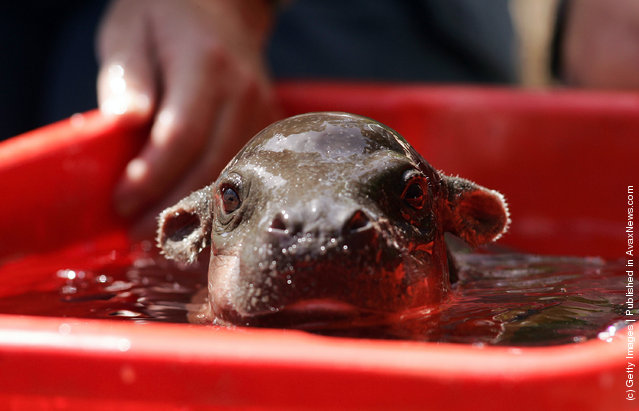
“The pygmy hippopotamus (Choeropsis liberiensis or Hexaprotodon liberiensis) is a large mammal native to the forests and swamps of western Africa (the specific name liberiensis means “of Liberia”, as this is where the vast majority live). The pygmy hippo is reclusive and nocturnal. It is one of only two extant species in the Hippopotamidae family, the other being its much larger cousin the common hippopotamus”. – Wikipedia

Photo: Monifa, a one month old baby Pygmy Hippopotamus takes a morning bath at Taronga Zoo on November 7, 2008 in Sydney, Australia. Monifa is the first Pygmy Hippopotamus to be born at Taronga Zoo in the past twenty three years. (Photo by Sergio Dionisio/Getty Images)
Details
11 Apr 2011 08:11:00
Marutaro The Hedgehog Part 2

With more than 40,000 followers on Twitter and 26,400 fans on Vine, it looks like Marutaro the hedgehog from Japan is one of the most popular hedgehogs on the Internet. And as his owner keeps on posting Marutaro’s pictures online daily, Marutaro’s popularity continues to grow. There are hundreds of cute photographs and videos of this little fellow, but the ones with little paper cut-out faces are probably the cutest. As Marutaro lies on his back, his owner gives him a variety of silly expressions and smiles. The 20 best of them will definitely boost your mood!
Details
11 Apr 2014 14:04:00