Loading...
Done
A staff member, wearing a face mask following the coronavirus disease (COVID-19) outbreak, looks at a robot at the venue for the World Artificial Intelligence Conference (WAIC) in Shanghai, China on July 9, 2020. (Photo by Aly Song/Reuters)

A staff member, wearing a face mask following the coronavirus disease (COVID-19) outbreak, looks at a robot at the venue for the World Artificial Intelligence Conference (WAIC) in Shanghai, China on July 9, 2020. (Photo by Aly Song/Reuters)
Details
25 Jul 2020 00:05:00
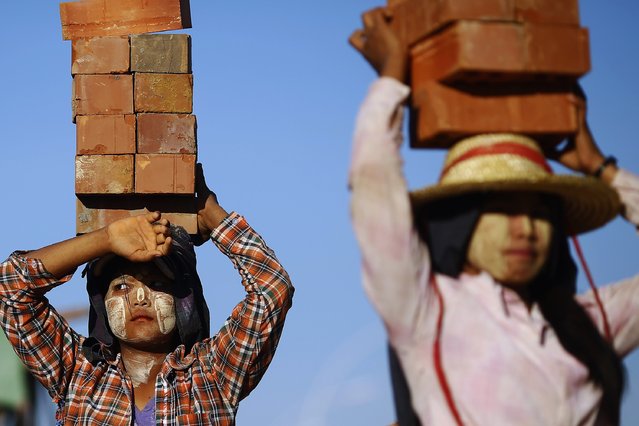
Construction workers carry bricks on their heads near the country's parliament building in Naypyitaw November 11, 2014. Yangon lost its status as Myanmar's capital in 2005, after the former military junta carved a new seat of government from a parched wilderness some 380 km (236 miles) to the north and called it Naypyitaw (“Abode of Kings”). (Photo by Damir Sagolj/Reuters)

Construction workers carry bricks on their heads near the country's parliament building in Naypyitaw November 11, 2014. Yangon lost its status as Myanmar's capital in 2005, after the former military junta carved a new seat of government from a parched wilderness some 380 km (236 miles) to the north and called it Naypyitaw (“Abode of Kings”). (Photo by Damir Sagolj/Reuters)
Details
15 Nov 2014 12:29:00
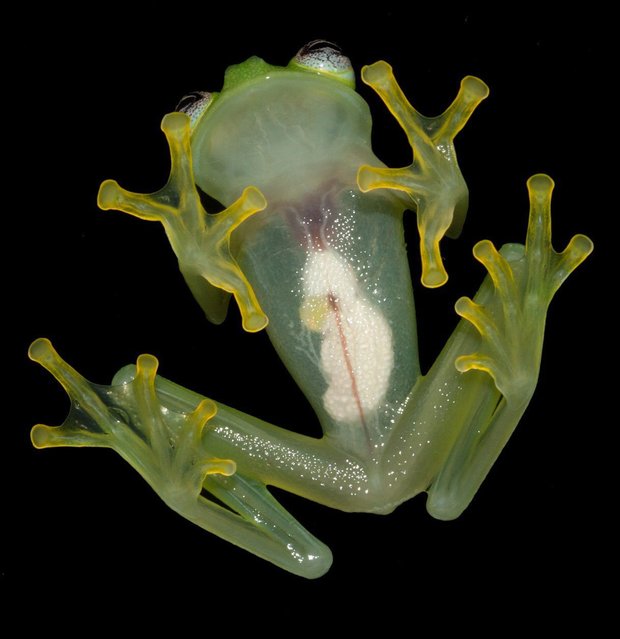
A handout photograph provided by Brian Kubicki of Costa Rican Amphibian Research Center on 26 April 2016 shows a “Crystal frog”, Hyalinobatrachium dianae (H. diane). This frog was discovered by US biologist Brian Kubicki and Costa Ricans Stanley Salazar and Robert Puschendorf in a rainy forest of Costa Rican caribbean after 40 years without notice of any new example of this kind. (Photo by Brian Kubicki/EPA/Costa Rican Amphibian Research Center)

A handout photograph provided by Brian Kubicki of Costa Rican Amphibian Research Center on 26 April 2016 shows a “Crystal frog”, Hyalinobatrachium dianae (H. diane). This frog was discovered by US biologist Brian Kubicki and Costa Ricans Stanley Salazar and Robert Puschendorf in a rainy forest of Costa Rican caribbean after 40 years without notice of any new example of this kind. (Photo by Brian Kubicki/EPA/Costa Rican Amphibian Research Center)
Details
02 May 2015 15:23:00
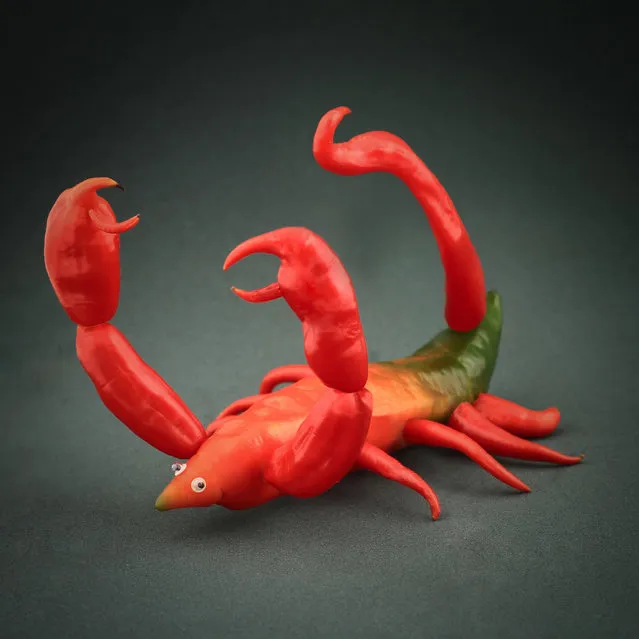
“Red Pepperpion. (Photo by Vanessa Dualib)

“Red Pepperpion. Red Pepperpions are secretive, nocturnal arachilli which can be spotted in kitchens of arid climates all around the world.

Red Pepperpions are equipped with a delicious (and depending on the quantity...deadly!) stinger at the end of its tail. If you happen to get bitten (or if you bite him!) it will produce a burning sensation on your taste nerves.

However, there is no need to worry, since the fact is that his potent stinger is usually only used when hunting or whenever the Pepperpion feels like he might become part of someones meal...

At daylight or when encountering a larger foe, such as a Saucier Chef, they retreat into burrows inside the fridge or hide beneath the oven”. (Photo and comment by Vanessa Dualib)


Details
08 Feb 2013 09:24:00
A Manipuri woman sells smoked and dry fish in Ima market - the world's largest all women market - in Imphal city, Manipur state, 06 January 2016. The 150-year-old Ima Keithel or 'Mothers's market' complex, which is run exclusively by women and was damaged in the 04 January 2016 earthquake, is returning back to normal. Nine deaths have been reported from in and around Imphal due to falling debris. (Photo by EPA/Stringer)

A Manipuri woman sells smoked and dry fish in Ima market - the world's largest all women market – in Imphal city, Manipur state, 06 January 2016. The 150-year-old Ima Keithel or “Mothers's market” complex, which is run exclusively by women and was damaged in the 04 January 2016 earthquake, is returning back to normal. Nine deaths have been reported from in and around Imphal due to falling debris. Imphal has a population of some 270,000 and people were jolted from their sleep and ran out of their homes in panic when the earth shook 04 January, reports say. (Photo by EPA/Stringer)
Details
08 Jan 2016 08:04:00
Liu Chunxia, a supporter of Xu Zhiyong, one of China's most prominent rights advocates, is detained by policemen while she gathers with other supporters nearby a court where Xu's trial is being held in Beijing January 22, 2014. (Photo by Kim Kyung-Hoon/Reuters)

Liu Chunxia, a supporter of Xu Zhiyong, one of China's most prominent rights advocates, is detained by policemen while she gathers with other supporters nearby a court where Xu's trial is being held in Beijing January 22, 2014. When dozens of activists unfurled banners across the country last March and April calling for officials to disclose their assets, they did so at the urging of one of China's most prominent rights advocates, Xu Zhiyong. Xu, 40, stands trial on Wednesday on a charge of “gathering a crowd to disturb public order” punishable by up to five years in prison. His case will almost certainly spark fresh criticism from Western governments over Beijing's crackdown on dissent. (Photo by Kim Kyung-Hoon/Reuters)
Details
26 Jan 2014 12:26:00
A narrow strip of clouds illuminated in the light of sunset before approaching rain clouds over an alley near Sieversdorf district Oder-Spree, Brandenburg, Germany on July 14, 2016. (Photo by Patrick Pleul/DPA)

A narrow strip of clouds illuminated in the light of sunset before approaching rain clouds over an alley near Sieversdorf district Oder-Spree, Brandenburg, Germany on July 14, 2016. (Photo by Patrick Pleul/DPA)
Details
04 Dec 2016 10:31:00
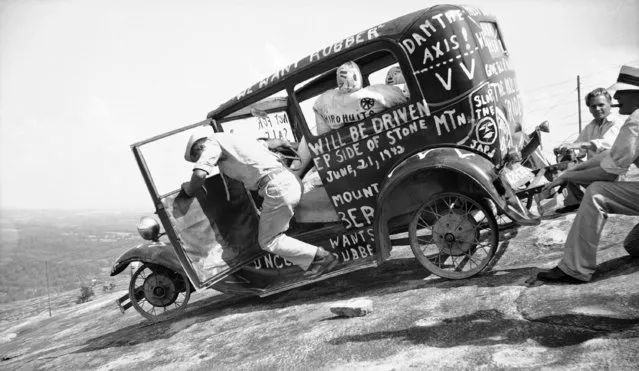
Hitler, Hirohito and Mussolini, in effigy, are about to take a mile-high plunge over Stone Mountain, near Atlanta, Georgia, June 21, 1942, as part of the scrap rubber drive. Private Elias Nour, who arranged the stunt as a farewell party on the eve of his entrance into the army, is on the running board. He guided as the “Axis” plunged to destruction. Spectators had to give a scrap of rubber as the price of admission to the spectacle. (Photo by AP Photo)

Hitler, Hirohito and Mussolini, in effigy, are about to take a mile-high plunge over Stone Mountain, near Atlanta, Georgia, June 21, 1942, as part of the scrap rubber drive. Private Elias Nour, who arranged the stunt as a farewell party on the eve of his entrance into the army, is on the running board. He guided as the “Axis” plunged to destruction. Spectators had to give a scrap of rubber as the price of admission to the spectacle. (Photo by AP Photo)
Details
24 Aug 2017 09:22:00