Loading...
Done
Assimilation By Dillon Marsh

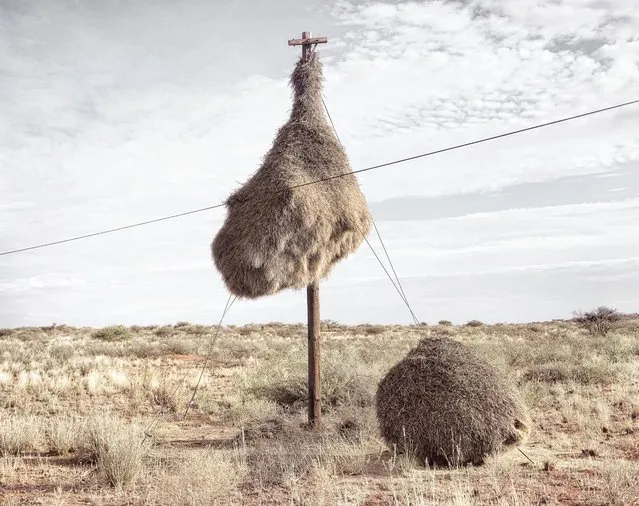
Captured by South African photographer Dillon Marsh, these fantastic photographs depict the many designs employed by sociable weavers to build sturdy nests that are safe from intruders such as cobras and tree snakes. They are also nice cool during the day, and stay warm during cold desert nights. A University of Stellenbosch graduate, Marsh is currently interested in landscape photographer who seeks out anomalies that can be arranged in a photographic series. Assimilation depicts scores of intricate weaver’s nests atop utility poles in Southern Africa. Colonies of sociable weavers have been known to stay attached to one particular nest for up to 100 years, according to The San Diego Zoo.
Details
15 Feb 2014 14:47:00
Polar Bear Photo Steven Kazlowski

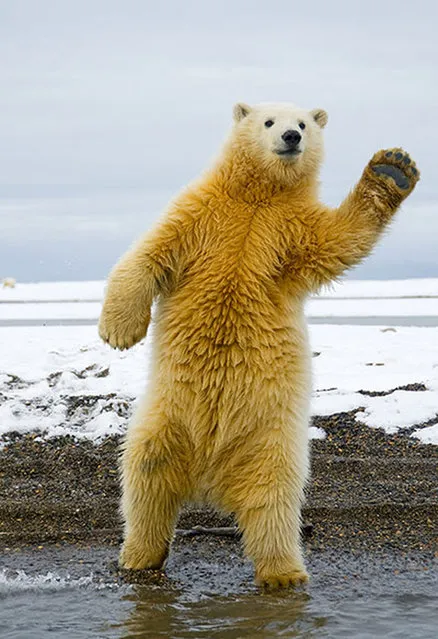
The polar bear — a charismatic icon in the struggle against climate change — faces a precarious future along with other ice-dependent species as its Arctic habitat rapidly continues to melt away.

With camera in hand, wildlife photographer Steven Kazlowski has dedicated over eight years of work to bring to life the immediate reality of this most pressing environmental crisis — the devastation of the Arctic ecosystem through global warming.
Details
18 Oct 2012 10:14:00
New Zealand Penguins in Need of Sweaters

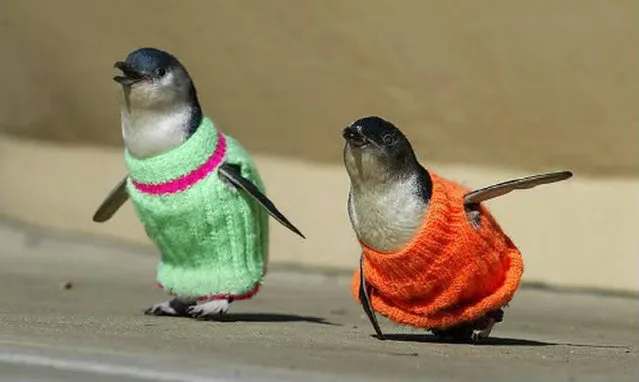
Penguin sweaters, also known as penguin jumpers, are sweaters which are knitted for penguins that have been caught in oil slicks. When an oil spill affects penguins, they are dressed in knitted sweaters to stop them preening their feathers and to keep them warm, since the spilled oil destroys their natural oils. This also prevents them from poisoning themselves by ingesting the oil. The sweaters are removed and discarded as soon as the penguins can be washed. The original project has been completed, but the knitting pattern is still available on-line, as subsequent oil spills make it necessary. The extra sweaters are kept on behalf of the Wildlife Rescue Team.
Details
31 Oct 2012 13:06:00
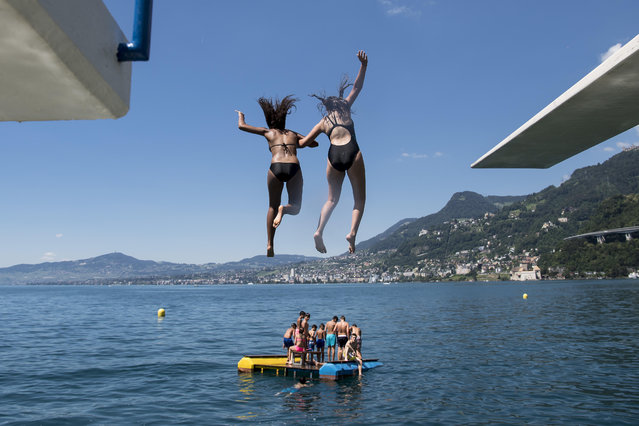
In this July 9, 2016 file photo, girls jump from a diving platform into the Geneva Lake and enjoy sunny and warm weather, in Villeneuve, Switzerland. After nearly 90 years, women can legally swim topless in Geneva’s lake and Rhone River without running the risk of a fine. Geneva’s regional council has voted to modify a 1929 ordinance that banned women from swimming topless in the city’s main natural waterways, though the change doesn’t apply to public swimming pools or swimming totally naked. Nicolas Bolle, an official with Geneva’s security department, on Thursday, April 6, 2017 confirmed the council’s action a day earlier. (Photo by Jean-Christophe Bott/Keystone via AP Photo)

In this July 9, 2016 file photo, girls jump from a diving platform into the Geneva Lake and enjoy sunny and warm weather, in Villeneuve, Switzerland. After nearly 90 years, women can legally swim topless in Geneva’s lake and Rhone River without running the risk of a fine. Geneva’s regional council has voted to modify a 1929 ordinance that banned women from swimming topless in the city’s main natural waterways, though the change doesn’t apply to public swimming pools or swimming totally naked. Nicolas Bolle, an official with Geneva’s security department, on Thursday, April 6, 2017 confirmed the council’s action a day earlier. (Photo by Jean-Christophe Bott/Keystone via AP Photo)
Details
08 Apr 2017 09:39:00
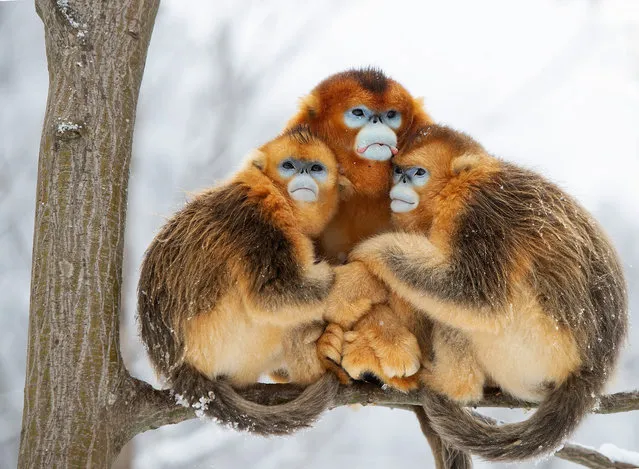
A golden huddle by Minqiang Lu, China. Two females and a male golden snub-nosed monkey huddle together to keep warm in the extreme cold. Threatened by forest loss and fragmentation, this endangered species is confined to central China. Restricted to living high up in the temperate forests, these monkeys – here in the Qinling mountains in Shaanxi province – feed mostly in the trees, on leaves, bark, buds and lichen. In heavy wind and snow, Minqiang walked up the mountain carrying his equipment. He stayed for half an hour in temperatures of –10C opposite the tree where the group was huddled before achieving this eye-level composition. (Photo by Minqiang Lu/Wildlife Photographer of the Year)

A golden huddle by Minqiang Lu, China. Two females and a male golden snub-nosed monkey huddle together to keep warm in the extreme cold. Threatened by forest loss and fragmentation, this endangered species is confined to central China. Restricted to living high up in the temperate forests, these monkeys – here in the Qinling mountains in Shaanxi province – feed mostly in the trees, on leaves, bark, buds and lichen. In heavy wind and snow, Minqiang walked up the mountain carrying his equipment. He stayed for half an hour in temperatures of –10C opposite the tree where the group was huddled before achieving this eye-level composition. (Photo by Minqiang Lu/Wildlife Photographer of the Year)
Details
12 Jan 2023 01:19:00
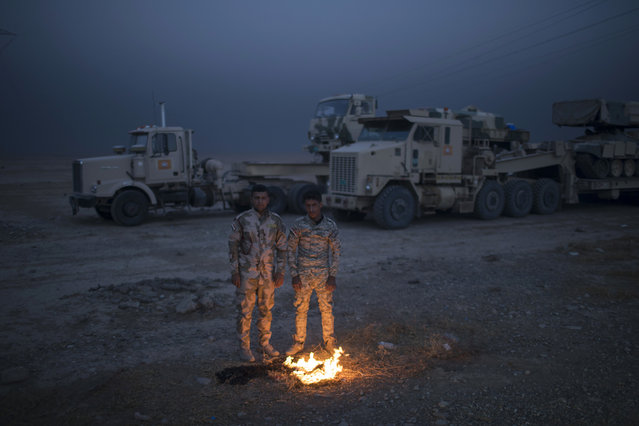
Iraqi army soldiers warm themselves next to a fire near the Qayara air base, south of Mosul, Iraq, Tuesday, November 1, 2016. The U.N. human rights office is lauding efforts by the U.S.-led coalition in the battle against the Islamic State group in Mosul. The office in Geneva says coalition flights over Iraq have largely succeeded in preventing IS from bringing in 25,000 more civilians to the city center, where the militant group has been using people as human shields as Iraqi forces advance on Mosul. (Photo by Felipe Dana/AP Photo)

Iraqi army soldiers warm themselves next to a fire near the Qayara air base, south of Mosul, Iraq, Tuesday, November 1, 2016. The U.N. human rights office is lauding efforts by the U.S.-led coalition in the battle against the Islamic State group in Mosul. The office in Geneva says coalition flights over Iraq have largely succeeded in preventing IS from bringing in 25,000 more civilians to the city center, where the militant group has been using people as human shields as Iraqi forces advance on Mosul. (Photo by Felipe Dana/AP Photo)
Details
03 Nov 2016 12:43:00
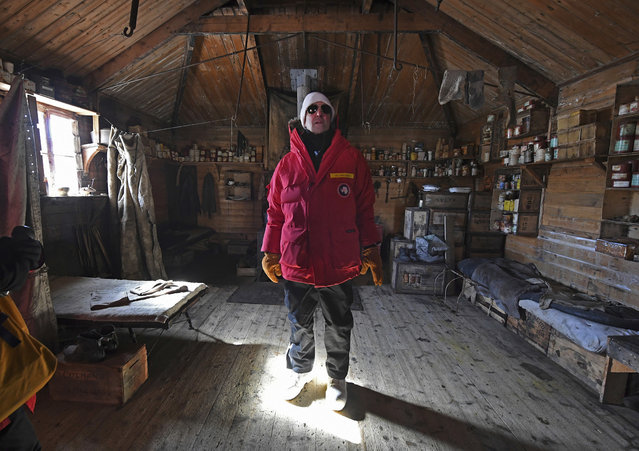
U.S. Secretary of State John Kerry stands inside the historic Shackleton hut near McMurdo Station, Antarctica, Friday, November 11, 2016. Kerry became the highest-ranking American official to visit Antarctica when he landed for a two-day trip on Friday. He's been hearing from scientists about the impact of climate change on the frozen continent. Kerry's aides described the trip as a learning opportunity for the secretary of state. He has been receiving briefings from scientists working to understand the effects of climate change on Antarctica. Kerry has made climate change an intensive focus of American diplomacy during his term, and had previously spent decades working on the issue as a U.S. senator. Trump has called climate change a hoax and said he would “cancel” U.S. involvement in the landmark Paris Agreement on global warming. (Photo by Mark Ralston/Pool Photo via AP Photo)

U.S. Secretary of State John Kerry stands inside the historic Shackleton hut near McMurdo Station, Antarctica, Friday, November 11, 2016. Kerry became the highest-ranking American official to visit Antarctica when he landed for a two-day trip on Friday. He's been hearing from scientists about the impact of climate change on the frozen continent. Kerry's aides described the trip as a learning opportunity for the secretary of state. He has been receiving briefings from scientists working to understand the effects of climate change on Antarctica. Kerry has made climate change an intensive focus of American diplomacy during his term, and had previously spent decades working on the issue as a U.S. senator. Trump has called climate change a hoax and said he would “cancel” U.S. involvement in the landmark Paris Agreement on global warming. (Photo by Mark Ralston/Pool Photo via AP Photo)
Details
12 Nov 2016 10:09:00
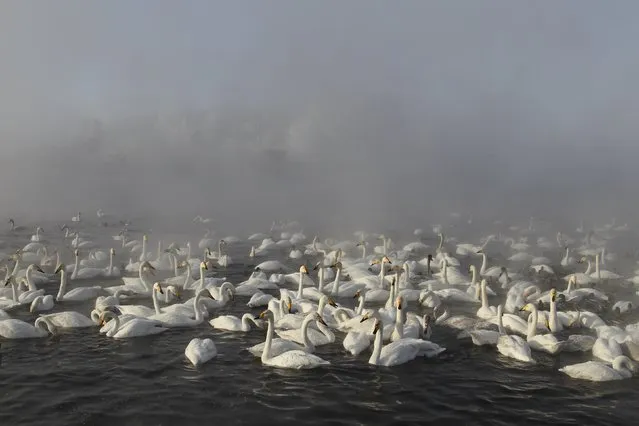
Swans swim over a lake, with the air temperature at about minus 35 degrees Celsius (minus 31 degrees Fahrenheit) as steam ascends above the water during sunset near the village of Urozhainy, Sovetsky district of Altai region, January 26, 2015. (Photo by Andrei Kasprishin/Reuters)

Swans swim over a lake, with the air temperature at about minus 35 degrees Celsius (minus 31 degrees Fahrenheit) as steam ascends above the water during sunset near the village of Urozhainy, Sovetsky district of Altai region, January 26, 2015. About 600 swans annually migrate to the lake, which is heated by warm springs, where they spend their winter being fed by yagers, which helps them to survive the severe cold. (Photo by Andrei Kasprishin/Reuters)
Details
28 Jan 2015 11:40:00