Loading...
Done
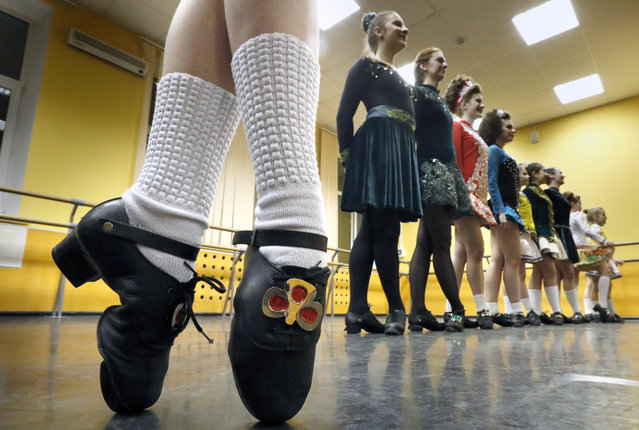
Girls during a class at the Teire Irish dance school in Moscow, Russia on March 15, 2019. (Photo by Sergei Karpukhin/TASS)

Girls during a class at the Teire Irish dance school in Moscow, Russia on March 15, 2019. (Photo by Sergei Karpukhin/TASS)
Details
23 Mar 2019 00:07:00
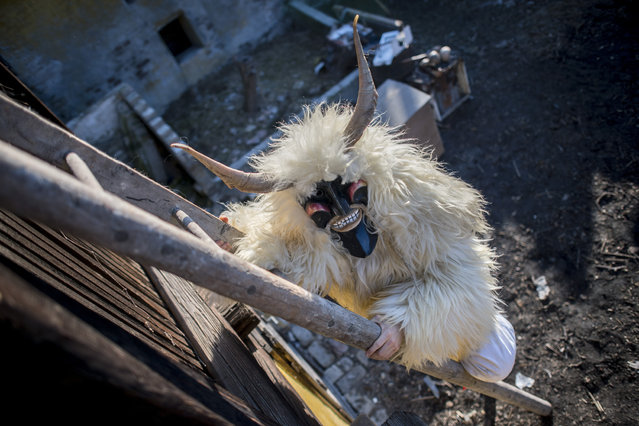
A man wears a busho mask and a costume made of sheep pelt while climbing up a ladder outside a barn in Mohacs, Hungary, 20 February 2020, on the first day of carnival. The traditional Busho carnival, which marks the end of winter, dates back to the 16th century. According to local legend, members of an ethnic South Slavic group living in Mohacs at the time dressed up in similar costumes and wore wooden masks to scare away Ottoman invaders, who mistook them for demons. (Photo by Tamas Soki/EPA/EFE)

A man wears a busho mask and a costume made of sheep pelt while climbing up a ladder outside a barn in Mohacs, Hungary, 20 February 2020, on the first day of carnival. The traditional Busho carnival, which marks the end of winter, dates back to the 16th century. According to local legend, members of an ethnic South Slavic group living in Mohacs at the time dressed up in similar costumes and wore wooden masks to scare away Ottoman invaders, who mistook them for demons. (Photo by Tamas Soki/EPA/EFE)
Details
23 Feb 2020 00:07:00
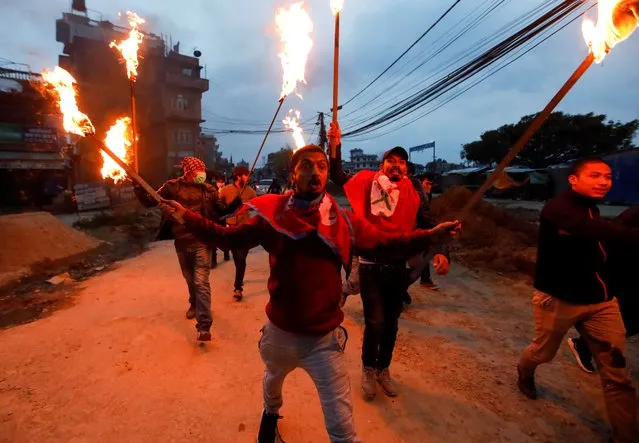
Students with torches protest against the alleged encroachment of Nepal border by India in far west of Nepal, during the 49th day of a lockdown imposed by the government amid concerns about the spread of the coronavirus disease (COVID-19), in Kathmandu, Nepal on May 11, 2020. (Photo by Navesh Chitrakar/Reuters)

Students with torches protest against the alleged encroachment of Nepal border by India in far west of Nepal, during the 49th day of a lockdown imposed by the government amid concerns about the spread of the coronavirus disease (COVID-19), in Kathmandu, Nepal on May 11, 2020. (Photo by Navesh Chitrakar/Reuters)
Details
13 May 2020 00:03:00
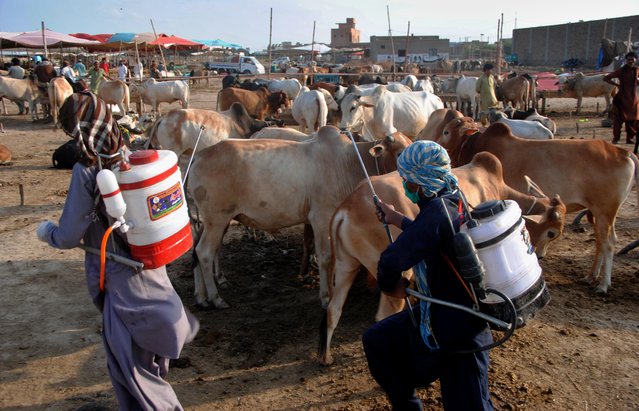
Health workers wearing face masks spray disinfectant liquid on sacrificial animals amid concerns over the spread of the SARS-CoV-2 coronavirus that causes the pandemic COVID-19 disease ahead of the Muslim festival of Eid al-Adha at an animal market in Hyderabad, southern Pakistan, 21 July 2020. Eid al-Adha, also known as the Festival of the Sacrifice, is the second and holiest of the two main Islamic holidays celebrated each year (the other one being Eid al-Fitr). Every year, on the 10th day of the Islamic lunar month of Dhu al-Hijjah, Muslims around the world ritually slaughter a sacrificial animal and split the meat into three parts: one is reserved for the family, another for friends and relatives, and the third is given to the poor and needy. The Saudi Supreme Court has declared that the first day of Eid al-Adha this year falls on 31 July. (Photo by Nadeem Khawar/EPA/EFE)

Health workers wearing face masks spray disinfectant liquid on sacrificial animals amid concerns over the spread of the SARS-CoV-2 coronavirus that causes the pandemic COVID-19 disease ahead of the Muslim festival of Eid al-Adha at an animal market in Hyderabad, southern Pakistan, 21 July 2020. (Photo by Nadeem Khawar/EPA/EFE)
Details
23 Jul 2020 00:07:00
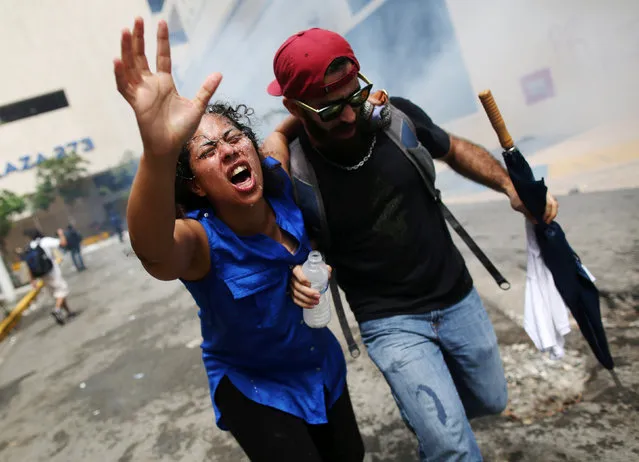
A woman affected by tear gas is assisted during a May Day protest against austerity measures, in San Juan, Puerto Rico May 1, 2018. (Photo by Alvin Baez/Reuters)

A woman affected by tear gas is assisted during a May Day protest against austerity measures, in San Juan, Puerto Rico May 1, 2018. (Photo by Alvin Baez/Reuters)
Details
03 May 2018 06:11:00
Iranian soccer fan wait for the start of the group B match between Iran and Spain at the 2018 soccer World Cup in the Kazan Arena in Kazan, Russia, Wednesday, June 20, 2018. (Photo by Diego Azubel/EPA/EFE)

Iranian soccer fan wait for the start of the group B match between Iran and Spain at the 2018 soccer World Cup in the Kazan Arena in Kazan, Russia, Wednesday, June 20, 2018. (Photo by Diego Azubel/EPA/EFE)
Details
23 Jun 2018 00:05:00
Bride Ana Vallejos, wearing a traditional “Caporales” Andean outfit, is escorted by her parents to her wedding celebration, in La Paz, Bolivia, Saturday, December 12, 2020. As a measure to reactivate the economy, the Bolivian government lifted restrictions to help curve the spread of the new coronavirus. Sporting, religious and cultural events may take place publicly until mid-January. (Photo by Juan Karita/AP Photo)

Bride Ana Vallejos, wearing a traditional “Caporales” Andean outfit, is escorted by her parents to her wedding celebration, in La Paz, Bolivia, Saturday, December 12, 2020. As a measure to reactivate the economy, the Bolivian government lifted restrictions to help curve the spread of the new coronavirus. Sporting, religious and cultural events may take place publicly until mid-January. (Photo by Juan Karita/AP Photo)
Details
14 Dec 2020 00:07:00
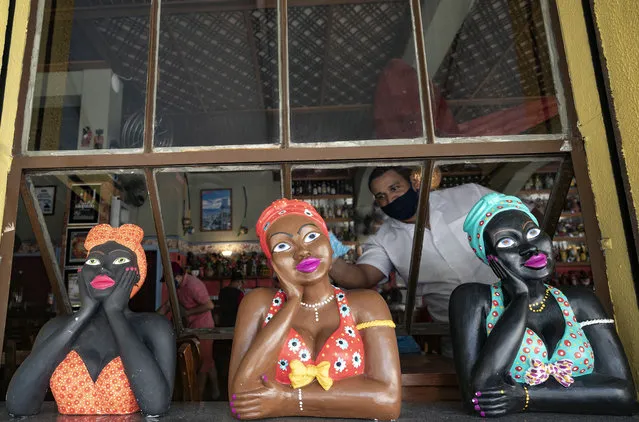
A restaurant worker wearing a mask cleans the windows as the restaurant reopens amid the COVID-19 pandemic in Sao Paulo, Brazil, Monday, July 6, 2020. Bars, restaurants and beauty salons were allowed to re-open Monday after over three months of quarantine, and are required to observe preventative measures and reduced operating hours only during the day. (Photo by Andre Penner/AP Photo)

A restaurant worker wearing a mask cleans the windows as the restaurant reopens amid the COVID-19 pandemic in Sao Paulo, Brazil, Monday, July 6, 2020. Bars, restaurants and beauty salons were allowed to re-open Monday after over three months of quarantine, and are required to observe preventative measures and reduced operating hours only during the day. (Photo by Andre Penner/AP Photo)
Details
26 Jan 2021 10:21:00