Loading...
Done
Special forces officers stand guard during a government-organised event marking Chechen language day in the centre of the Chechen capital Grozny April 25, 2013. (Photo by Maxim Shemetov/Reuters)

“What did I know about Chechnya before last week? For someone who grew up in the 1990s the very word Chechnya meant a string of grainy images on TV showing people in battered camouflage outfits, shooting at each other amid destruction and ruin. Fear, wahhabis, Shamil Basayev, terrorism, mountains: these were the words that used to spring to my mind when someone mentioned Chechnya”. – Maxim Shemetov. Photo: Special forces officers stand guard during a government-organised event marking Chechen language day in the centre of the Chechen capital Grozny April 25, 2013. (Photo by Maxim Shemetov/Reuters)
Details
14 May 2013 12:02:00


“Chameleons (family Chamaeleonidae) are a distinctive and highly specialized clade of lizards. They are distinguished by their parrot-like zygodactylous feet, their separately mobile and stereoscopic eyes, their very long, highly modified, and rapidly extrudable tongues, their swaying gait, the possession by many of a prehensile tail, crests or horns on their distinctively shaped heads, and the ability of some to change color. Uniquely adapted for climbing and visual hunting, the approximately 160 species of chameleon range from Africa, Madagascar, Spain and Portugal, across south Asia, to Sri Lanka, have been introduced to Hawaii, California and Florida, and are found in warm habitats that vary from rain forest to desert conditions”. – Wikipedia

Photo: A woman with the latest fashion accessory, a chameleon. (Photo by Fox Photos/Getty Images). Circa 1926
Details
20 Mar 2011 15:45:00
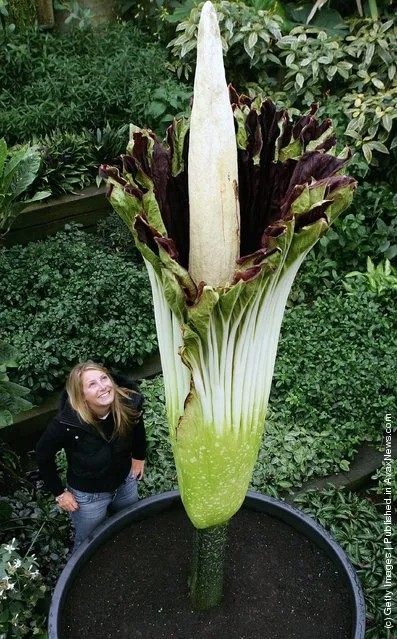
Kew Gardens employee Lauren Bird Royal examines the flowering of the Titan Arum lily at the Botanical Gardens

“The titan arum or Amorphophallus titanum (from Ancient Greek amorphos, “without form, misshapen” + phallos, “phallus”, and titan, “giant”) is a flowering plant with the largest unbranched inflorescence in the world. The titan arum's inflorescence is not as large as that of the Talipot palm, Corypha umbraculifera, but the inflorescence of the Talipot palm is branched rather than unbranched”. – Wikipedia

Photo: Kew Gardens employee Lauren Bird Royal examines the flowering of the Titan Arum lily at the Botanical Gardens at Kew on September 30, 2005 in London, England. For the first time in horticultural history, the Titan Arum lily can be seen at all three active stages in its lifecycle – in flower, fruit and leaf.The flowering corm is nearly three metres tall and weighs 91kg and is very rarely seen outside of the rainforests of Sumatra, Indonesia. (Photo by Scott Barbour/Getty Images)
Details
20 Sep 2011 11:13:00
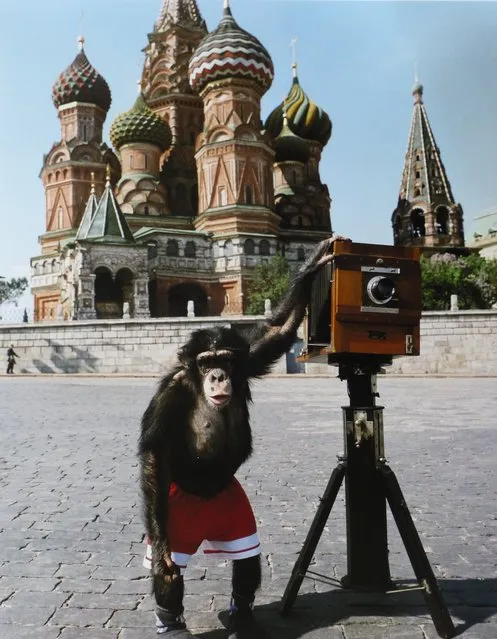
Picture by Guzelian GUZELIAN: SAY BANANAS! COLLECTION OF PHOTOGRAPHS TAKEN BY A MONKEY GO UNDER THE HAMMER. A collection of one-of-a-kind photographs is set to go under the hammer - so unique because the set was taken by a CHIMPANZEE. The pictures, which will be sold at Sotheby's Auction House, London, on June 5, are expected to fetch between £50,000 - £70,000.

“As is probably stated somewhere in the theory of infinity, if you give an infinite amount of monkeys an infinite number of old-timey Polaroid cameras, one will eventually take “artistic” blurry photos of historical sites in Moscow which will then be auctioned at Sotheby's for an estimated $75,000 – $100,000. Fortunately for every simian art fan with a spare $100k, we are currently living in the very universe in which that concept is reality. Eighteen photographs by – and of – Mikki The Chimpanzee are going to auction on June 5, 2013”. – Callie Beusman via Jezebel.com. (Photo by Guzelian)
Details
21 May 2013 09:31:00
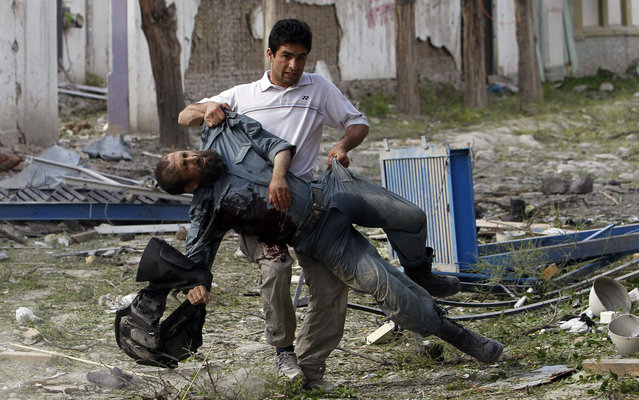
A wounded Afghan policeman is carried away from the site of an explosion in Kabul May 24, 2013. Several large explosions rocked a busy area in the centre of the Afghan capital, Kabul, on Friday with Reuters witnesses describing shooting in the area. (Photo by Omar Sobhani/Reuters)

A wounded Afghan policeman is carried away from the site of an explosion in Kabul May 24, 2013. Several large explosions rocked a busy area in the centre of the Afghan capital, Kabul, on Friday with Reuters witnesses describing shooting in the area. (Photo by Omar Sobhani/Reuters)

P.S. All pictures are presented in high resolution. To see Hi-Res images – just TWICE click on any picture. In other words, click small picture – opens the BIG picture. Click BIG picture – opens VERY BIG picture (if available; this principle works anywhere on the site AvaxNews)
Details
26 May 2013 12:36:00


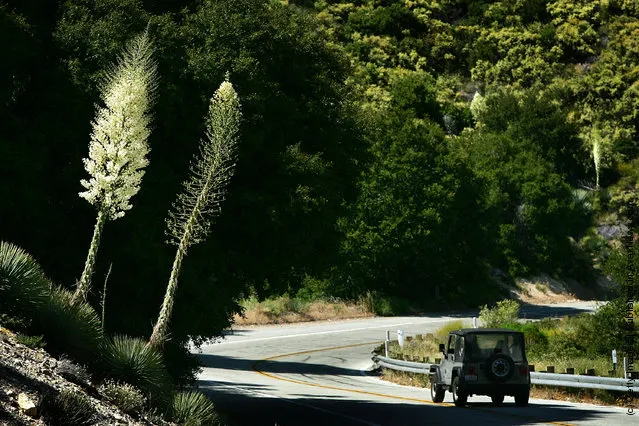
“Yucca is a genus of perennial shrubs and trees in the agave family, Agavaceae. Its 40-50 species are notable for their rosettes of evergreen, tough, sword-shaped leaves and large terminal panicles of white or whitish flowers. They are native to the hot and dry (arid) parts of North America, Central America, South America, and the Caribbean. Early reports of the species were confused with the cassava (Manihot esculenta). Consequently, Linnaeus mistakenly derived the generic name from the Carib word for the latter, yuca. It is also colloquially known in the midwest United States as “Ghosts in the graveyard”, as it is commonly found growing in rural graveyards and when in bloom the flowers appear as an apparition floating.” – Wikipedia

Photo: A yucca standing among flowers bursts forth a very large stalk of flowers as a heavy wildflower bloom on June 21, 2005 in the Angeles National Forest northwest of La Canada, California. (Photo by David McNew/Getty Images)
Details
29 Mar 2011 07:31:00
Wells Clock – World's Oldest Mechanical Clock

“Wells Cathedral is a Church of England cathedral in Wells, Somerset, England. Built between 1175 and 1490, Wells Cathedral has been described as “the most poetic of the English Cathedrals”. The Wells clock, an astronomical clock, is located in the north transept. The surviving mechanism, dated to between 1386 and 1392, was replaced in the 19th century, and was eventually moved to the Science Museum in London, where it continues to operate. It is the second-oldest surviving clock in England”. – Wikipedia

Photo: The clock face of world's oldest continually-working mechanical clock is seen as it is hand wound for the very last time on August 21, 2010 in Wells, England. (Photo by Matt Cardy/Getty Images)
Details
10 Aug 2011 11:23:00
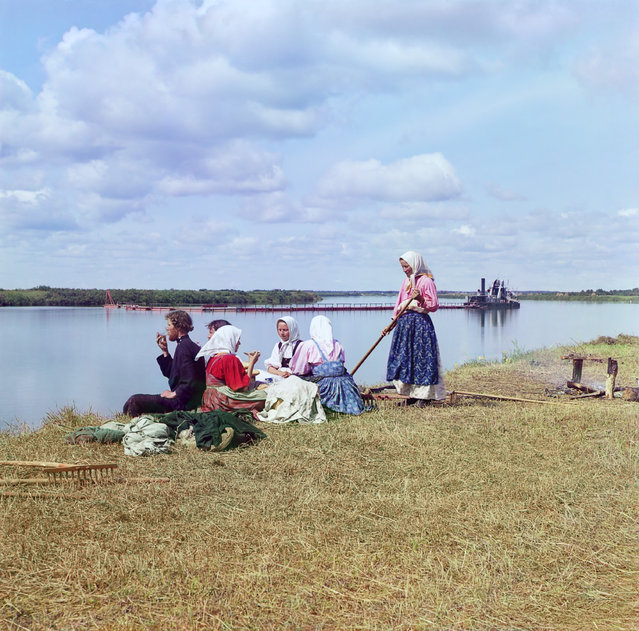
Photos by Sergey Prokudin-Gorsky. Dinner during haying. Russian Empire, Novgorod province, county Cherepovets, 1909

“Sergey Mikhaylovich Prokudin-Gorsky (August 30 1863 Russian Empire – September 27, 1944 Paris, France) was a Russian chemist and photographer. He is best known for his pioneering work in color photography of early 20th-century Russia”. – Wikipedia

Photo: Dinner during haying. Russian Empire, Novgorod province, county Cherepovets, 1909. (Photos by Sergey Prokudin-Gorsky via US Library of Congress and Prokudin-Gorsky.org)

P.S. All pictures are presented in high resolution. To see Hi-Res images – just TWICE click on any picture. In other words, click small picture – opens the BIG picture. Click BIG picture – opens VERY BIG picture (if available; this principle works anywhere on the site AvaxNews). Enjoy.
Details
24 Jul 2012 12:03:00