Loading...
Done
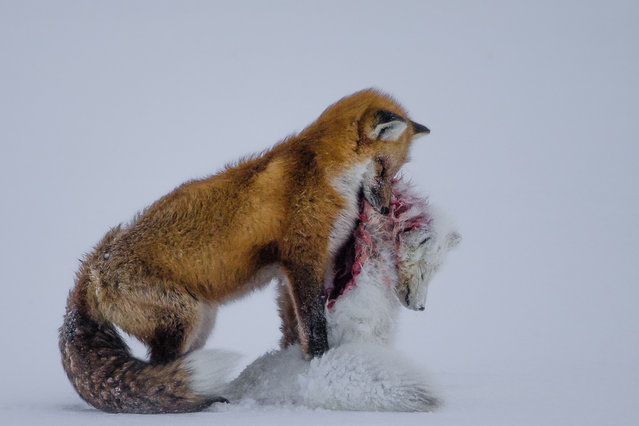
A tale of two foxes. Surprising behaviour, witnessed in Wapusk national park, on Hudson Bay, Canada, in early winter. Red foxes don’t actively hunt Arctic foxes, but where the ranges of two predators overlap, there can be conflict. Though the light was poor, the snow-covered tundra provided the backdrop for the moment that the red fox paused with the smaller fox in its mouth in a grim pose. (Photo by Don Gutoski/2015 Wildlife Photographer of the Year)

A tale of two foxes. Surprising behaviour, witnessed in Wapusk national park, on Hudson Bay, Canada, in early winter. Red foxes don’t actively hunt Arctic foxes, but where the ranges of two predators overlap, there can be conflict. Though the light was poor, the snow-covered tundra provided the backdrop for the moment that the red fox paused with the smaller fox in its mouth in a grim pose. (Photo by Don Gutoski/2015 Wildlife Photographer of the Year)
Details
20 Oct 2015 08:02:00
Master Sergey Suprun uses a portable radio set as he stands near a rotary dredge which works on the coal face of the Borodinsky opencast colliery, near the Siberian town of Borodino, east of Krasnoyarsk, Russia October 27, 2015. The Borodinsky colliery, 9 km (5.6 miles) long and more than 100 meters (328 feet) deep, annually produces more than 20 million tons of coal and is considered to be the biggest opencast coal mine in Russia, according to official representatives. (Photo by Ilya Naymushin/Reuters)

Master Sergey Suprun uses a portable radio set as he stands near a rotary dredge which works on the coal face of the Borodinsky opencast colliery, near the Siberian town of Borodino, east of Krasnoyarsk, Russia October 27, 2015. The Borodinsky colliery, 9 km (5.6 miles) long and more than 100 meters (328 feet) deep, annually produces more than 20 million tons of coal and is considered to be the biggest opencast coal mine in Russia, according to official representatives. (Photo by Ilya Naymushin/Reuters)
Details
31 Oct 2015 08:01:00
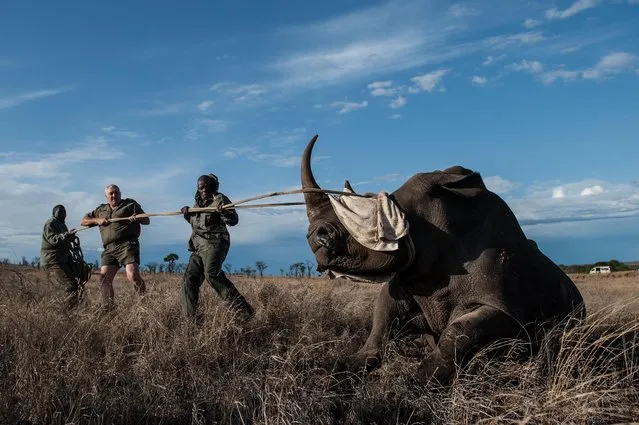
Dr. Marius Kruger (C) and memeber of the Kruger National Park keeps the head of a rhino up during a white rhino relocation capture on October 17, 2014. The Kruger National Park relocated four rhinoceros from a high risk poaching area to a safer area as part of ongoing strategic rhinoceros management plan. (Photo by Stefan Heunis/AFP Photo)

Dr. Marius Kruger (C) and memeber of the Kruger National Park keeps the head of a rhino up during a white rhino relocation capture on October 17, 2014. The Kruger National Park relocated four rhinoceros from a high risk poaching area to a safer area as part of ongoing strategic rhinoceros management plan. (Photo by Stefan Heunis/AFP Photo)
Details
20 Oct 2014 09:37:00
A woman promotes a go-go dance bar in Pattaya, Thailand March 25, 2017. With mascots dressed as smiling fish and a police rock band, Thai authorities launched a “Happy Zone” at the weekend to improve the image of a city notorious for sеx tourism. Stung by foreign headlines portraying the seaside resort of Pattaya as “Sin City” and “The World’s Sеx Capital”, Thailand’s junta has begun a new effort to re-brand it. Businesses in the Happy Zone are asked to make the area feel safer, there are increased security patrols, police launched a mobile phone app for visitors to summon them if an emergency occurs. (Photo by Jorge Silva/Reuters)

A woman promotes a go-go dance bar in Pattaya, Thailand March 25, 2017. With mascots dressed as smiling fish and a police rock band, Thai authorities launched a “Happy Zone” at the weekend to improve the image of a city notorious for sеx tourism. Stung by foreign headlines portraying the seaside resort of Pattaya as “Sin City” and “The World’s Sеx Capital”, Thailand’s junta has begun a new effort to re-brand it. Businesses in the Happy Zone are asked to make the area feel safer, there are increased security patrols, police launched a mobile phone app for visitors to summon them if an emergency occurs. (Photo by Jorge Silva/Reuters)
Details
28 Mar 2017 09:20:00
Visitors look at a giant puppet of a grandmother sleeping on a bed inside St George's Hall in Liverpool, northern England July 23, 2014. (Photo by Nigel Roddis/Reuters)

Visitors look at a giant puppet of a grandmother sleeping on a bed inside St George's Hall in Liverpool, northern England July 23, 2014. The grandmother is one of two giant models made for a World War I commemorative event. (Photo by Nigel Roddis/Reuters)
Details
26 Jul 2014 11:39:00
“The most difficult aspect of this shoot was to get each African pygmy dormouse – also known as micro squirrels – on to a separate camera. Once in place, they needed to remain still long enough to get them both in the frame and looking at me. Often solitary, they naturally wanted to move away”. (Photo by David Yeo/Leica Studio Mayfair/The Guardian)

David Yeo’s photography places naturally small species alongside animals that have been selectively bred to be tiny and cute. Here: “The most difficult aspect of this shoot was to get each African pygmy dormouse – also known as micro squirrels – on to a separate camera. Once in place, they needed to remain still long enough to get them both in the frame and looking at me. Often solitary, they naturally wanted to move away”. (Photo by David Yeo/Leica Studio Mayfair/The Guardian)
Details
24 Oct 2017 08:20:00
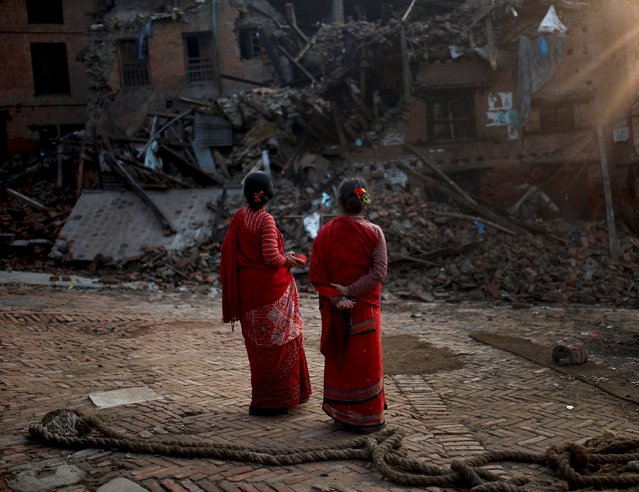
Women look at a collapsed building caused by earthquakes, in  Bhaktapur, Nepal, May 18, 2015. (Photo by Ahmad Masood/Reuters)

Women look at a collapsed building caused by earthquakes, in Bhaktapur, Nepal, May 18, 2015. Nepal is facing billions in reconstruction costs with almost 745,600 buildings and homes damaged or destroyed, including at least 87,700 in the capital, according to Nepal's emergency authority. (Photo by Ahmad Masood/Reuters)
Details
21 May 2015 11:39:00
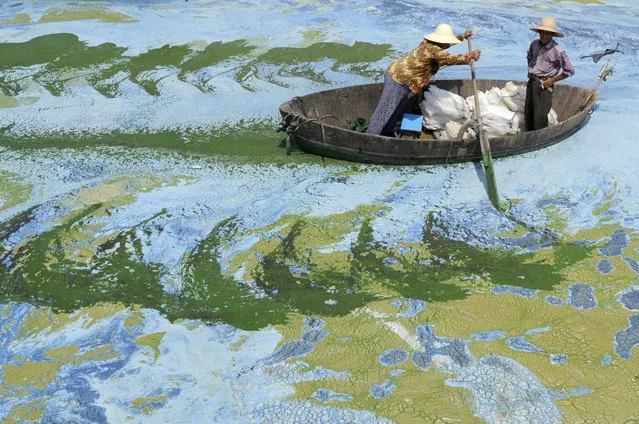
Fishermen row a boat in the algae-filled Chaohu Lake in Hefei, Anhui province, June 19, 2009. The country has invested 51 billion yuan ($7.4 billion) towards the construction of 2,712 projects for the treatment of eight rivers and lakes including Huaihe River, Haihe River, Liaohe River, Chaohu Lake, Dianchi Lake, Songhua River, the Three Gorges region of the Yangtze River and its upstream area, Xinhua News Agency reported. (Photo by Jianan Yu/Reuters)

Growing cities, overuse of fertilizers and factory wastewater have degraded China's water supplies to the extent that half the nation's rivers and lakes are severely polluted. China aims to spend $850 billion to improve filthy water supplies over the next decade, but even such huge outlays may do little to reverse damage caused by decades of pollution and overuse in Beijing's push for rapid economic growth. Photo: Fishermen row a boat in the algae-filled Chaohu Lake in Hefei, Anhui province, June 19, 2009. (Photo by Jianan Yu/Reuters)
Details
03 Aug 2014 08:01:00