Loading...
Done


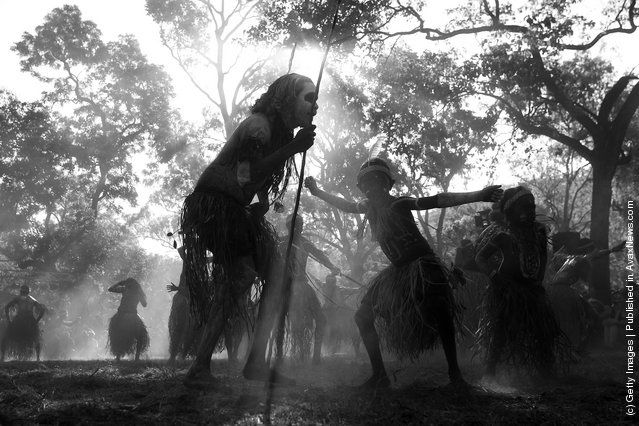
Dancers from the Yarrabah community perform during the Laura Aboriginal Dance Festival on June 18, 2011 in Laura, Australia. The Laura Aboriginal Dance Festival is a celebration of aboriginal dance and culture that takes place Biennially in Cape York Peninsula at the site of a traditional Bora ground that is sacred to the aboriginal community and surrounded by some of the oldest rock art in the world. Over 5000 visitors attend the festival, offering a unique insight into the community and providing an opportunity to spread cultural traditions to new generations. The festival takes place June 17-19. (Photo by Mark Kolbe/Getty Images for Tourism Queensland)
Details
22 Jun 2011 11:10:00
1935: American-Chinese actress Anna May Wong (1907 - 1961) wearing an Oriental-style costume and headdress

“Anna May Wong (January 3, 1905 – February 3, 1961) was an American actress, the first Chinese American movie star, and the first Asian American to become an international star. Her long and varied career spanned both silent and sound film, television, stage, and radio”. – Wikipedia

Photo: American-Chinese actress Anna May Wong wearing an Oriental-style costume and headdress. (Photo by General Photographic Agency/Getty Images). Circa 1935
Details
29 Dec 2011 09:56:00
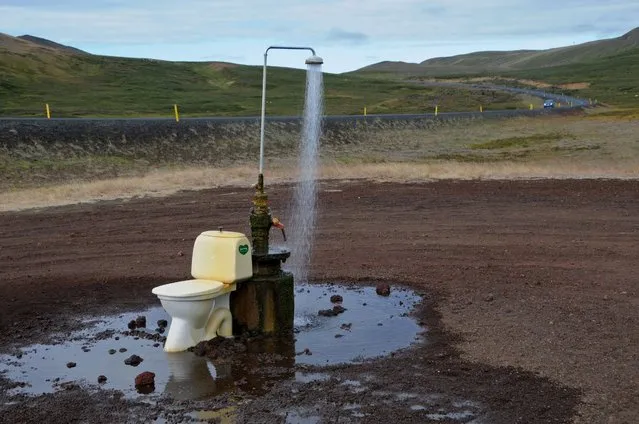
An open-air toilet and a hot spring shower are seen in the middle of nowhere on the road to the Krafla geothermal power station and lava fields, near Reykjahlid and Lake Myvatn in northeastern Iceland, on August 19, 2012. (Photo by Mariana Suarez/AFP Photo)

In 2013, the United Nations General Assembly officially designated November 19 as World Toilet Day, which is coordinated by UN-Water in collaboration with governments and partners. Here: An open-air toilet and a hot spring shower are seen in the middle of nowhere on the road to the Krafla geothermal power station and lava fields, near Reykjahlid and Lake Myvatn in northeastern Iceland, on August 19, 2012. (Photo by Mariana Suarez/AFP Photo)
Details
20 Nov 2017 07:27:00

A handout image provided by the New Zealand Defence Force shows aid supplies being unloaded by Fijian soldiers from an Royal New Zealand Airforce C-130 Hercules plane in Suva, Fiji, 23 February 2016. Tool kits, generators, ration packs, water containers and chainsaws make up part of the New Zealand relief following Tropical Cyclone Winston. The death toll from the cyclone that hit Fiji over the weekend climbed to 29, local media reported ON 23 February. (Photo by Sam Shepherd/EPA/NZ Defence Force)

A handout image provided by the New Zealand Defence Force shows aid supplies being unloaded by Fijian soldiers from an Royal New Zealand Airforce C-130 Hercules plane in Suva, Fiji, 23 February 2016. Tool kits, generators, ration packs, water containers and chainsaws make up part of the New Zealand relief following Tropical Cyclone Winston. The death toll from the cyclone that hit Fiji over the weekend climbed to 29, local media reported ON 23 February. Cyclone Winston, the most powerful storm in Fiji's history, battered the country's main island of Viti Levu and other smaller surrounding islands on Saturday, the Fiji Broadcasting Corporation reported. (Photo by Sam Shepherd/EPA/NZ Defence Force)
Details
24 Feb 2016 12:56:00
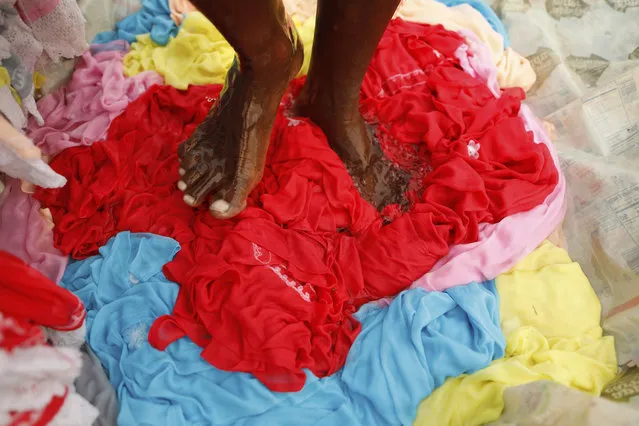
A dhobi, or a washerman washes cloths on the banks of the River Gomti in Lucknow, India, Saturday, September 12, 2020. Dhobis are traditional laundry workers who wash clothes by hand and dry them in the sun, an occupation which has been in existence for generations. Most cities in India have a Dhobi Ghat, or washermen's area, where the city's pile of clothes is laundered. This practice is still popular in India, despite of modern technology. Around 1,000 families work in Lucknow's Dhobi Ghat. However, in light of the novel coronavirus, their wages have decreased drastically. With each family earning around US$100-200 per month. (Photo by Rajesh Kumar Singh/AP Photo)

A dhobi, or a washerman washes cloths on the banks of the River Gomti in Lucknow, India, Saturday, September 12, 2020. Dhobis are traditional laundry workers who wash clothes by hand and dry them in the sun, an occupation which has been in existence for generations. Most cities in India have a Dhobi Ghat, or washermen's area, where the city's pile of clothes is laundered. This practice is still popular in India, despite of modern technology. Around 1,000 families work in Lucknow's Dhobi Ghat. However, in light of the novel coronavirus, their wages have decreased drastically. With each family earning around US$100-200 per month. (Photo by Rajesh Kumar Singh/AP Photo)
Details
25 Sep 2020 00:03:00
Caoimhe Cooburn-Gray poses for a picture on St. Patrick's day in Dublin, Ireland March 17, 2016. (Photo by Clodagh Kilcoyne/Reuters)

Caoimhe Cooburn-Gray poses for a picture on St. Patrick's day in Dublin, Ireland March 17, 2016. Saint Patrick's Day is a cultural and religious celebration held on 17 March, the traditional death date of Saint Patrick (c. AD 385–461), the foremost patron saint of Ireland. Celebrations generally involve public parades and festivals, céilithe, and the wearing of shamrocks, as well as green or orange attire. (Photo by Clodagh Kilcoyne/Reuters)
Details
18 Mar 2016 12:39:00
Monumental Plant Sculptures At The 2013 Mosaicultures Internationales De Montreal

Mosaïcultures Internationales de Montréal is an international mosaiculture competition held in Montréal, Canada. According to their website, mosaiculture “is a refined horticultural art that involves creating and mounting living artworks made primarily from plants with colourful foliage (generally annuals, and occasionally perennials).” The 2013 competition and exhibition opened June 22 and runs through September 29 at the Montréal Botanical Garden and features some 22,000 plant species and cultivars distributed throughout 10 exhibition greenhouses and 30 themed gardens.
Details
29 Jan 2014 11:38:00


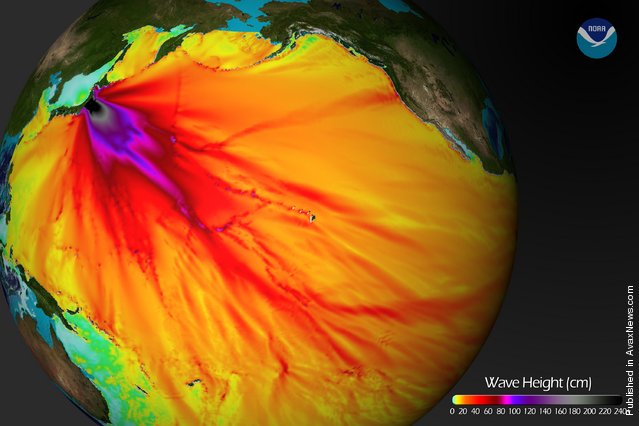
In this handout image provided by the National Oceanic and Atmospheric Administration (NOAA), model runs from the Center for Tsunami Research at the NOAA Pacific Marine Environmental Laboratory show the expected wave heights of the tsunami as it travels across the Pacific basin March 11, 2011. The largest wave heights are expected near the earthquake epicenter, off Japan. The wave will decrease in height as it travels across the deep Pacific but grow taller as it nears coastal areas. In general, as the energy of the wave decreases with distance, the near shore heights will also decrease (e.g., coastal Hawaii will not expect heights of that encountered in coastal Japan). (Photo by NOAA via Getty Images)
Details
13 Mar 2011 14:29:00