Loading...
Done
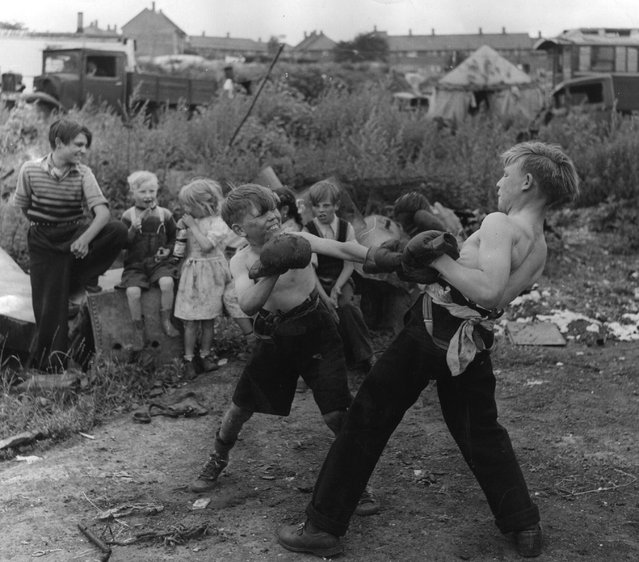
The unromantic gypsies. Children boxing in a gypsy camp in Kent, England on July 1, 1951. Like all boys these gypsy lads like to try their hand at boxing. Encouraged by their friends they fight it out on Corke's Meadow. Few Romanies now live a life of wandering romance. Most are like the three hundred squatters of Corke's Meadow, Kent, which is part of a “gypsy problem” that involves about 100,000 today. Of those about 25,000 can be rightly called gypsies, the rest are Mumpers and Posh-rats and Hobos. Corke's Meadow has both kinds. “Picture Post” cameraman Bert Hardy photographs the Corke's Meadow gypsies in their encampment. (Photo by Hulton-Deutsch Collection/Corbis via Getty Images)

The unromantic gypsies. Children boxing in a gypsy camp in Kent, England on July 1, 1951. Like all boys these gypsy lads like to try their hand at boxing. Encouraged by their friends they fight it out on Corke's Meadow. Few Romanies now live a life of wandering romance. Most are like the three hundred squatters of Corke's Meadow, Kent, which is part of a “gypsy problem” that involves about 100,000 today. Of those about 25,000 can be rightly called gypsies, the rest are Mumpers and Posh-rats and Hobos. Corke's Meadow has both kinds. “Picture Post” cameraman Bert Hardy photographs the Corke's Meadow gypsies in their encampment. (Photo by Hulton-Deutsch Collection/Corbis via Getty Images)
Details
12 Mar 2017 00:01:00
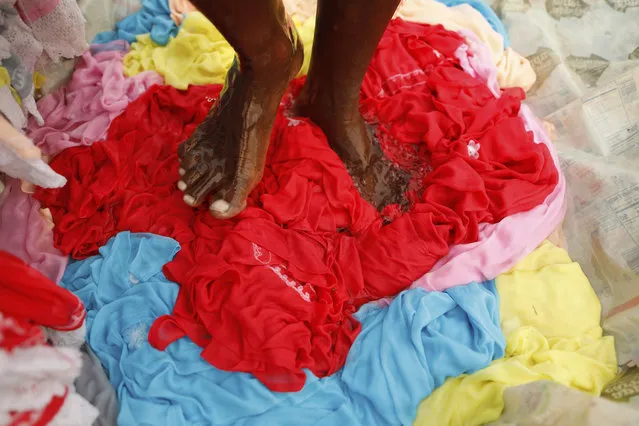
A dhobi, or a washerman washes cloths on the banks of the River Gomti in Lucknow, India, Saturday, September 12, 2020. Dhobis are traditional laundry workers who wash clothes by hand and dry them in the sun, an occupation which has been in existence for generations. Most cities in India have a Dhobi Ghat, or washermen's area, where the city's pile of clothes is laundered. This practice is still popular in India, despite of modern technology. Around 1,000 families work in Lucknow's Dhobi Ghat. However, in light of the novel coronavirus, their wages have decreased drastically. With each family earning around US$100-200 per month. (Photo by Rajesh Kumar Singh/AP Photo)

A dhobi, or a washerman washes cloths on the banks of the River Gomti in Lucknow, India, Saturday, September 12, 2020. Dhobis are traditional laundry workers who wash clothes by hand and dry them in the sun, an occupation which has been in existence for generations. Most cities in India have a Dhobi Ghat, or washermen's area, where the city's pile of clothes is laundered. This practice is still popular in India, despite of modern technology. Around 1,000 families work in Lucknow's Dhobi Ghat. However, in light of the novel coronavirus, their wages have decreased drastically. With each family earning around US$100-200 per month. (Photo by Rajesh Kumar Singh/AP Photo)
Details
25 Sep 2020 00:03:00
Volunteers transport an inflated sphere into a canoe to be lowered in MacArthur Park Lake during the installation of Portraits of Hope's exhibition “Spheres at MacArthur Park” in Los Angeles, California August 21, 2015. (Photo by Mario Anzuoni/Reuters)

Volunteers transport an inflated sphere into a canoe to be lowered in MacArthur Park Lake during the installation of Portraits of Hope's exhibition “Spheres at MacArthur Park” in Los Angeles, California August 21, 2015. The installation will feature about 3,000 inflatable hand-painted spheres. (Photo by Mario Anzuoni/Reuters)
Details
23 Aug 2015 09:15:00
Tsukimi Ayano steps out of her house in the village of Nagoro on Shikoku Island in southern Japan February 24, 2015. (Photo by Thomas Peter/Reuters)

Tsukimi Ayano steps out of her house in the village of Nagoro on Shikoku Island in southern Japan February 24, 2015. Tsukimi Ayano made her first scarecrow 13 years ago to frighten off birds pecking at seeds in her garden. The life-sized straw doll resembled her father, so she made more. Today, the tiny village of Nagoro in southern Japan is teeming with Ayano's hand-sewn creations, frozen in time for a tableau that captures the motions of everyday life. (Photo by Thomas Peter/Reuters)
Details
17 Mar 2015 12:38:00
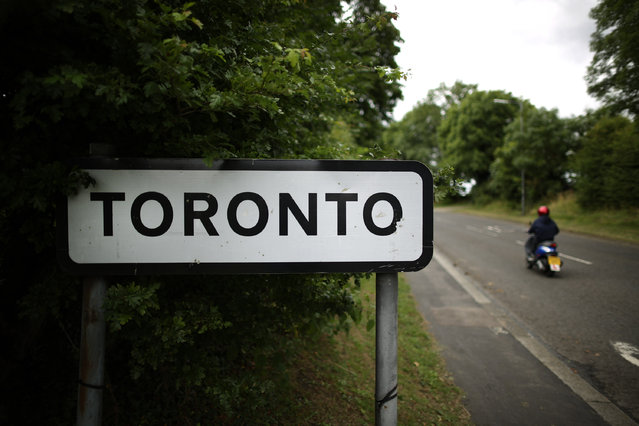
A road sign points the way on August 6, 2013 in Toronto, England. Originally called Newton Cap in the county of Durham, built for workers at the nearby colliery,  owner Henry Stobart re-named the village Toronto after visiting Canada. (Photo by Peter Macdiarmid/Getty Images)

A handful of villages in the U.K. share the same name as cities or countries from around the world, and they’re spending life in the shadows of their more famous namesakes. Photo: A road sign points the way on August 6, 2013 in Toronto, England. Originally called Newton Cap in the county of Durham, built for workers at the nearby colliery, owner Henry Stobart re-named the village Toronto after visiting Canada. (Photo by Peter Macdiarmid/Getty Images)
Details
29 Aug 2014 11:51:00
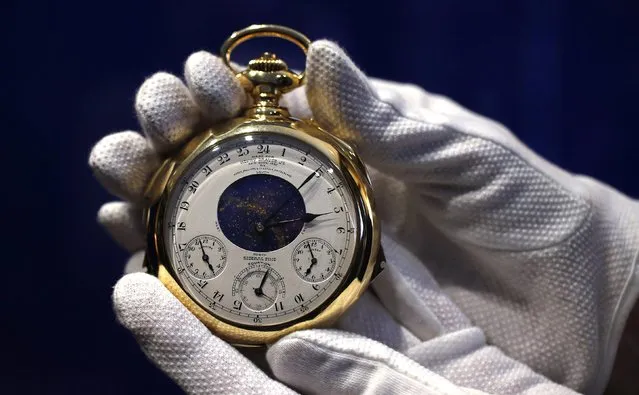
A staff member holds “The Henry Graves Supercomplication” handmade watch by Patek Philippe which was completed in 1932 at Sotheby's auction house in London October 21, 2014. (Photo by Suzanne Plunkett/Reuters)

What makes a watch the most valuable in the world? It’s supercomplicated – literally. In 1925 banker Henry Graves Jr. (considered the greatest watch collector of the 20th century) commissioned Patek Philippe to create a unique gold pocket watch. When Graves finally received it – eight years later – it was the most complex timepiece ever created by human hands... (Photo by Suzanne Plunkett/Reuters)
Details
21 Oct 2014 13:23:00
Gandhi as Yoda. (Photo by Mike Leavitt/Rex USA)

An artist has created a homage to cultural and historical figures – by immortalising them as Star Wars characters. Mike Leavitt wanted to “document the pulse of our times” through his sculpture by splicing non-fiction characters with famous faces. He chose the sci-fi trilogy as a basis for what he calls his “pop culture satirical mash-ups”, with many of the pieces hand-carved from wood. The hilarious results include Albert Einstein as R2D2, Michael Jackson as an Ewok and Angelina Jolie in Princess Leia's famous slave girl outfit. Photo: Gandhi as Yoda. (Photo by Mike Leavitt/Rex USA)
Details
20 Dec 2013 08:42:00
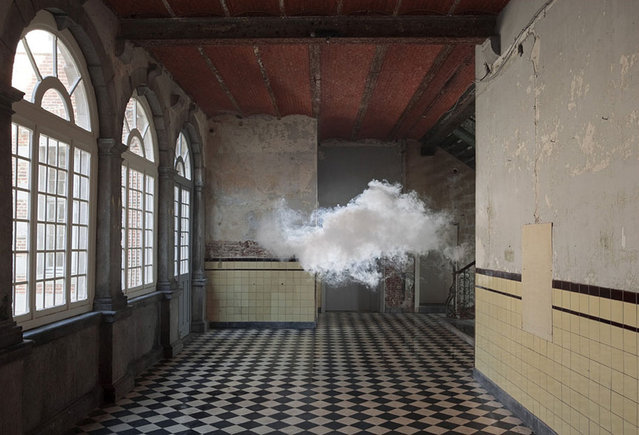
Berndnaut Smilde Creater Clouds

Dutch artist Berndnaut Smilde is interested in the ephemeral -- impermanent states of being which he documents through photographs. For Nimbus II, he used a smoke machine, combined with moisture and dramatic lighting to create a hovering indoor cloud in the empty setting of a sixteenth-century chapel in Hoorn, a small town in Holland. “I imagined walking into a museum hall with just empty walls. The place even looked deserted. On the one hand I wanted to create an ominous situation. You could see the cloud as a sign of misfortune. You could also read it as an element out of the Dutch landscape paintings in a physical form in a classical museum hall.”
Details
25 Dec 2012 12:31:00