Loading...
Done
Twenty-Year-Old People Celebrate Coming-Of-Age Around Japan

A Japanese twenty-year-old woman enjoys a cigarette during the annual Coming-of-Age Day ceremony at Toshimaen Amusement Park on January 11, 2010 in Tokyo, Japan. 1.27 million young people celebrate their passage into adulthood on the day while they become eligible to drink alcohol, smoke and vote at the age of 20. (Photo by Koichi Kamoshida/Getty Images)
Details
18 Dec 2011 12:32:00
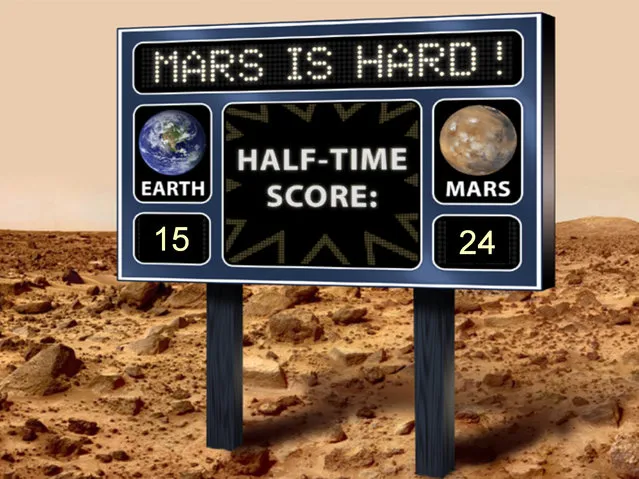
This artist's scoreboard displays a fictional game between Mars and Earth, with Mars in the lead. (Image by NASA/JPL-Caltech)

This artist's scoreboard displays a fictional game between Mars and Earth, with Mars in the lead. It refers to the success rate of sending missions to Mars, both as orbiters and landers. Of the previous 39 missions targeted for Mars from around the world, 15 have been successes and 24 failures. For baseball fans, that's a batting average of .385. The United States has had 13 successes out of 18 attempts, or a “batting average” of .722. NASA's Curiosity rover, set to land on the Red Planet the evening of Aug. 5, 2012 PDT (morning of Aug. 6 EDT), will mark the United States' 19th attempt to tackle the challenge of Mars, and the world's 40th attempt. (Image by NASA/JPL-Caltech)
Details
06 Aug 2012 09:47:00
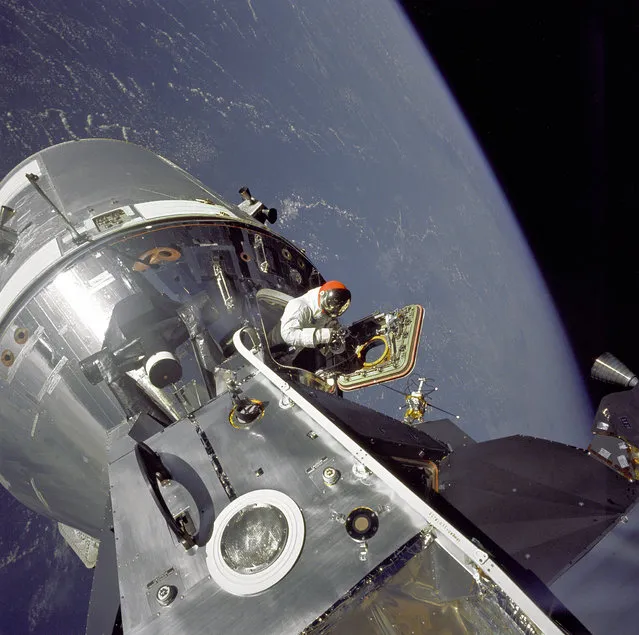
Apollo 9 Command/Service Modules (CSM) nicknamed “Gumdrop” and Lunar Module (LM), nicknamed “Spider” are shown docked together as Command Module pilot David R. Scott stands in the open hatch. Astronaut Russell L. Schweickart, Lunar Module pilot, took this photograph of Scott during his EVA as he stood on the porch outside the Lunar Module. Apollo 9 was an Earth orbital mission designed to test docking procedures between the CSM and LM as well as test fly the Lunar Module in the relative safe confines of Earth orbit. (Photo by NASA)

Apollo 9 Command/Service Modules (CSM) nicknamed “Gumdrop” and Lunar Module (LM), nicknamed “Spider” are shown docked together as Command Module pilot David R. Scott stands in the open hatch. Astronaut Russell L. Schweickart, Lunar Module pilot, took this photograph of Scott during his EVA as he stood on the porch outside the Lunar Module. Apollo 9 was an Earth orbital mission designed to test docking procedures between the CSM and LM as well as test fly the Lunar Module in the relative safe confines of Earth orbit. (Photo by NASA)
Details
20 Jul 2014 11:47:00
Dream Chaser

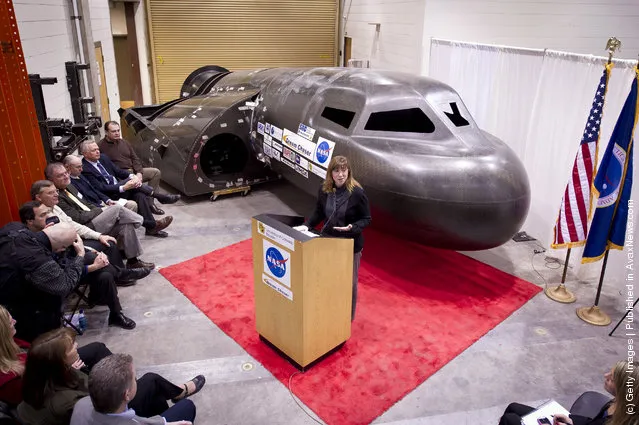
“The Dream Chaser is a planned crewed suborbital and orbital vertical-takeoff, horizontal-landing (VTHL) lifting-body spaceplane being developed by SpaceDev, a wholly owned subsidiary of Sierra Nevada Corporation (SNC). The Dream Chaser design is planned to carry seven people to and from low earth orbit. The vehicle would launch vertically on an Atlas V and land horizontally on conventional runways”. – Wikipedia

Photo: NASA Deputy Administrator Lori Garver talks during a press conference with Sierra Nevada's Dream Chaser spacecraft in the background at the University of Colorado at Boulder on February 5, 2011 in Boulder, Colorado. Sierra Nevada's Dream Chaser spacecraft is under development with support from NASA's Commercial Crew Development Program to provide crew transportation to and from low Earth orbit. NASA is helping private companies develop innovative technologies to ensure that the U.S. remains competitive in future space endeavors. (Photo by Bill Ingalls/NASA via Getty Images)
Details
12 Aug 2011 14:16:00
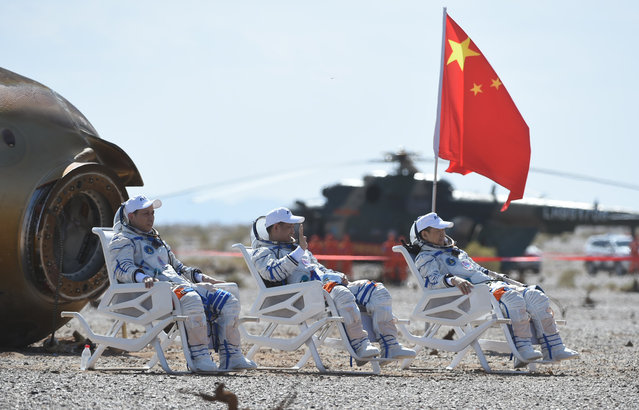
Astronauts Nie Haisheng (C), Liu Boming (R) and Tang Hongbo are out of the return capsule of the Shenzhou-12 spaceship at the Dongfeng landing site in north China's Inner Mongolia Autonomous Region on September 17, 2021. Three Chinese astronauts, the first sent to orbit for space station construction, have completed their three-month mission and returned to Earth safely on Friday. Photo by Lian Zhen/Xinhua News Agency)

Astronauts Nie Haisheng (C), Liu Boming (R) and Tang Hongbo are out of the return capsule of the Shenzhou-12 spaceship at the Dongfeng landing site in north China's Inner Mongolia Autonomous Region on September 17, 2021. Three Chinese astronauts, the first sent to orbit for space station construction, have completed their three-month mission and returned to Earth safely on Friday. Photo by Lian Zhen/Xinhua News Agency)
Details
22 Sep 2021 08:41:00


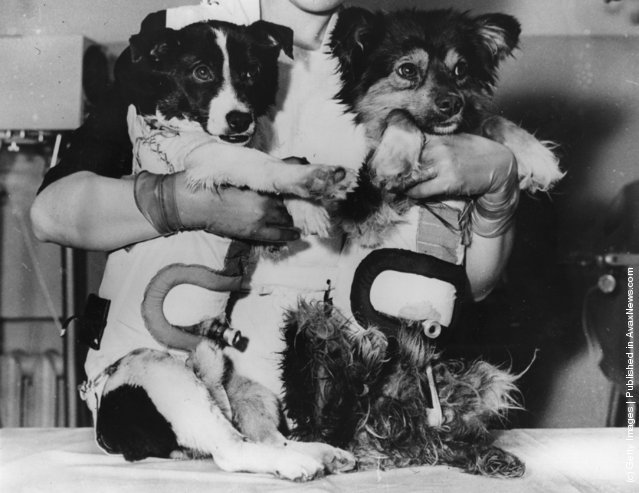
Two dogs sent into outer space by the Soviet Union after their safe return to earth. They spent 22 days in orbit. (Photo by Central Press/Getty Images). 22nd March 1966
Details
12 Apr 2011 09:39:00
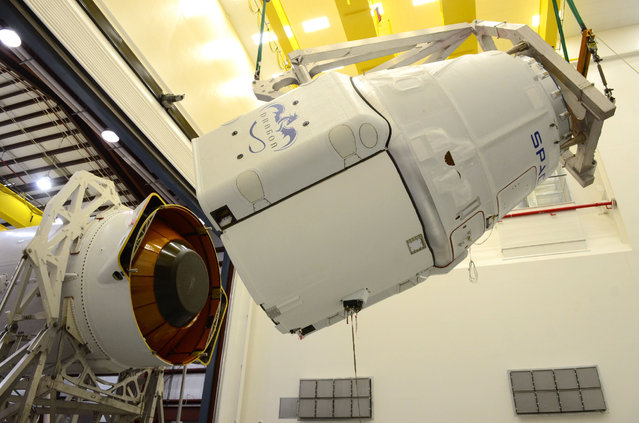
SpaceX’s Dragon spacecraft, March 6, 2014. SpaceX's Falcon 9 rocket and Dragon spacecraft launched from Launch Complex 40 at the Cape Canaveral Air Force Station, Florida, for their third official Commercial Resupply (CRS) mission to the orbiting lab on April 18, 2014. Dragon is the only operational spacecraft capable of returning a significant amount of supplies back to Earth, including experiments. (Photo by Ron Lin/SpaceX Photos)

SpaceX’s Dragon spacecraft, March 6, 2014. SpaceX's Falcon 9 rocket and Dragon spacecraft launched from Launch Complex 40 at the Cape Canaveral Air Force Station, Florida, for their third official Commercial Resupply (CRS) mission to the orbiting lab on April 18, 2014. Dragon returned to Earth with a parachute-assisted splashdown off the coast of southern California on May 14, 2014. Dragon is the only operational spacecraft capable of returning a significant amount of supplies back to Earth, including experiments. (Photo by Ron Lin/SpaceX Photos)
Details
30 Mar 2015 13:11:00
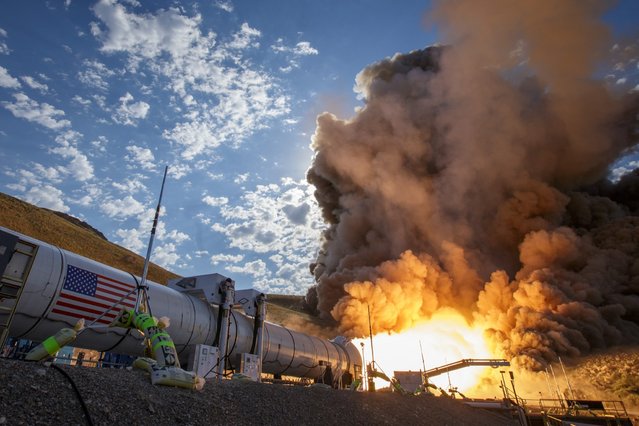
The second and final qualification motor (QM-2) test for the Space Launch System's booster, June 28, 2016, at Orbital ATK Propulsion Systems test facilities in Promontory, Utah. (Photo by Bill Ingalls/NASA)

The second and final qualification motor (QM-2) test for the Space Launch System's booster, June 28, 2016, at Orbital ATK Propulsion Systems test facilities in Promontory, Utah. During the Space Launch System flight the boosters will provide more than 75 percent of the thrust needed to escape the gravitational pull of the Earth, the first step on NASA's Journey to Mars. (Photo by Bill Ingalls/NASA)
Details
29 Jun 2016 11:32:00