Loading...
Done


“Itasha (痛車), literally “painmobile”, is a Japanese term for an otaku fad of individuals decorating the bodies of their cars with fictional characters of anime, manga, or video games (especially bishōjo game or eroge). These characters are predominately “cute” female. The decorations usually involve paint schemes and stickers. Automobiles are called Itasha, while similar motorcycles and bicycles are called itansha (痛単車) and itachari (痛チャリ), respectively”. – Wikipedia


Photo: A visitor takes pictures of an anime-decorated «Itasha» car displayed during the “Moe Fes in Washimiya” at Washimiya Town Hall on July 18, 2009 in Washimiya, Saitama, Japan. Itasha, a word derived from “itai” (painful) and “sha” (car), are vehicles decorated with mostly female characters from Japanese manga, anime and video games. (Photo by Kiyoshi Ota/Getty Images)
Details
02 May 2011 08:38:00
The fur of a horse ices up in the –40 cold of Mongolia. (Photo by Batzaya Choijiljav/Caters News)

These horses are pictured in the Khentii province in eastern Mongolia during the Winter Horse Festival – where skillful horsemen gather to challenge the strength of their horses and show off their riding skills. Pictures were taken by Batzaya Choijiljav, a travel company director from Mongolia. Here: The fur of a horse ices up in the –40 cold of Mongolia. (Photo by Batzaya Choijiljav/Caters News)
Details
29 Feb 2016 11:40:00
New York Bike Style By Sam Polcer

America may be a nation obsessed with automobiles, but today the bicycle is giving the car a run for its money. And while New York is just one of many cities that is implementing new bikefriendly policies, the local cyclist population stands out as one of the most diverse, inventive, and stylish in the world.
Details
21 Aug 2014 09:35:00
Labourers work at a garment factory in Bac Giang province, near Hanoi October 21, 2015. Vietnam's textiles and footwear would gain strongly from the TPP, after exports of $31 billion last year for brands such as Nike, Adidas, H&M, Gap, Zara, Armani and Lacoste. (Photo by Reuters/Kham)

Labourers work at a garment factory in Bac Giang province, near Hanoi October 21, 2015. Vietnam's textiles and footwear would gain strongly from the TPP, after exports of $31 billion last year for brands such as Nike, Adidas, H&M, Gap, Zara, Armani and Lacoste. (Photo by Reuters/Kham)
Details
24 Oct 2015 08:00:00
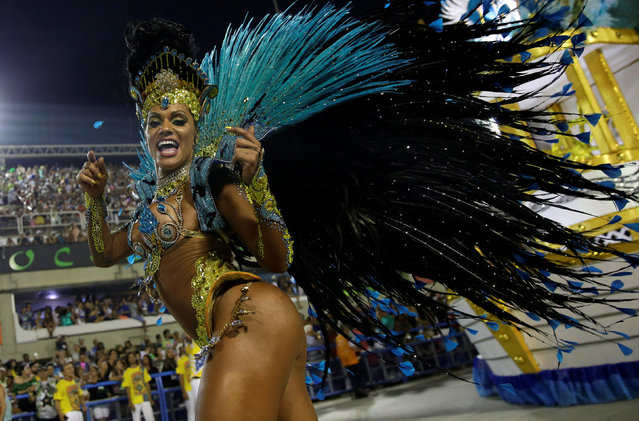
Members of Imperio Serrano samba school get ready prior to their entrance during 2023 Carnival parades at Marquês de Sapucaí Sambodrome on February 19, 2023 in Rio de Janeiro, Brazil. (Photo by Buda Mendes/Getty Images)

Members of Imperio Serrano samba school get ready prior to their entrance during 2023 Carnival parades at Marquês de Sapucaí Sambodrome on February 19, 2023 in Rio de Janeiro, Brazil. (Photo by Buda Mendes/Getty Images)
Details
30 Jun 2024 03:13:00
Dancers perform during the closing ceremony of the 19th Asian Games at the Hangzhou Olympic Sports Centre Stadium on October 8, 2023 in Hangzhou, Zhejiang Province of China. (Photo by Tingshu Wang/Reuters)

Dancers perform during the closing ceremony of the 19th Asian Games at the Hangzhou Olympic Sports Centre Stadium on October 8, 2023 in Hangzhou, Zhejiang Province of China. (Photo by Tingshu Wang/Reuters)
Details
26 Oct 2023 05:04:00
Buddy the dog peers from a vehicle before the start of a movie at a drive in cinema in Snagov, Romania, Monday, June 1, 2020. Romania further loosened the measures imposed during a nationwide lockdown in order to limit the spread of the COVID-19 infections, with museums, open air restaurants, cinemas and beaches opening for public on Monday. (Photo by Andreea Alexandru/AP Photo)

Buddy the dog peers from a vehicle before the start of a movie at a drive in cinema in Snagov, Romania, Monday, June 1, 2020. Romania further loosened the measures imposed during a nationwide lockdown in order to limit the spread of the COVID-19 infections, with museums, open air restaurants, cinemas and beaches opening for public on Monday. (Photo by Andreea Alexandru/AP Photo)
Details
21 Jun 2020 00:05:00


Wang Zeyu, 4, a fee-paying enthusiast of kung fu, practises during a training class at a kung fu school near the Shaolin Temple April 10, 2005 in Dengfeng, Henan Province, China. Zeyu's father sent him to the school from his home in Jiangsu Province, thousands kilometres away from Dengfeng, when he was just 3 years old. And his father must pay 9,800 yuan (US$1195) for one year's tuition at the school, a huge amount for most Chinese. There are more than 80 kung fu schools that line the road from the city of Dengfeng to the Shaolin Temple with hundreds and thousands of young kung-fu lovers from all over the country and beyond studying here. All the schools use the Shaolin name to attract students as the Shaolin Temple is the birthplace of Chinese Kung Fu. (Photo by Cancan Chu/Getty Images)
Details
06 Jul 2011 11:21:00