
10 May 2012 06:18:00,post received
0 comments

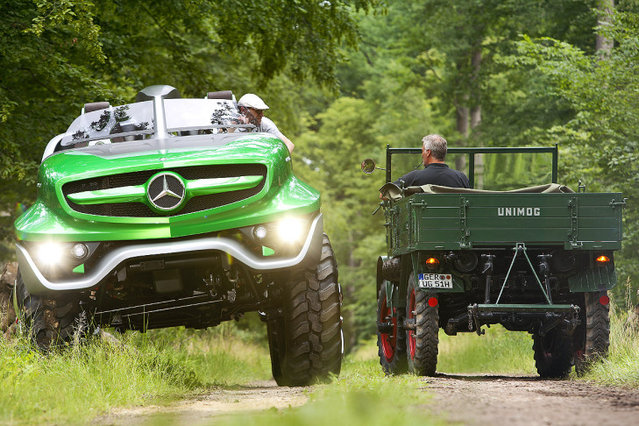
How much do things change in 60 years? Sometimes the best answer to that kind of question is a picture. Here you can see an original Unimog (right), built sometime between the start of production in 1948 and 1951, when Mercedes bought the operation in order to expand it enough to keep up with demand. On the left is a “60th Anniversary” Unimog design concept, celebrating not the actual birth of the Unimog, but its purchase by Mercedes. Needless to say, the contrast between the two is… breathtaking. And if you’re curious about the evolution of this hugely influential vehicle, if you can’t help wondering how it grew from a (relatively) tiny, spartan utility vehicle to a garish, Mercedes-starred behemoth.
31 Oct 2012 11:24:00,post received
0 comments

“In a nutshell and to prevent my english readers from experiencing eye bleeding after having read too many syntax errors, I’m a french journalist – I work as an editor, not as photographer – who happens to be nuts about photography. Being the happy owner of too many Leica M for a man to shoot, I spend most of my free time shooting my friend and my town, Strasbourg, in b&w and sometimes in colors”. – Manuel Plantin
Photo: “Even detectives got the blues”. Strasbourg, 2011 (Photo by Manuel Plantin)
Photo: “Even detectives got the blues”. Strasbourg, 2011 (Photo by Manuel Plantin)
18 Dec 2012 10:28:00,post received
0 comments
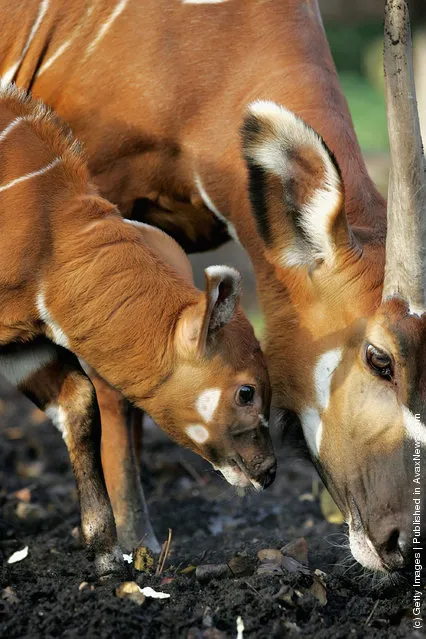
“The western or lowland bongo is a herbivorous, mostly nocturnal forest ungulate and among the largest of the African forest antelope species. Bongos are characterised by a striking reddish-brown coat, black and white markings, white-yellow stripes and long slightly spiralled horns”. – Wikipedia
Photo: The one month old newborn Bongo Antelope Calf ventures out in the cold with his mother in their enclosure at London Zoo on December 9, 2005 in London, England. (Photo by Christopher Lee/Getty Images)
Photo: The one month old newborn Bongo Antelope Calf ventures out in the cold with his mother in their enclosure at London Zoo on December 9, 2005 in London, England. (Photo by Christopher Lee/Getty Images)
21 Feb 2012 12:17:00,post received
0 comments

An Israeli missile is launched from the Iron Dome missile system in response to a rocket launch from the nearby Palestinian Gaza Strip, on March 12, 2012 near Ashdod, Israel. (Photo by Uriel Sinai/Getty Images)
13 Mar 2012 11:24:00,post received
0 comments

Men wearing masks and dressed as military members take part in a festival honouring San Silvestre, in the town of Catarina, Nicaragua January 1, 2016. The placard reads, “I'm not afraid, young people off the streets, Ortega you sell our country”, in reference Nicaragua's President Daniel Ortega. (Photo by Oswaldo Rivas/Reuters)
04 Jan 2016 08:05:00,post received
0 comments

Supporter Mette Peluce, 11, waits for U.S. Democratic presidential candidate Bernie Sanders to speak in East Los Angeles, California, U.S. May 23, 2016. (Photo by Lucy Nicholson/Reuters)
25 May 2016 13:15:00,post received
0 comments
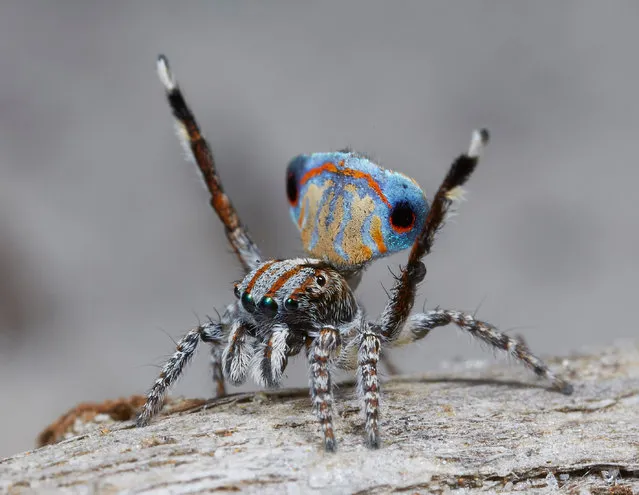
Several new species of peacock spider – just a few millimetres long and featuring extraordinary colours – have been discovered in Western Australia and South Australia. Jürgen Otto, a biologist from Sydney, has been researching the arachnids since 2005, and has gained a significant following online with his footage. He believes there are now 48 confirmed species of peacock spider within the Maratus genus, found across Australia but particularly in Western Australia – and many more awaiting confirmation. Here: Maratus Tasmanicus, one of seven new species of peacock spiders studied by the Sydney biologist Jürgen Otto. (Photo by Jürgen Otto)
30 May 2016 08:40:00,post received
0 comments