Loading...
Done
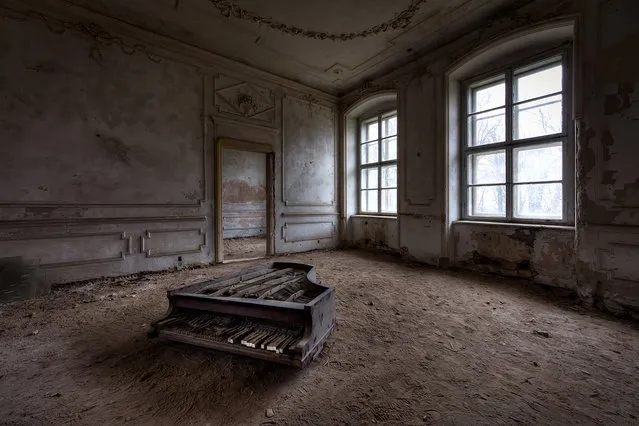
This piano was located in one of many rooms of a huge chateau in Poland. (Photo by Vincent Jansen)

Photographer Vincent Jansen travels throughout Europe, visiting beautiful abandoned places. He explores churches, factories, sanatoriums, mortuaries, villas and theaters, all quietly waiting for renovation or demolition. His photos show a unique perspective on what is happening behind the “no trespassing” signs: where nature is slowly gaining ground and the desolation, loneliness and decay leave their stunning traces. Photo: This piano was located in one of many rooms of a huge chateau in Poland. (Photo by Vincent Jansen)
Details
11 May 2014 12:10:00
In this July 17, 2015 photo, Michael Chilton squeezes into a corner of his car to make a quick repair to some body panels after he ran into a wall during dirt track racing in the late model division at the Ponderosa Speedway in Junction City, Ky. He banged up the car in the qualifying round and had a few minutes to fix it before the final race. (Photo by David Stephenson/AP Photo)

In this July 17, 2015 photo, Michael Chilton squeezes into a corner of his car to make a quick repair to some body panels after he ran into a wall during dirt track racing in the late model division at the Ponderosa Speedway in Junction City, Ky. He banged up the car in the qualifying round and had a few minutes to fix it before the final race. (Photo by David Stephenson/AP Photo)
Details
22 Jul 2015 12:02:00
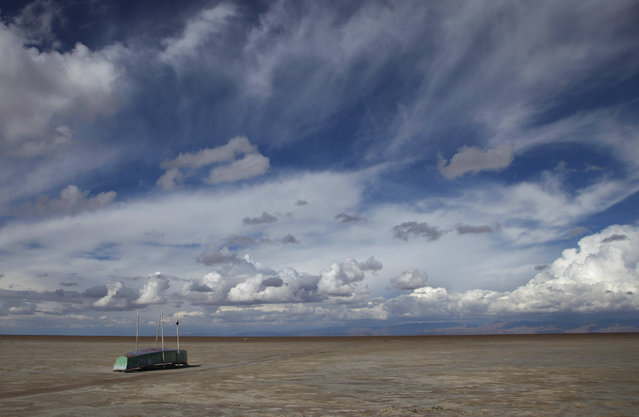
In this January 12, 2016 photo, an abandoned boat lies on the dried up lake bed of Lake Poopo, on the outskirts of Untavi, Bolivia. Drought caused by the recurrent El Nino meteorological phenomenon is considered the main driver of the lake's demise. Along with glacial melting, authorities say another factor is the diversion of water from Poopo's tributaries, mostly for mining but also for agriculture. (Photo by Juan Karita/AP Photo)

In this January 12, 2016 photo, an abandoned boat lies on the dried up lake bed of Lake Poopo, on the outskirts of Untavi, Bolivia. Drought caused by the recurrent El Nino meteorological phenomenon is considered the main driver of the lake's demise. Along with glacial melting, authorities say another factor is the diversion of water from Poopo's tributaries, mostly for mining but also for agriculture. (Photo by Juan Karita/AP Photo)
Details
21 Jan 2016 12:33:00
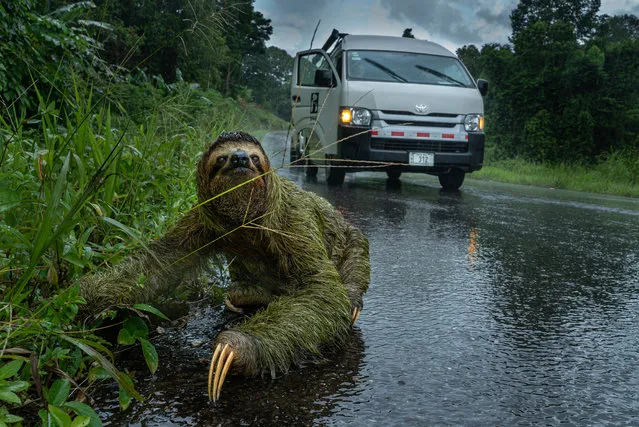
People and Nature category winner: Why did the sloth cross the road? by Andrew Whitworth (Osa Conservation and University of Glasgow), taken in Osa Peninsula, Costa Rica. “I was driving out from the Osa Peninsula, located on the southern Pacific coast of Costa Rica on a dark, stormy day. This female three-toed sloth (Bradypus variegatus) had luckily just about made it across the road, and the drivers of the Toyota on this occasion had spotted her in good time”. (Photo by Andrew Whitworth/2019 British Ecological Society Photography Competition)

People and Nature category winner: Why did the sloth cross the road? by Andrew Whitworth (Osa Conservation and University of Glasgow), taken in Osa Peninsula, Costa Rica. “I was driving out from the Osa Peninsula, located on the southern Pacific coast of Costa Rica on a dark, stormy day. This female three-toed sloth (Bradypus variegatus) had luckily just about made it across the road, and the drivers of the Toyota on this occasion had spotted her in good time”. (Photo by Andrew Whitworth/2019 British Ecological Society Photography Competition)
Details
30 Nov 2019 00:05:00
Unidentified people beat Svyatoslav Sheremet (L, bottom), head of Gay-Forum of Ukraine public organization, in Kiev, May 20, 2012. Sheremet was attacked after meeting with members of the media to inform them that a scheduled gay parade was cancelled. The attackers ran off when they realised members of the media were documenting the attack. (Photo by Anatolii Stepanov/Reuters)

Unidentified people beat Svyatoslav Sheremet (L, bottom), head of Gay-Forum of Ukraine public organization, in Kiev, May 20, 2012. Sheremet was attacked after meeting with members of the media to inform them that a scheduled gay parade was cancelled. The attackers ran off when they realised members of the media were documenting the attack. (Photo by Anatolii Stepanov/Reuters)
Details
16 May 2020 00:03:00
People drink in the street in the Soho area of London, on April 12, 2021 as coronavirus restrictions are eased across the country in step two of the government's roadmap out of England's third national lockdown. Britons on Monday toasted a significant easing of coronavirus restrictions, with early morning pints – and much-needed haircuts – as the country took a tentative step towards the resumption of normal life. Businesses including non-essential retail, gyms, salons and outdoor hospitality were all able to open for the first time in months in the second step of the government's roadmap out of lockdown. (Photo by Tolga Akmen/AFP Photo)

People drink in the street in the Soho area of London, on April 12, 2021 as coronavirus restrictions are eased across the country in step two of the government's roadmap out of England's third national lockdown. Britons on Monday toasted a significant easing of coronavirus restrictions, with early morning pints – and much-needed haircuts – as the country took a tentative step towards the resumption of normal life. Businesses including non-essential retail, gyms, salons and outdoor hospitality were all able to open for the first time in months in the second step of the government's roadmap out of lockdown. (Photo by Tolga Akmen/AFP Photo)
Details
13 Apr 2021 08:02:00


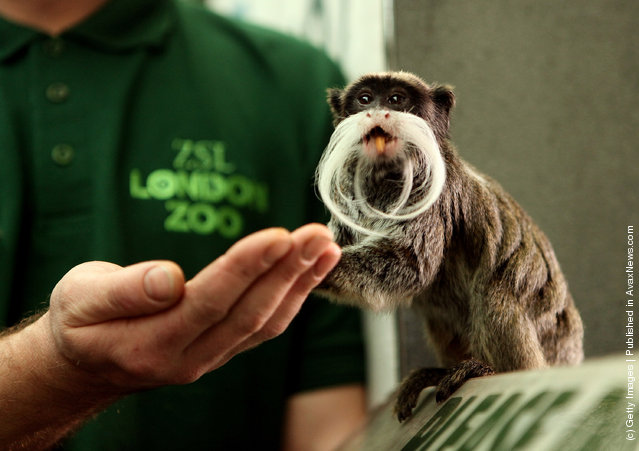
An Emperor Tamarin monkey, native to the Amazon rainforest, experiences its new home in the living rainforest enclosure at ZSL London Zoo on March 25, 2010 in London, England. Entitled “Rainforest Life” the large temperature and humidity controlled bio-dome is home to free-roaming monkeys, sloths, tree anteaters and tropical birds. The exhibit, which is opening in the International Year of Biodiversity, will be open to the public from March 27, 2010. (Photo by Oli Scarff/Getty Images)
Details
19 Apr 2011 11:48:00


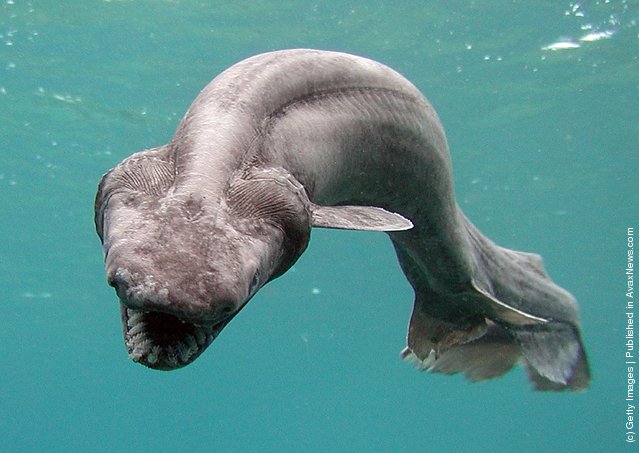
“The frilled shark (Chlamydoselachus anguineus) is one of two extant species of shark in the family Chlamydoselachidae, with a wide but patchy distribution in the Atlantic and Pacific Oceans. This uncommon species is found over the outer continental shelf and upper continental slope, generally near the bottom though there is evidence of substantial upward movements. It has been caught as deep as 1,570 m (5,150 ft), whereas in Suruga Bay, Japan it is most common at depths of 50–200 m (160–660 ft). Exhibiting several “primitive” features, the frilled shark has often been termed a «living fossil»”. – Wikipedia

Photo: A 1.6 meter long Frill shark swims in a tank after being found by a fisherman at a bay in Numazu, on January 21, 2007 in Numazu, Japan. The frill shark, also known as a Frilled shark usually lives in waters of a depth of 600 meters and so it is very rare that this shark is found alive at sea-level. It's body shape and the number of gill are similar to fossils of sharks which lived 350,000,000 years ago. (Photo by Awashima Marine Park/Getty Images)
Details
05 May 2011 10:01:00