Loading...
Done
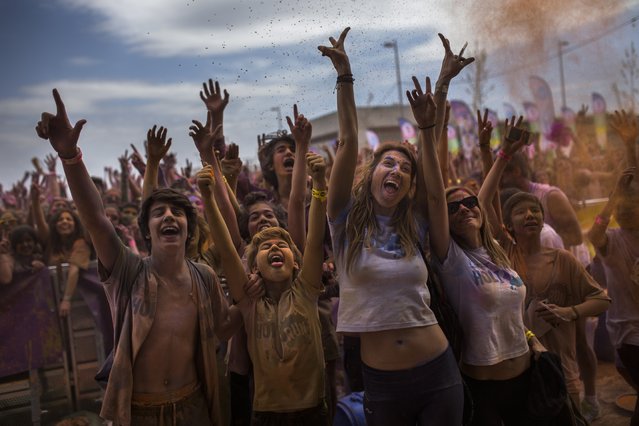
Revelers, covered in coloured powder, celebrate, during a Holi Run Festival in Madrid, Spain, Sunday, April 12, 2015. Thousands of revelers took part in the festival that includes a mini marathon. The festivals are fashioned after the Hindu spring festival Holi, which is mainly celebrated in the north and east of India. (Photo by Andres Kudacki/AP Photo)

Revelers, covered in coloured powder, celebrate, during a Holi Run Festival in Madrid, Spain, Sunday, April 12, 2015. Thousands of revelers took part in the festival that includes a mini marathon. The festivals are fashioned after the Hindu spring festival Holi, which is mainly celebrated in the north and east of India. (Photo by Andres Kudacki/AP Photo)
Details
18 Apr 2015 09:38:00
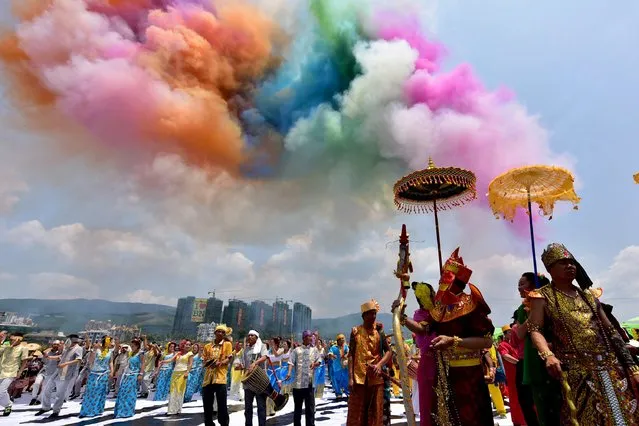
People wearing costumes attend the annual water-splashing festival to mark the New Year of the Dai minority in Jinghong, Yunnan province, April 13, 2015. (Photo by Reuters/China Daily)

People wearing costumes attend the annual water-splashing festival to mark the New Year of the Dai minority in Jinghong, Yunnan province, April 13, 2015. (Photo by Reuters/China Daily)
Details
18 Apr 2015 10:01:00
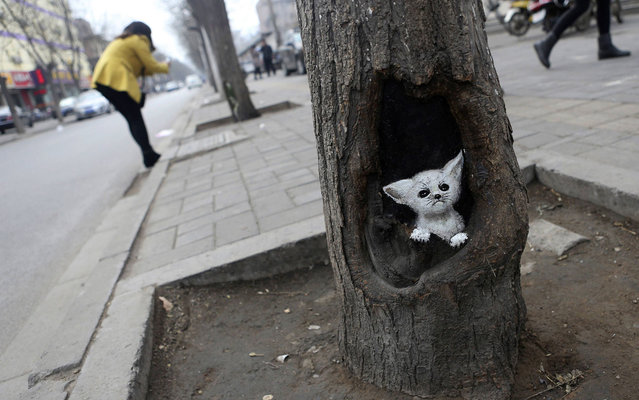
An image of a Fennec fox painted on a tree hole by Wang Yue is seen in Shijiazhuang, on March 13, 2013. Wang Yue, a senior at Dalian Industry University, uses her paintbrush to turn ugly tree holes into lovely views in Shijiazhuang, capital city of Hebei Province, China. Wang and her companions call the tree-hole paintings “meitu”, which means “beautiful journey”. The paintings on the trees have brightened the city during the dull, grey winter. (Photo by Pillar Lee/Reuters)

An image of a Fennec fox painted on a tree hole by Wang Yue is seen in Shijiazhuang, on March 13, 2013. Wang Yue, a senior at Dalian Industry University, uses her paintbrush to turn ugly tree holes into lovely views in Shijiazhuang, capital city of Hebei Province, China. Wang and her companions call the tree-hole paintings “meitu”, which means “beautiful journey”. The paintings on the trees have brightened the city during the dull, grey winter. (Photo by Pillar Lee/Reuters)

P.S. All pictures are presented in high resolution. To see Hi-Res images – just TWICE click on any picture. In other words, click small picture – opens the BIG picture. Click BIG picture – opens VERY BIG picture (if available; this principle works anywhere on the site AvaxNews).
Details
16 Mar 2013 11:27:00
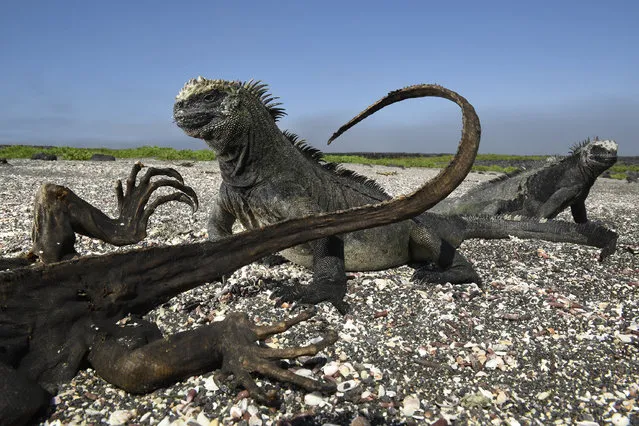
Galapagos – Rocking the Cradle: Four major ocean currents converge along the Galapagos archipelago, creating the conditions for an extraordinary diversity of animal life, April 25, 2016. The islands are home to at least 7,000 flora and fauna species, of which 97 percent of the reptiles, 80 percent of the land birds, 50 percent of the insects and 30 percent of the plants are endemic. The local ecosystem is highly sensitive to the changes in temperature, rainfall and ocean currents that characterize the climatic events known as El Niño and La Niña. These changes cause marked fluctuations in weather and food availability. Many scientists expect the frequency of El Niño and La Niña to increase as a result of climate change, making the Galapagos a possible early-warning location for its effects. (Photo by Thomas P. Peschak for National Geographic/World Press Photo)

Galapagos – Rocking the Cradle: Four major ocean currents converge along the Galapagos archipelago, creating the conditions for an extraordinary diversity of animal life, April 25, 2016. The islands are home to at least 7,000 flora and fauna species, of which 97 percent of the reptiles, 80 percent of the land birds, 50 percent of the insects and 30 percent of the plants are endemic. (Photo by Thomas P. Peschak for National Geographic/World Press Photo)
Details
16 Apr 2018 00:01:00
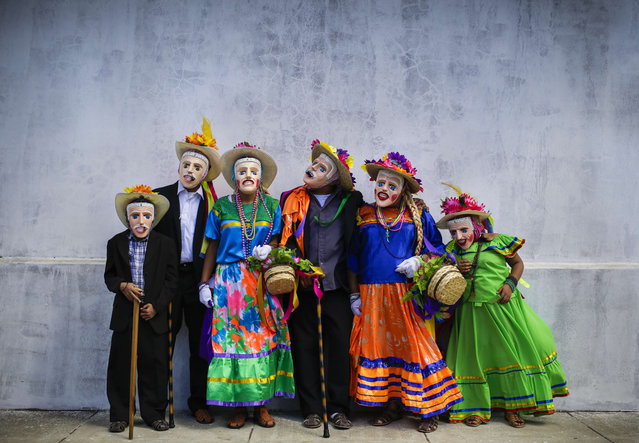
Dancers pose after performing “El Macho Raton”, “El Toro Huaco” and “El Gueguense” traditional dances during San Sebastian festivity in Diriamba, province of Carazo, some 50 km south of Managua on January 19, 2016. Devotees of Saint Sebastian dance in traditional costumes between the cities of Diriamba and Dolores, which are some three kilometers away. (Photo by Inti Ocon/AFP Photo)

Dancers pose after performing “El Macho Raton”, “El Toro Huaco” and “El Gueguense” traditional dances during San Sebastian festivity in Diriamba, province of Carazo, some 50 km south of Managua on January 19, 2016. Devotees of Saint Sebastian dance in traditional costumes between the cities of Diriamba and Dolores, which are some three kilometers away. (Photo by Inti Ocon/AFP Photo)
Details
21 Jan 2016 12:08:00
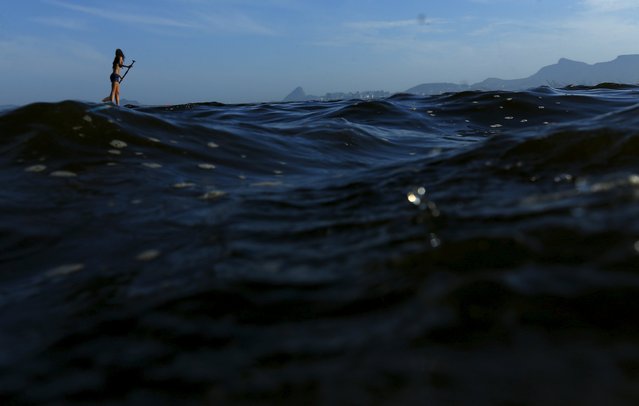
A girl paddles on her stand-up board on the waters of Guanabara bay at Bica beach in Rio de Janeiro Brazil, January 10, 2016. (Photo by Ricardo Moraes/Reuters)

A girl paddles on her stand-up board on the waters of Guanabara bay at Bica beach in Rio de Janeiro Brazil, January 10, 2016. Few features capture the beauty, or the problems, of one of the world's most dramatic urban landscapes like Guanabara Bay - the finger-like inlet that forms the shoreline and harbor for Rio de Janeiro. The bay, which carves into southeast Brazil from the Atlantic Ocean, literally gave Rio its name when Portuguese mariners mistook it for a “rio”, or “river”. Four centuries later, the bay is preparing to welcome another sort of seafarer – Olympic sailors, who will navigate the bay when the 2016 Rio Olympics kick off in August. (Photo by Ricardo Moraes/Reuters)
Details
28 Apr 2016 12:13:00
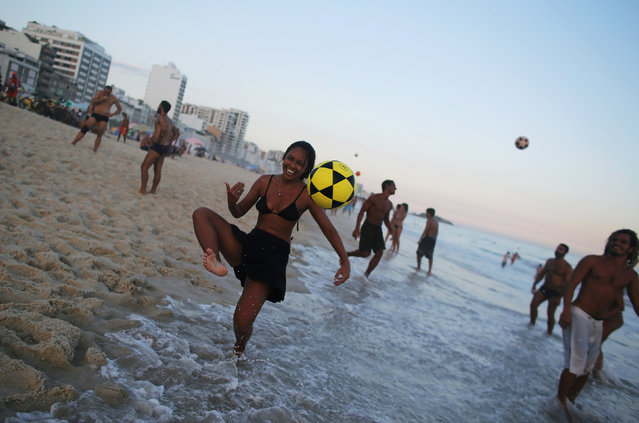
A woman controls a ball on Ipanema beach in Rio de Janeiro, Brazil, April 14, 2016. (Photo by Nacho Doce/Reuters)

A woman controls a ball on Ipanema beach in Rio de Janeiro, Brazil, April 14, 2016. As hundreds of thousands of tourists begin descending on Rio de Janeiro for the Olympics that start August 5, the headlines have focused on the street violence, the Zika virus, the water pollution and the rush to finish venues and transport. But Rio, known by Brazilians as the “Marvelous City”, glistens despite it all. The beach is a way of life here. (Photo by Nacho Doce/Reuters)
Details
19 Jul 2016 13:10:00
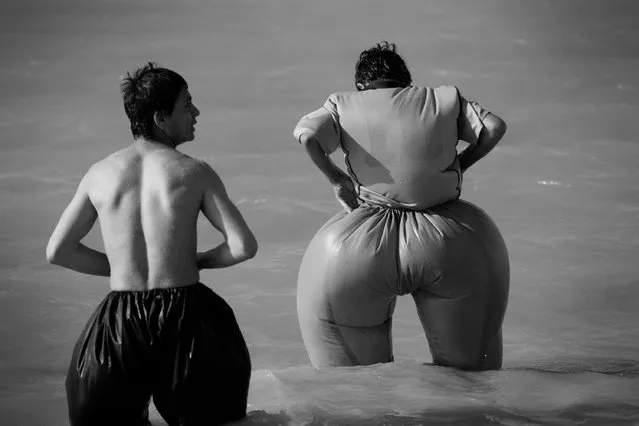
Afghan men escape increasing summer temperatures by wading in the Qarga reservoir on July 9, 2010 in a suburb of Kabul, Afghanistan. (Photo by Majid Saeedi/Getty Images)

“Life in War” (FotoEvidence Press) by Iranian photographer Majid Saeedi is probably the only book about Afghanistan that doesn’t show images of war. For ten years his camera photographed daily life in the context of war. His photographs reveal the humanity of a people living through decades of war. Here: Afghan men escape increasing summer temperatures by wading in the Qarga reservoir on July 9, 2010 in a suburb of Kabul, Afghanistan. (Photo by Majid Saeedi/Getty Images)
Details
17 Oct 2014 12:07:00