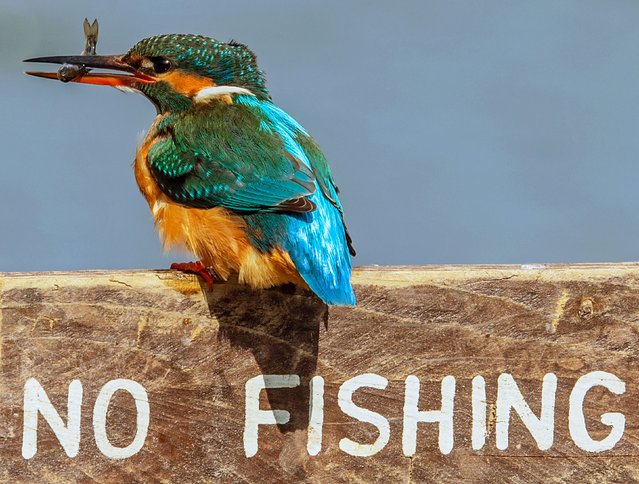
A kingfisher ignores the “no fishing” sign after catching food at Teddesley Park in Staffordshire, England, on Saturday, April 5, 2025. (Photo by Stuart Brock/Anadolu/Getty Images)
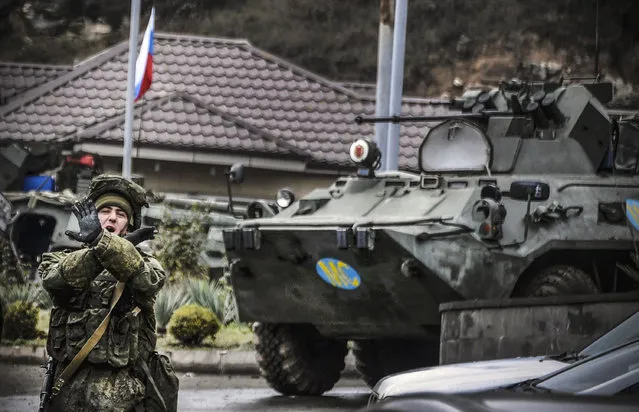
A Russian peacekeeper shouts “No pictures!” at a checkpoint outside the city of Stepanakert on November 13, 2020, during a ceasefire in the military conflict between Armenia and Azerbaijan over the breakaway region of Nagorno-Karabakh. Russian began deploying 2,000 peacekeepers to Nagorno-Karabakh on November 10 after Armenia and Azerbaijan agreed a peace deal to end weeks of fierce fighting over the disputed region. (Photo by Alexander Nemenov/AFP Photo)
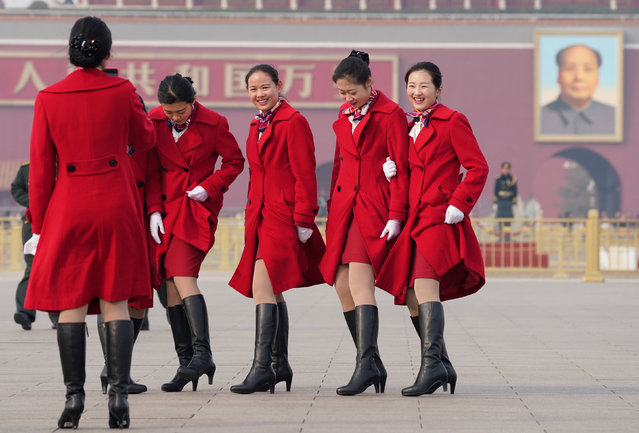
Hotel ushers pose for a photo at Tiananmen Square as delegates attend the second plenary session of the National People's Congress (NPC) in Beijing, China, March 9, 2018. The CPPCC is the top advisory body of the Chinese political system and runs alongside the annual plenary meetings of the 13th National People's Congress (NPC), together known as “Lianghui” or “Two Meetings”. (Photo by Jason Lee/Reuters)
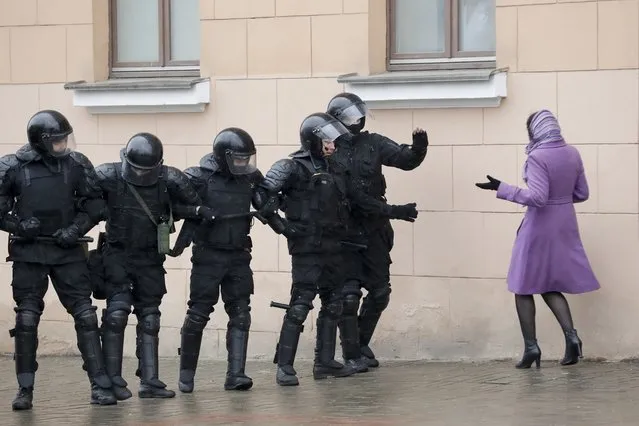
A woman argues as Belarus police block a street during an opposition rally in Minsk, Belarus, Saturday, March 25, 2017. Over the past two months, protests have broken out across the country of 9.5 million, sometimes attracting thousands – initially they were focused on the labor law but have grown to encompass calls for the resignation of President Alexander Lukashenko, whom critics call Europe's last dictator. (Photo by Sergei Grits/AP Photo)
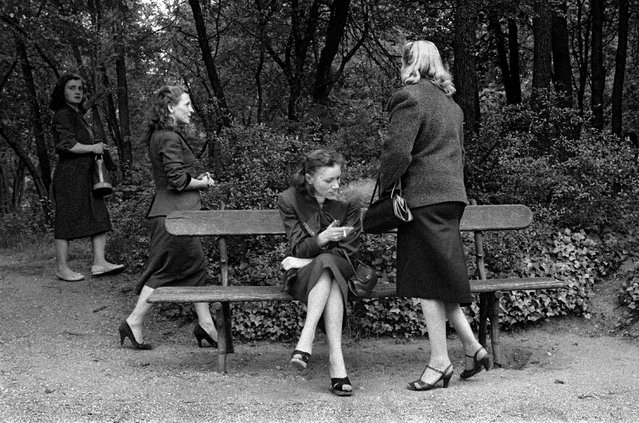
Born in 1958 in Abbazia, Italy, Frank Horvat is considered one of the founding fathers of French fashion photography. Frank Horvat: Storia di un Fotografo is on at Palazzo Chiablese Musei Reali, Turin, until 16 June. Here: Prostitutes, Bois de Boulogne, 1956. (Photo by Frank Horvat/The Guardian)
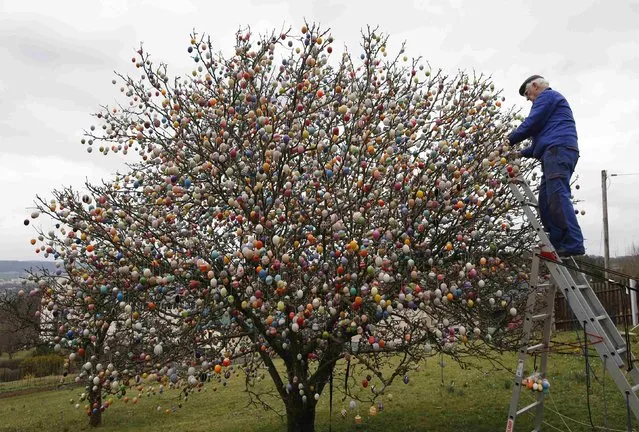
German pensioner Volker Kraft decorates an apple tree with Easter eggs in the garden of his summerhouse, in the eastern German town of Saalfeld, March 19, 2014. Each year since 1965 Volker and his wife Christa spend up to two weeks decorating the tree with their collection of 10,000 colourful hand-painted Easter eggs in time for Easter celebrations. (Photo by Fabrizio Bensch/Reuters)
I know, this answer was a little too short, so let me explain in a little more detail.
Imagine tossing a coin. Normally, any normal coin toss has two possible outcomes - heads or tails - with each one having a 50% chance of happening. Ideally, that is, because factors like the force of your finger tossing the coin, gravity, the wind, the moon phase and a passing TARDIS can all influence the outcome of the toss - but I have deviated from the subject.