Loading...
Done
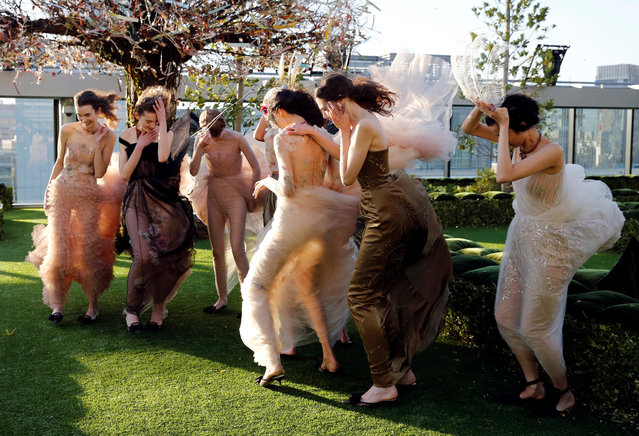
Models struggle against strong wind before the rehearsal of Christian Dior's Haute Couture Spring-Summer 2017 live show to celebrate Dior's new flagship store on the rooftop of Ginza Six mall in Tokyo, Japan, April 19, 2017. (Photo by Toru Hanai/Reuters)

Models struggle against strong wind before the rehearsal of Christian Dior's Haute Couture Spring-Summer 2017 live show to celebrate Dior's new flagship store on the rooftop of Ginza Six mall in Tokyo, Japan, April 19, 2017. (Photo by Toru Hanai/Reuters)
Details
06 Jan 2018 08:46:00
An animal rights activist washes herself with red dye to mimic blood during a protest against the testing of shampoo on animals in Barcelona

An animal rights activist washes herself with red dye to mimic blood during a protest against the testing of shampoo on animals in Barcelona. April 24, 2012. (Photo by Raul Albaledo/AFP Photo)
Details
28 Apr 2012 12:28:00
Galapagos – Rocking the Cradle: Four major ocean currents converge along the Galapagos archipelago, creating the conditions for an extraordinary diversity of animal life, April 25, 2016. The islands are home to at least 7,000 flora and fauna species, of which 97 percent of the reptiles, 80 percent of the land birds, 50 percent of the insects and 30 percent of the plants are endemic. The local ecosystem is highly sensitive to the changes in temperature, rainfall and ocean currents that characterize the climatic events known as El Niño and La Niña. These changes cause marked fluctuations in weather and food availability. Many scientists expect the frequency of El Niño and La Niña to increase as a result of climate change, making the Galapagos a possible early-warning location for its effects. (Photo by Thomas P. Peschak for National Geographic/World Press Photo)

Galapagos – Rocking the Cradle: Four major ocean currents converge along the Galapagos archipelago, creating the conditions for an extraordinary diversity of animal life, April 25, 2016. The islands are home to at least 7,000 flora and fauna species, of which 97 percent of the reptiles, 80 percent of the land birds, 50 percent of the insects and 30 percent of the plants are endemic. (Photo by Thomas P. Peschak for National Geographic/World Press Photo)
Details
16 Apr 2018 00:01:00
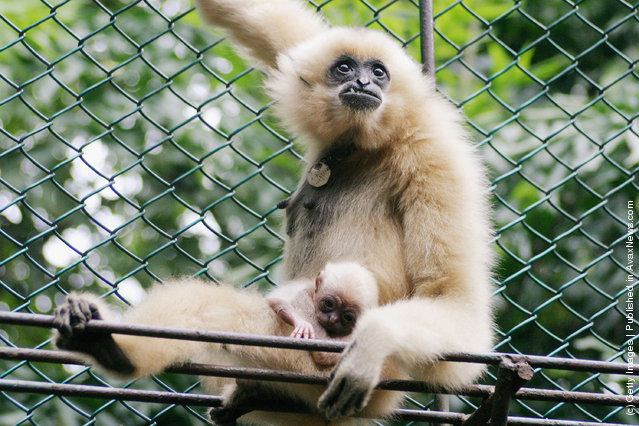
Newborn White-Cheeked Gibbon Nomascus

“Nomascus is the second most speciose genus of gibbons (family Hylobatidae). Originally this genus was a subgenus of Hylobates, and all individuals were considered one species, Hylobates concolor. Species within Nomascus are characterized by 52 chromosomes. Some species are all black, some light with a distinct black tuft of crown fur, and some by distinct, light-colored cheek patches. Nomascus is found from southern China (Yunnan) to southern Vietnam, and also on Hainan Island. One of the genus' species, Nomascus nasutus, has been deemed “the most critically endangered ape species in the world”. All of the species in this genus are endangered or critically endangered”. – Wikipedia

Photo: A newborn White-Cheeked Gibbon clings to its mother in the Nanning Zoo on April 12, 2004 in Nanning, Guangxi province, China. The White-Cheeked Gibbon's natural habitat is Southern China as well as Vietnam and Laos. They are classified as highly endangered and are on the brink of extinction due to poaching and reduction of natural rainforests. (Photo by Getty Images)
Details
12 Aug 2011 11:51:00
South Korean residents 89-year-old Jeong Nam-poong and 80-year-old Jang Yoon-hui , wearing protective masks, dance at park after their daytime discotheque “colatec” has been closed amid the coronavirus disease (COVID-19) outbreak in Seoul, South Korea, May 19, 2020. (Photo by Minwoo Park/Reuters)

South Korean residents 89-year-old Jeong Nam-poong and 80-year-old Jang Yoon-hui , wearing protective masks, dance at park after their daytime discotheque “colatec” has been closed amid the coronavirus disease (COVID-19) outbreak in Seoul, South Korea, May 19, 2020. (Photo by Minwoo Park/Reuters)
Details
09 Jun 2020 00:01:00
Festival-goers enjoy a fairground ride at Reading Festival in Reading, west of London, on August 27, 2021. As coronavirus covid-19 infection levels rise across the country, vaccines will be offered to revellers throughout the weekend. The organiser of Reading and Leeds Festivals has said such events are arguably “safer places to be” because attendees have been tested for covid-19. The festivals are returning this year with headliners including Stormzy, after being cancelled last year due to the pandemic. (Photo by Daniel Leal-Olivas/AFP Photo)

Festival-goers enjoy a fairground ride at Reading Festival in Reading, west of London, on August 27, 2021. As coronavirus covid-19 infection levels rise across the country, vaccines will be offered to revellers throughout the weekend. The organiser of Reading and Leeds Festivals has said such events are arguably “safer places to be” because attendees have been tested for covid-19. The festivals are returning this year with headliners including Stormzy, after being cancelled last year due to the pandemic. (Photo by Daniel Leal-Olivas/AFP Photo)
Details
29 Mar 2022 06:15:00
Family Tree By Zhang Huan

All the people we meet, all the things we know, and all of our experiences shape our souls, forever marking our faces. This was probably the main idea of the performance piece created by Chinese artist Zhang Huan, in which his face was painted over by three calligraphers with the names of people he knew, personal stories, and random thoughts. Truly, it amazing just how much we can find out about a person just by looking at their face. Surely, not everyone has the ability to see into the soul of the person just by looking at their face, but those that do can easily see the person’s personality, their intelligence, and sometimes even get glimpse into their past. Though it sounds like magic to people who don’t have this ability, it is completely true. Somehow, our mind can pick up on the miniscule changes of the facial structure and figure out the dominant facial expressions of that person. (Photo by Zhang Huan)

Details
23 Nov 2014 12:47:00
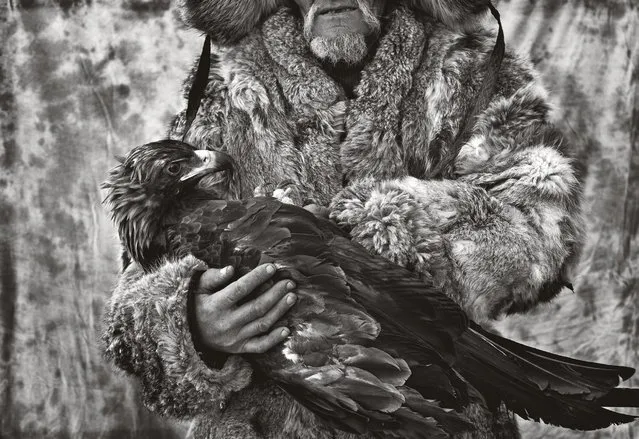
A Kazakh hunter has taken an eaglet from the nest, given it pride of place in their home and trained it. All hunters describe the eagle as part of their family. (Photo by Palani Mohan)

Kazakh nomads have been grazing their livestock in Mongolia for hundreds of years. Fascinated by the bond between hunter and eagle, photographer Palani Mohan has spent the last few years documenting the burkitshi. Mohan's photos of the landscape, isolation of the hunt, and most of all the trusting relationship between man and bird, convey the importance that the eagle plays in their lives. (Photo by Palani Mohan)
Details
11 Jan 2016 08:03:00