Loading...
Done
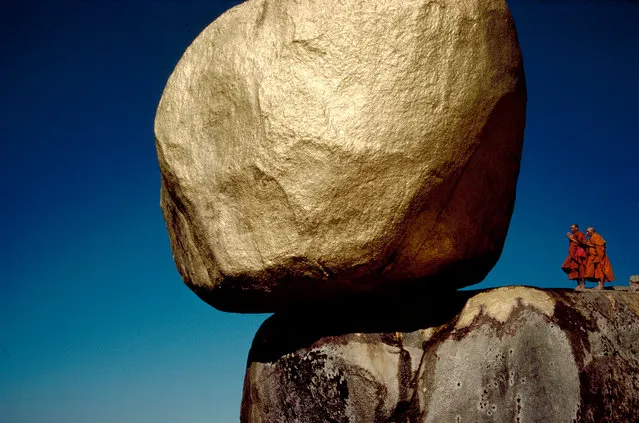
Kyaiktiyo, Burma, 1978. The Golden Rock at Shwe Pyi Daw (the Golden Country), the Buddhist holy place. Hiroji Kubota writes: “I was desperate to keep a distance from America for a while; luckily, I found Burma and its gentle and compassionate people. In the spring of 1978, on the top of the hill where I took this photo, I had two Leica bodies: the one with Tri-X and the other with Kodachrome 64. Soon after, I realised that the colour one looked very colourful and was more powerful. That was my decisive moment, to become a colour photographer”. (Photo by Hiroji Kubota/Magnum Photos)

Kyaiktiyo, Burma, 1978. The Golden Rock at Shwe Pyi Daw (the Golden Country), the Buddhist holy place. Hiroji Kubota writes: “I was desperate to keep a distance from America for a while; luckily, I found Burma and its gentle and compassionate people. In the spring of 1978, on the top of the hill where I took this photo, I had two Leica bodies: the one with Tri-X and the other with Kodachrome 64. Soon after, I realised that the colour one looked very colourful and was more powerful. That was my decisive moment, to become a colour photographer”. (Photo by Hiroji Kubota/Magnum Photos)
Details
10 Jun 2016 13:30:00
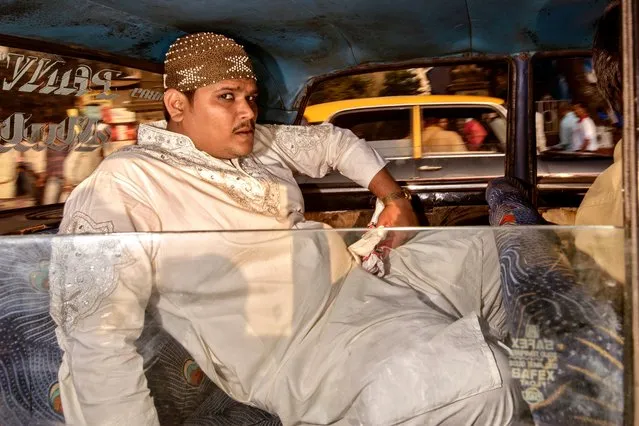
“I’m not scared of breaking the fourth wall”, Wallace has said of the photos where the subject is clearly aware of him taking the shot. “If they are looking at you in a photograph most photographers will think, oh, that’s not a good image. (But) people like to be involved and in the picture. You can see what they are thinking, see them talking”. (Photo by Dougie Wallace/The Guardian)

In Dougie Wallace’s photos of Mumbai taxis, the chatter, yelling, and constant horns of the city are almost audible. A selection of his images is on show at Gayfield Creative Spaces, Edinburgh, as part of the Retina photography festival until 30 July. For four years, the Glasgow-born Wallace focused his photos on one kind of taxi in particular: the Premier Padmini, a 1960s workhorse painted in black and yellow. Locally known as “Kaali-Peeli”, there were once more than 60,000 of them in the Indian city. But thanks to laws restricting pollution, the cars now are fast disappearing from Mumbai’s streets. (Photo by Dougie Wallace/The Guardian)
Details
13 Jul 2016 13:50:00
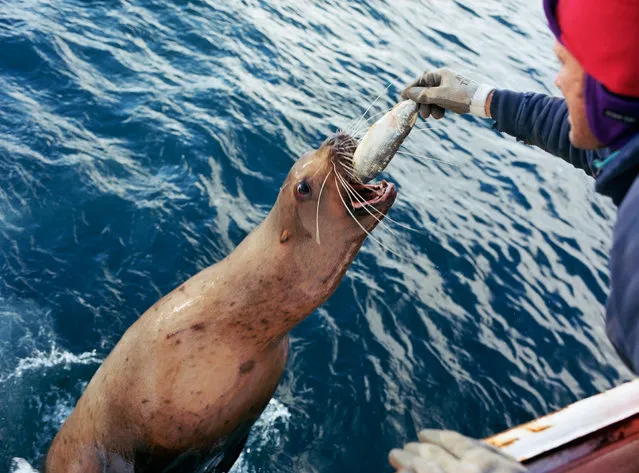
Before heading up to Alaska, the ship loads up with 3 months worth of food. Even so, it's hardly necessary. The ship's cook is constantly steaming fresh crab legs and seafood caught during the day. The hard labour of fishing requires a diet heavy in fat, protein, and omega-3s. Here, a sea lion gets a bite of the grub. (Photo by Corey Arnold)

In 2002 photographer Corey Arnold left behind a poor economy in San Francisco and headed up to Alaska to try his luck at his longtime passion of fishing. Arnold, who had worked summers during college on a salmon boat in Alaska, signed onto the f/v Rollo, a crabbing boat that fishes in the dangerous Bering Sea. While working long, strenuous hours on the Rollo, Arnold often stole away with the captain’s permission to grab his camera and photograph the crew and the ship. Arnold eventually put together “Fish Work: Bering Sea”, a documentation of his seven adventurous and dicey crab seasons aboard the Rollo. (Photo by Corey Arnold)
Details
20 Aug 2014 10:05:00
In this February 19, 2014 photo, a skate seller puts slices of skate into styrofoam boxes for shipment to customers around South Korea at a fish market in Mokpo, a port city on the southwestern tip of the Korean Peninsula. The aroma of one of southwestern South Korea's most popular delicacies regularly gets compared to rotting garbage and filthy bathrooms. (Photo by Ahn Young-joon/AP Photo)

In this February 19, 2014 photo, a skate seller puts slices of skate into styrofoam boxes for shipment to customers around South Korea at a fish market in Mokpo, a port city on the southwestern tip of the Korean Peninsula. The aroma of one of southwestern South Korea's most popular delicacies regularly gets compared to rotting garbage and filthy bathrooms. And that's by fans. The unusual dish is typically made by taking dozens of fresh skate, a cartilage-rich fish that looks like a stingray, stacking them up in a walk-in refrigerator and waiting. Up to a month in some cases. (Photo by Ahn Young-joon/AP Photo)
Details
11 Apr 2014 07:41:00
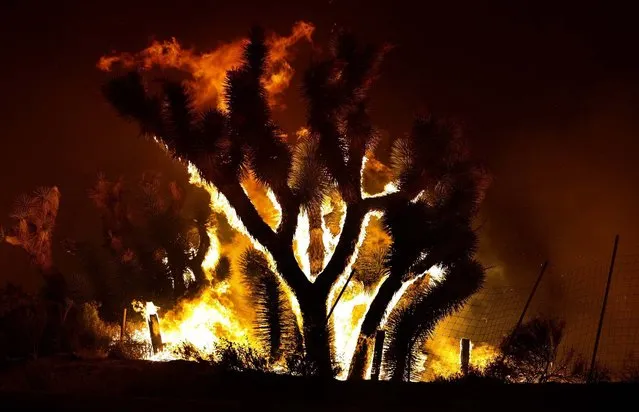
Yuccas catch fire as the Powerhouse fire makes a fast run toward Lake Hughes, south of Lake Hughes, California, on June 1, 2013. The 19,500-acre wildfire destroyed numerous homes overnight. (Photo by David McNew/Getty Images)

Yuccas catch fire as the Powerhouse fire makes a fast run toward Lake Hughes, south of Lake Hughes, California, on June 1, 2013. The 19,500-acre wildfire destroyed numerous homes overnight. (Photo by David McNew/Getty Images)
Details
03 Jun 2013 09:24:00
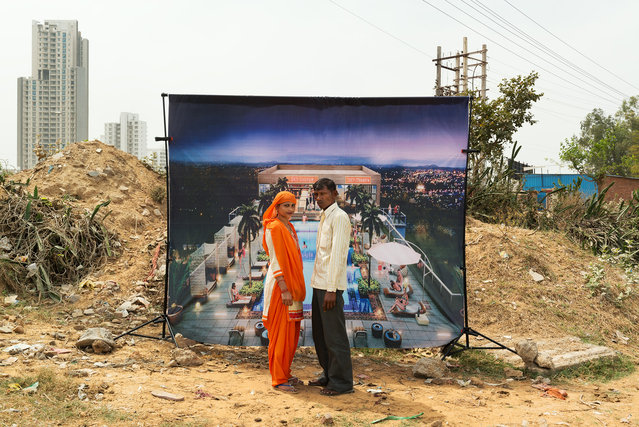
Luxury Living Bhiwadi: “Sky Club on 18th Floor”. Passersby, workers and villagers pose in front of the idealised representations of modern homes. (Photo by Arthur Crestani/The Guardian)

Inspired by traditional Indian travelling photography studios, Arthur Crestani photographed the inhabitants of Gurgaon, a city built almost entirely by private companies. Arthur Crestani’s “Bad City Dreams” contrasts the glossy ideal sold by developers with urban reality. Here: Luxury Living Bhiwadi: “Sky Club on 18th Floor”. (Photo by Arthur Crestani/The Guardian)
Details
16 Mar 2018 00:01:00
Underwater pictures show the 23-year-old diver cosying up to a range of animals. (Photo by Amelia Klonaris/Mediadrumworld)

Dublin student beat depression by befriending sharks, stingrays and pigs in the Bahamas. Awesome underwater pictures show the 23-year-old diver cosying up to a range of animals including turtles, stingray and sharks. The sunny selfies were taken in the Bahamas by Stuart’s Cove dive instructor and native of the island, Amelia Klonaris – who beat depression by embracing her incredible beach paradise lifestyle. (Photo by Amelia Klonaris/Mediadrumworld)
Details
01 Jul 2017 07:38:00
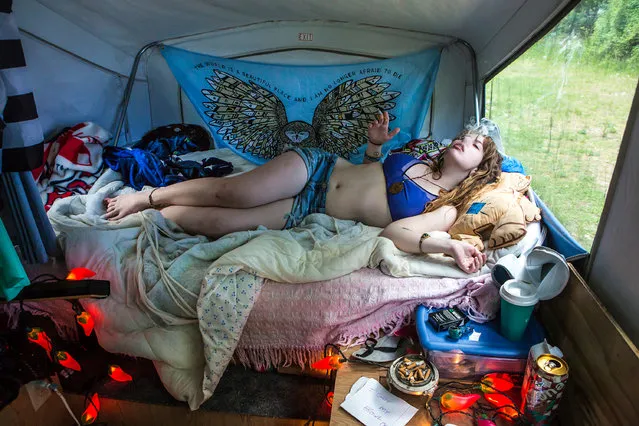
Jessica, Milford, New Hampshire: “Sometimes life throws you in all sorts of directions. The most important part about life is to remember you are exactly where you need to be”. (Photo by Barbara Peacock/Recipient of the Getty Images Grant for Editorial Photography 2017)

Barbara Peacock is one of five recipients of the Getty Images annual Grants for Editorial Photography programme, which gives photojournalists an award of $10,000 as well as the agency’s support in pursuing projects of their choosing. American Bedroom is an ongoing series of portraits in which she explores the complexities and idiosyncrasies of contemporary American life. Here: Jessica, Milford, New Hampshire: “Sometimes life throws you in all sorts of directions. The most important part about life is to remember you are exactly where you need to be”. (Photo by Barbara Peacock/Recipient of the Getty Images Grant for Editorial Photography 2017)
Details
19 Sep 2017 07:44:00