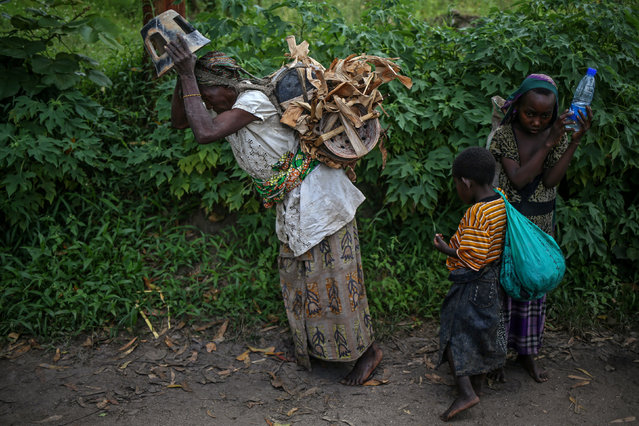
Habimana, 45, and her children walk to market to sell pottery on Idjwi island in the Democratic Republic of Congo, November 23, 2016. (Photo by Therese Di Campo/Reuters)
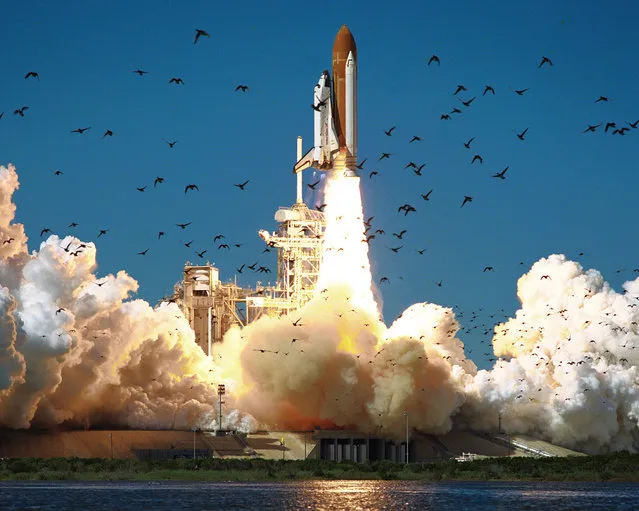
A wide-angle view shows the ascent of the shuttle Challenger on January 28, 1986. In the seconds after ignition, the rocket engines' hot blast began the process of destruction. (Photo by NASA)
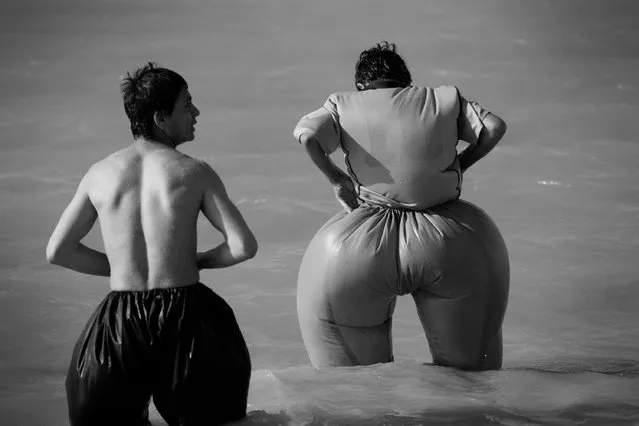
“Life in War” (FotoEvidence Press) by Iranian photographer Majid Saeedi is probably the only book about Afghanistan that doesn’t show images of war. For ten years his camera photographed daily life in the context of war. His photographs reveal the humanity of a people living through decades of war. Here: Afghan men escape increasing summer temperatures by wading in the Qarga reservoir on July 9, 2010 in a suburb of Kabul, Afghanistan. (Photo by Majid Saeedi/Getty Images)
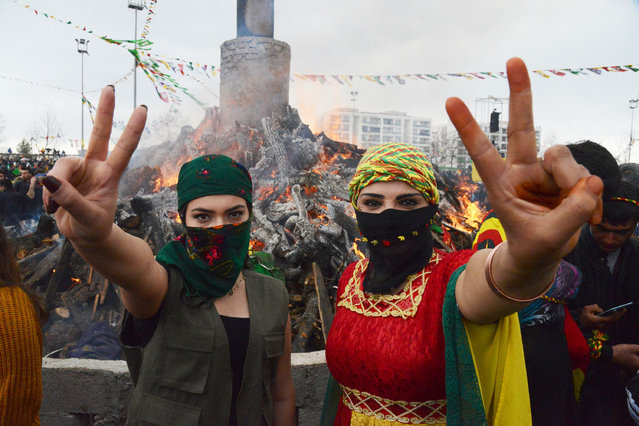
Young women flash the victory sign in front of a bonfire as Turkish Kurds gather during Newroz celebrations for the new year in Diyarbakir, southeastern Turkey, on March 21, 2017. Newroz (also known as Nawroz or Nowruz) is an ancient Persian festival, which is also celebrated by Kurdish people, marking the first day of spring, which falls on March 21. (Photo by Ilyas Akengin/AFP Photo)
Kamo Mphela, a South African dancer and singer performs Amapiano, a South African musical export that has crossed borders and cultural barriers, reaching as far as Japan, during a music concert in Pretoria, South Africa, July 22, 2022. (Photo by Shafiek Tassiem/Reuters)
An Extinction Rebellion protestor holds up a sign saying “You Can Change Climate Change” in St Martin's Lane in London, United Kingdom on August 23, 2021. (Photo by James Veysey/Rex Features/Shutterstock)
An actor performs during the show “Paris de Nuit” in Santiago, Chile, 20 September 2016. The show is a combination of cabaret and circus, produced by the Recirquel Contemporary Circus Company from Budapest, and will be performed at the Mapocho Cultural station from 20 to 25 September. (Photo by Mario Ruiz/EPA)
I know, this answer was a little too short, so let me explain in a little more detail.
Imagine tossing a coin. Normally, any normal coin toss has two possible outcomes - heads or tails - with each one having a 50% chance of happening. Ideally, that is, because factors like the force of your finger tossing the coin, gravity, the wind, the moon phase and a passing TARDIS can all influence the outcome of the toss - but I have deviated from the subject.